
Spot gold traded as high as US$3,685.30 an ounce on 27 November and last traded at US$3,640.36, up 1.31% on the day, according to Kitco News. J.P. Morgan expects the metal to reach about US$4,600 an ounce by the end of 2027, strategist Yuxuan Tang said in an interview with CNBC.
Tang put the call plainly. “We still have a bullish view, medium term,” she said. “Our year-end outlook for 2027 is about $4,600 in its range.” She said J.P. Morgan expects gold to appreciate by around 30% over the coming year. From Friday’s US$3,640.36, the US$4,600 target implies a rise of about 26%.
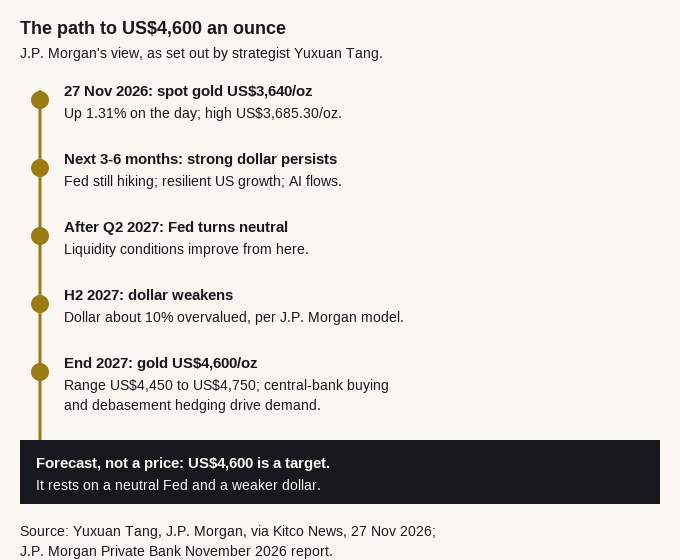
The US$4,600 figure is the midpoint of a US$4,450 to US$4,750 year-end 2027 range in J.P. Morgan Private Bank’s November 2026 strategy report, according to Gold Silver Mastery, which cites the bank’s report “The November View”.
Tang is a strategist at J.P. Morgan Private Bank, and her CNBC remarks restate the bank’s published November view rather than a new number.
However, Tang was clear that the path to that target runs through more pressure first. “I think over the near term it’s going to be tough, because it’s not the best environment for gold in a rising yield environment,” she said. “It’s the overall monetary tightening backdrop that is adding pressure to gold.”
The bank expects the strong-dollar environment to continue over the next three to six months. Tang pointed to three supports for the greenback: the Federal Reserve is still hiking, higher yields are supported by resilient growth in the US economy, and the AI super cycle is driving flows into the United States.
At the same time, Tang said the dollar’s strength has an expiry date in the bank’s thinking. “According to our model, it’s about 10% overvalued now against its long-term average,” she said.
“Ultimately, we think over the second half of 2027, it’s going to go back to its structural weakening trend as international investors try to diversify from their dollar overweights they have accumulated over many years.”
Conditions turn in gold’s favour after the second quarter of 2027, in Tang’s reading. “As we move into 2027, especially after Q2 when we think the Fed is going to turn neutral and the liquidity conditions are going to improve from here, and we ultimately expect a weaker dollar environment, and that would be a better backdrop for gold.”
The demand case behind the target is structural, not cyclical. Tang said central banks are buying gold to diversify away from the dollar, and investors are increasingly seeking it as a longer-term hedge against currency debasement.
“More importantly, we still believe it’s a portfolio diversifier, so it still makes sense to hold that in your portfolio,” she added.
That central-bank leg of the argument has fresh numbers behind it. Central banks bought 321 tonnes of gold in the third quarter of 2026, up 42% year on year, according to World Gold Council data. DrillTape reported the third-quarter figures on 25 November.
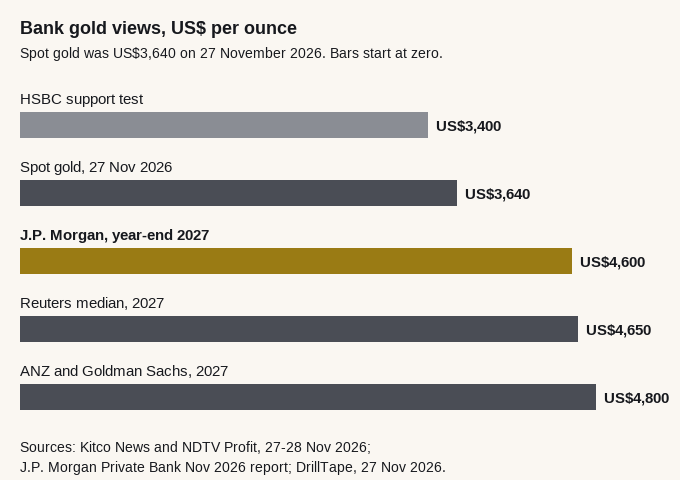
J.P. Morgan’s US$4,600 sits US$200 below ANZ’s US$4,800 target for 2027, a gap of about 4%. DrillTape reported ANZ’s call on 27 November. Goldman Sachs is with ANZ at US$4,800 by the end of 2027, after cutting its target from US$5,400, NDTV Profit reported.
A Reuters survey of 30 analysts and traders puts the median 2027 forecast at US$4,650, just US$50 above J.P. Morgan.
HSBC sets the floor of the published range. The bank has warned that continued weakness in equity markets could push gold through major support at US$3,400 an ounce, and said it is too early to call an end to the slide. That US$3,400 level is US$240 below Friday’s spot price, and US$1,200 below J.P. Morgan’s year-end 2027 target.
One older J.P. Morgan number needs retiring. The bank’s Global Research arm forecast in June 2026 that gold would average US$6,000 an ounce in the fourth quarter of 2026 and US$6,263 across 2027.
That is a different desk and a different date from Tang’s Private Bank view, and the November Private Bank report supersedes it as the bank’s current year-end 2027 position. Readers of the ANZ article, which cited the US$6,300 figure, should use US$4,600 as J.P. Morgan’s current target.
The two banks also disagree on the rate path that gets gold there. ANZ expects the Federal Reserve to raise rates by 25 basis points each in December, January and March, and says a 50 basis point rise in December cannot be ruled out.
Tang expects the Fed to turn neutral after the second quarter of 2027. Both agree on the near term: tightening and a strong dollar keep gold under pressure before any recovery starts.
The week ahead tests Tang’s near-term caution before it tests her target. November ISM manufacturing and October job openings land on Tuesday 1 December, ADP private payrolls on Wednesday 2 December, and November ISM services on Thursday 3 December.
The November jobs report follows on Friday 4 December, after October added 165,000 jobs at 4.1% unemployment. The Federal Reserve decides on rates on Wednesday 9 December, and November consumer prices follow on Thursday 10 December.
J.P. Morgan’s call, restated, is US$4,600 an ounce by the end of 2027, inside a US$4,450 to US$4,750 range, on three assumptions: the Fed turns neutral after the second quarter of 2027, liquidity improves from here, and the dollar gives back the 10% overvaluation the bank’s model shows.
If the December jobs report and the Fed decision keep yields rising and the dollar supported, the pressure Tang warned about comes first. If they point the other way, the road to US$4,600 opens early.
Sources
- Kitco News, Gold will reach $4,600/oz by Q4 2027 as rates fall, USD gives back 10% overvaluation - J.P. Morgan’s Tang, 27 November 2026: Tang’s CNBC interview, US$4,600 year-end 2027 target, around 30% appreciation, Fed neutral after Q2 2027, dollar about 10% overvalued, strong dollar for three to six months, spot US$3,640.36 up 1.31%, high US$3,685.30.
- NDTV Profit, Gold Price Has Fallen From Rs 1.8 Lakh To Rs 1.25 Lakh. Where It Could Be Six Months From Now, 28 November 2026: independent report of the same Tang/CNBC interview, US$4,600 by end of 2027, Goldman Sachs cut to US$4,800 from US$5,400, Reuters survey of 30 analysts median US$4,650 for 2027.
- Gold Silver Mastery, J.P. Morgan Private Bank lowers year-end 2027 gold outlook to $4,600, 17 November 2026: J.P. Morgan Private Bank November 2026 strategy report, US$4,450 to US$4,750 year-end 2027 range, US$4,600 midpoint, citing “The November View”, pp. 17 and 35.
- DrillTape, ANZ holds US$4,800 gold target for 2027 as CommBank sees limited downside after sell-off, 27 November 2026: ANZ US$4,800 in 2027, HSBC US$3,400 support test, ANZ Fed hike base case (25 basis points in December, January and March), JPMorgan June 2026 US$6,000 Q4 average / US$6,300 end-2027 figure (now superseded).
- DrillTape, Central banks bought 321 tonnes of gold in Q3 while retail faded, 25 November 2026: World Gold Council Q3 2026 central-bank buying of 321 tonnes, up 42% year on year.
- FXIFY, The FXIFY Trading Desk Brief: Week of 30 November 2026: ISM manufacturing and JOLTS on Tuesday 1 December, ISM services on Thursday 3 December, November payrolls on Friday 4 December, FOMC decision on Wednesday 9 December, CPI on Thursday 10 December.
- Morningstar, What’s Happening in the Markets This Week: November ISM manufacturing on Tuesday 1 December, ADP employment on Wednesday 2 December, ISM services on Thursday 3 December, November employment situation report on Friday 4 December (nonfarm payrolls 87.5K vs 165.0K in October).
- Wikimedia Commons, File:Bullion Gold bar at Swiss Money Museum (Ank Kumar, Infosys).jpg: hero image, a gold bullion bar on display at the Swiss Money Museum in Zurich, by Ank Kumar, CC BY-SA 4.0, 6000 x 4000 px.
