
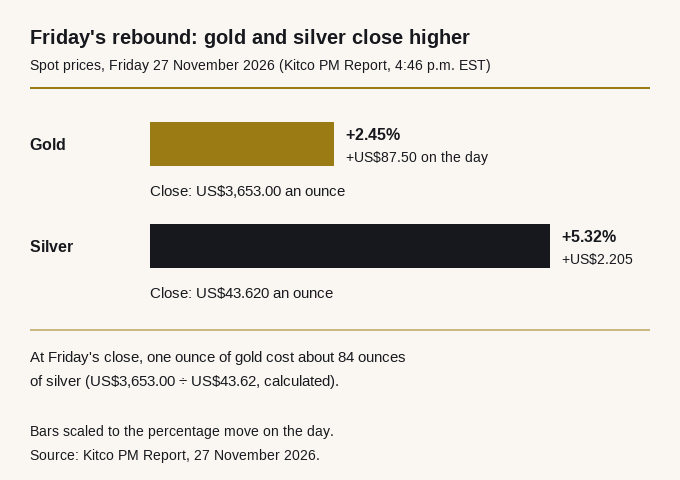
Spot gold closed Friday at US$3,653.00 an ounce, up US$87.50, or 2.45%, on the day, while silver rose US$2.205, or 5.32%, to US$43.620 an ounce, according to Kitco’s PM Report. The rally came despite persistent expectations of further Federal Reserve tightening, with a softer dollar, renewed Chinese physical demand and improving equity sentiment doing the heavy lifting.
Wednesday’s data had pointed the other way. The October personal consumption expenditures price index rose 0.3% on the month and 3.8% from a year earlier, while core inflation accelerated to 3.3% and third-quarter GDP was revised higher to an annualised 4.3%.
Futures markets still put the chance of a 25-basis-point rate rise at the Federal Reserve’s 8-9 December meeting at about 96%, Kitco reported. The 10-year Treasury yield moved toward 4.93% on Friday from Wednesday’s 4.845% close, while the two-year yield climbed above 4.69%.
Friday’s rally capped a violent week and reversed the sell-off DrillTape covered on 25 November, when gold stood 37% below its January record high. Gold opened the week at US$3,532.80 an ounce on Sunday and set a weekly high of US$3,689.08 on Monday.
Selling then intensified after Wednesday’s data, driving gold to a weekly low of US$3,426.35 an ounce before the rebound. Friday’s surge left the metal about 3% higher on the week, Kitco reported.
The closing levels check out against independent quotes. Trading Economics had spot gold at US$3,647.79 an ounce, up 2.26%, in early Friday trading, while February COMEX gold futures settled at US$3,668.50 an ounce, up 2.91%.
Ole Hansen, head of commodity strategy at Saxo Bank, said the rebound was driven as much by selling fatigue as by any change in fundamentals. Gold has swung from trading 45% above its 200-day moving average in January to 20% below it this week.
Saxo described the move as the deepest 12-month drawdown since the early 1980s, with gold down 37% from its January record high. Hansen warned that being oversold is not in itself a buy signal, and markets can stay oversold longer than investors expect.
Adam Button, head of currency strategy at investingLive, told Kitco News that gold and equities moved together all week. “Correlations have gone to one this week, in terms of equities and gold,” Button said. “Gold is going to go where equities take them.”
Button added that the seasonal calendar now favours gold, with India’s wedding and festival season, the run-up to Christmas, Chinese New Year and Valentine’s Day all ahead. “The seasonals really pick up for gold here from now, and equities as well,” he said. “If those two are going to go together, that’s a double tailwind there.”
Hansen made the same seasonal point, noting gold has recorded positive December-January returns for 11 consecutive years. Silver, which trades 37% below its 200-day moving average, and platinum, 27% below, look more stretched still, Saxo said.
Silver outran gold on Friday as bargain hunting and renewed speculative demand accelerated the rebound, Kitco reported. Spot silver traded between US$41.630 and US$44.690 an ounce during the day, and at Friday’s close one ounce of gold cost about 84 ounces of silver.
Wall Street’s rebound helped end the forced selling that had dragged gold down with stocks. The S&P 500 gained 1.60% on Friday to 7,297.49 and 5.6% on the week, its strongest week since April 2025, while the Nasdaq climbed 2.31% on the day and 6.7% on the week.
Rich Checkan, president and chief operating officer of Asset Strategies International, was unconvinced the turn would hold. “Until the bleeding in equities, specifically technology and AI, stops, gold will be sold to meet margin calls,” he told Kitco News. “So I do not see a reversal of fortunes until the AI bubble stops deflating.”
The latest Kitco News Weekly Gold Survey showed Wall Street sentiment creeping higher after the bounce, while Main Street kept its bearish bias. Of 15 analysts, six, or 40%, expected gold to gain in the week ahead, five, or 33%, saw declines, and four, or 27%, had no conviction.
Among 159 retail voters, 57, or 36%, looked for gains, 68, or 43%, predicted declines, and 34, or 21%, expected consolidation. The split leaves the survey almost evenly divided, with the professional side turning and the retail side holding its bearish bias.
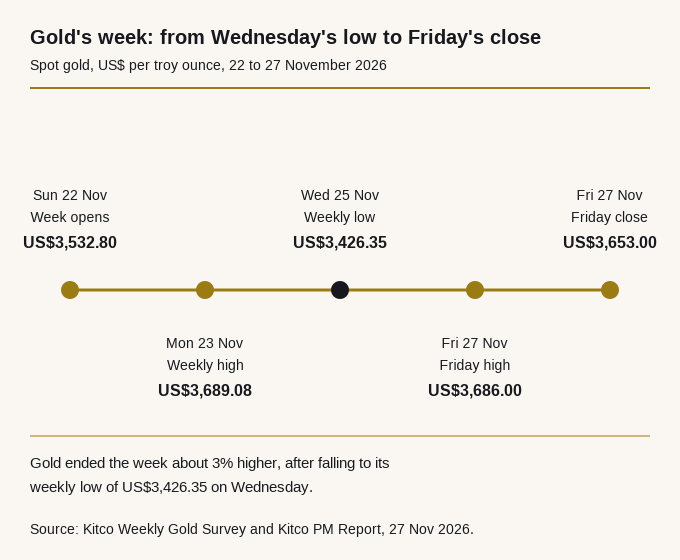
Marc Chandler, managing director at Bannockburn Global Forex, said gold recorded the low for the year on Wednesday, a little below US$3,427, then recovered to poke above US$3,685 on Friday. “The momentum indicators are turning up,” Chandler noted. “Nearby resistance is seen in the 3700-3705, basis the spot market.”
Colin Cieszynski, chief market strategist at SIA Wealth Management, was bullish for the coming week, calling gold oversold in the short term with a trading bounce under way. Adrian Day, president of Adrian Day Asset Management, was unchanged, saying gold needs a washout first and Monday’s rally was likely mostly short covering.
Jesse Colombo, independent precious metals analyst and founder of the BubbleBubble Report, put gold’s support at US$3,200 to US$3,500 an ounce, the range where it consolidated in the summer of 2025. He said he highly doubted gold would drop below there, and the next confirmation he wants is a retake of US$3,900 to US$4,100.
Technically, Kitco put gold’s first resistance at US$3,650.00 and then at US$3,697.00, with a sustained recovery targeting the US$3,780.00 to US$3,800.00 area. First support sits at US$3,595.00 and then at US$3,520.00. Silver’s first resistance is US$44.570 to US$45.000, with support at US$43.000 and then at US$41.340.
The longer view still points higher. ANZ holds a US$4,800 gold target for 2027, while Commonwealth Bank expects US$3,500 to US$3,700 by year-end and HSBC warns US$3,400 is the next test if support fails, as DrillTape reported on 27 November.
Looking ahead, the test of Friday’s rally comes in the data. Monday brings the Chicago purchasing managers’ index and Canadian monthly GDP, Tuesday the ISM Manufacturing PMI and JOLTS job openings, and Wednesday ADP private payrolls.
Thursday brings weekly jobless claims and the ISM Services PMI, and the week ends with Friday’s November employment report at 8:30 a.m. EST. Kitco noted softer jobs data could reduce expectations for aggressive tightening and support bullion, while persistent labour-market strength would reinforce the Fed’s focus on inflation.
Sources
- Kitco News, Gold climbs above $3,650, silver surges as Wall Street rebounds sharply - Kitco PM Report, 27 November 2026, 17:32 EST; closing levels (gold US$3,653.00, +US$87.50, +2.45%; silver US$43.620, +US$2.205, +5.32%; day ranges; PCE, GDP, claims; Fed meeting odds; Treasury yields; equities; technical levels; week-ahead calendar).
- Kitco News, Gold rallies above $3,600, silver surges as dollar weakness supports metals - Kitco AM Report, 27 November 2026, 08:43 EST; morning snapshot (gold near US$3,649.60, +2.36%; silver near US$43.640, +5.37%); drivers (softer dollar, renewed Chinese physical demand, improving equity sentiment); 96% December hike probability.
- Kitco News, Wall Street’s bullish bets tick higher after gold bounces back above $3,600, Main Street maintains bearish bias with payrolls on deck, Ernest Hoffman, 27 November 2026, 18:01 EST; week chronology (open US$3,532.80, Monday high US$3,689.08, Wednesday low US$3,426.35, Friday above US$3,680, close just above US$3,650); survey counts; Chandler, Day, Checkan, Cieszynski, Newsom, Button, Colombo, Frappell views; week-ahead calendar.
- Kitco News, Selling fatigue and seasonal tailwinds fueling gold’s recovery - Saxo Bank, 27 November 2026, 13:00 EST; Ole Hansen, head of commodity strategy at Saxo Bank (200-day moving average swing, deepest 12-month drawdown since the early 1980s, selling fatigue, 11 consecutive positive December-January returns).
- Saxo Bank, Precious metals: From historic exuberance to historic distress, 26 November 2026; 37% slump from January’s record high; silver 37% and platinum 27% below their 200-day moving averages; year-to-date losses (gold 19%, silver 43%, platinum 39%).
- Kitco News, Gold and silver bounce from 15-month lows, but Fed risks loom large, 27 November 2026, 17:05 EST; Friday high US$3,685, Wednesday low US$3,426, gold on track for about a 3% weekly gain.
- FinanceFeeds, Gold Price Today $3,650: Rebound From 15-Month Low, 27 November 2026; second quote (Trading Economics spot gold US$3,647.79, +2.26%, at 06:45 GMT; Swissquote bid US$3,650.08).
- The Nation, Gold rebounds 2.4% on 27 Nov as traders weigh Fed rate rises, 28 November 2026; spot gold US$3,653.43 at 4:50 p.m. New York time; February COMEX gold futures settled at US$3,668.50, up 2.91%.
- DrillTape, Gold down 37% from its January record as the debasement trade unwinds, 25 November 2026; the sell-off this rally reversed.
- DrillTape, ANZ holds US$4,800 gold target for 2027 as CommBank sees limited downside after sell-off, 27 November 2026; ANZ US$4,800 target for 2027, Commonwealth Bank US$3,500 to US$3,700 by year-end, HSBC US$3,400 next test.