
The bulk carrier Tower Point sailed from Morebaya Anchorage in Guinea on 23 November carrying 79,081 tonnes of Simandou iron ore fines, bound for Dunkirk in France. Shipping data firm Kpler expects the vessel at Dunkirk on 4 December, making it the first Simandou cargo to sail to Europe.
Every Simandou cargo in the project’s first year went to China. The Dunkirk sailing breaks that pattern, and a second Europe-bound cargo is already loading. SimFer, the Rio Tinto-led venture that operates Simandou’s two southern mining blocks, shipped the cargo.
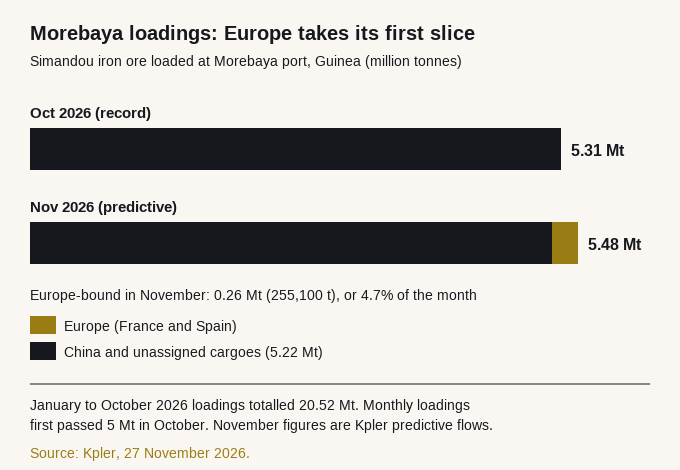
The shipment is small against the scale of the project now moving through Morebaya. The port loaded 20.52 million tonnes of iron ore from January to October, Kpler data shows, and monthly loadings passed 5 million tonnes for the first time in October, at a record 5.31 million tonnes. The 79,081-tonne cargo is about 1.5 per cent of that single month’s loadings.
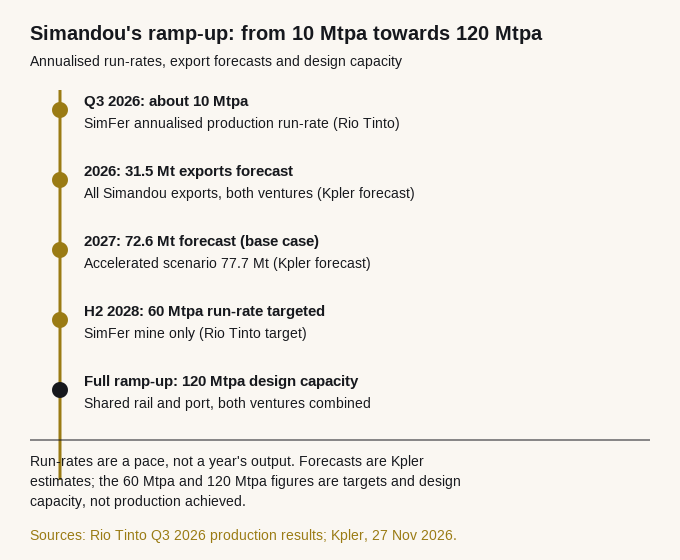
Put another way, it is about three days of output at the pace SimFer was running in the third quarter. Rio Tinto said in its third-quarter production results on 14 October that Simandou had hit an annualised production run-rate of about 10 million tonnes a year, on a 100 per cent basis. That is a pace, not a year’s output, and the cargo itself is a shipment of fines, not a production figure. At the 10 million tonne pace, SimFer produces roughly 27,000 tonnes a day.
Simandou is still early in its ramp-up. Rio Tinto, Aluminum Corporation of China (Chinalco), Baowu and their consortium partners are jointly developing the project, and the Guinean government holds a 15 per cent stake in each of the two mining ventures developing its four blocks. SimFer holds Blocks 3 and 4 in the south, while the Winning Consortium Simandou venture holds Blocks 1 and 2 in the north.
The first Simandou shipment left Guinea in December 2025, and first sales followed in April 2026. Rio Tinto reported that 2.2 million tonnes were shipped to China in the first half of 2026, with sales of 0.4 million tonnes at an average grade of 65.8 per cent iron. That grade sits above the 62 per cent iron benchmark grade the seaborne market prices against. Rio Tinto’s 2026 sales guidance for Simandou is 5 to 10 million tonnes, on a 100 per cent basis.
“The Simandou iron ore mine hit an annualised production run-rate of ~10 Mtpa (100% basis) in the quarter as the project continues to ramp up,” Rio Tinto chief executive Simon Trott said in the third-quarter results. The company remains on track to reach a 60 million tonne a year run-rate at SimFer during the second half of 2028. The wider Simandou development, with its shared railway and port, is designed to export up to 120 million tonnes a year once fully ramped up.
A second vessel is already following Tower Point across the Atlantic. True Caspian, a Capesize, arrived at the Morebaya anchorage on 24 November and is loading 176,000 tonnes for Gijon in Spain, with arrival expected on 8 December, according to Kpler. The two confirmed cargoes total 255,000 tonnes, and market sources told Kpler a third European shipment is being booked, most likely for Fos-sur-Mer, also home to an ArcelorMittal steelworks.
The logistics behind the ramp-up are also moving. Wontanara, the first of five transhipment shuttle vessels built for SimFer, sailed for the anchorage on 24 November after sitting at her berth for 33 days, and was alongside the Newcastlemax Shandong Peace two days later. At 42,366 deadweight tonnes, each Wontanara trip carries more than three times the deadweight of the Winning Morebaya shuttles serving the northern venture. Kpler forecasts Simandou exports of 31.5 million tonnes in 2026, rising to 72.6 million tonnes in 2027 in its base case and 77.7 million tonnes in its accelerated scenario.
Why Europe, and why now?
The two confirmed cargoes are bound for ports that feed ArcelorMittal’s integrated steel plants. ArcelorMittal, the world’s second-largest steelmaker after China Baowu Steel Group, operates the Dunkirk plant and has steelmaking operations at Gijon. It produces nearly 50 million tonnes of iron ore a year from its own mines, covering more than 70 per cent of its requirements.
The case for the trade starts with a gap in ArcelorMittal’s own supply. In its third-quarter results on 5 November, the company cut its 2026 Liberia shipment guidance to about 16 million tonnes, from about 18 million tonnes, blaming poor weather that began late in the second quarter and lasted through the third. Kpler data shows Liberian iron ore exports reached 11.34 million tonnes in the first nine months of 2026, up 72 per cent on the 6.60 million tonnes of a year earlier, but most of the extra ore sailed to China. China took 5.41 million tonnes of Liberian ore in the nine months, against 0.41 million tonnes a year earlier, while shipments to France and Spain fell 10.2 per cent to 3.73 million tonnes.
The second part of the case is the steel those plants are being rebuilt to make. ArcelorMittal is building a 2 million tonne a year electric arc furnace at Dunkirk, a 1.3 billion euro project, with equipment supplier Danieli confirming its selection on 23 November and start-up scheduled for 2029. The furnace is designed to produce steel at about 0.6 tonnes of carbon dioxide per tonne of steel, roughly one-third of the blast furnace route, using a mix of scrap, hot briquetted iron, direct reduced iron and hot metal. At Gijon, a 1.1 million tonne long products electric arc furnace and a 1.6 million tonne expansion at Sestao are on track for commissioning in the fourth quarter of 2026. High-grade ore such as Simandou’s, sold in the first half at 65.8 per cent iron, is the feedstock that route needs.
The case for caution is just as clear in Kpler’s own numbers. The two Europe-bound cargoes total 255,100 tonnes, or 4.7 per cent of November’s predictive loadings of 5.48 million tonnes. Tower Point is an 82,050 deadweight tonne Kamsarmax carrying under 80,000 tonnes, the kind of parcel a steelmaker buys to test a new ore in its sinter blend, while 98 per cent of November’s loadings sailed on much larger Capesize, Newcastlemax and very large ore carrier tonnage. Kpler’s verdict is blunt: for now, Simandou remains a China story with a European footnote.
Distance cuts both ways. Tower Point should cover Morebaya to Dunkirk in about 10 to 11 days, against 43 to 53 days for Simandou cargoes sailing to China this month. But Kpler notes the tonnes Simandou sends to Europe appear to be replacing Liberian tonnes on an equally short West Africa to Europe run, while Liberia’s extra ore makes the long haul to China. Whether the trade grows will turn on grade, contracts and price, not on geography alone.
That question now has a market backdrop working against it. Iron ore has slipped below US$90 a tonne, its lowest level in nearly four years, and the fall has dragged BHP and Rio Tinto into bear markets. DrillTape’s iron ore coverage sets out how the benchmark fell to about US$88.15 a tonne on 17 November. Simandou is adding high-grade supply into a market where the benchmark is already under pressure.
The next test is immediate. Tower Point is due at Dunkirk on 4 December and True Caspian at Gijon on 8 December. If a third cargo is booked for Fos-sur-Mer, and if the Dunkirk and Gijon plants take repeat parcels rather than one trial lot each, the European footnote starts to look like a second market. If not, Simandou’s first European cargo will stand as a trial shipment from a project still building towards its 60 million tonne SimFer run-rate in the second half of 2028.
Sources
- Kpler, Simandou iron ore to Europe: first cargoes, 27 November 2026; Tower Point sailed Morebaya Anchorage 23 November with 79.1kt Simandou Fines sold by SimFer, expected Dunkerque 4 December; True Caspian loading 176kt for Gijon, expected 8 December; two cargoes 255kt; third cargo being booked; Morebaya loaded 20.52Mt January to October, record 5.31Mt in October, November predictive 5.48Mt with Spain and France 255.1kt (4.7%); ArcelorMittal Liberia guidance cut 18Mt to 16Mt in Q3 results 5 November; Liberian exports 11.34Mt in first nine months 2026, up 72% on 6.60Mt, China 5.41Mt against 0.41Mt, France and Spain down 10.2% to 3.73Mt; Gijon and Sestao EAF projects commissioning 4Q 2026; 2026 Simandou exports forecast 31.5Mt, 2027 base case 72.6Mt, accelerated 77.7Mt; Wontanara first SimFer shuttle, 42,366dwt.
- Rio Tinto, Rio Tinto releases third quarter 2026 production results, 14 October 2026; Simandou annualised production run-rate of ~10 Mtpa (100% basis) in Q3, on track for a 60 Mtpa production run-rate during H2 2028; 2026 Simandou sales guidance 5-10 Mt; Simon Trott quote.
- Rio Tinto, 2026 half year results, 29 July 2026, via SEC Form 6-K (https://www.sec.gov/Archives/edgar/data/863064/000162828026050377/rio-20260630_d2.htm); first high-grade iron ore sales in April 2026; 2.2 Mt shipped to China in H1, sales of 0.4 Mt at an average grade of 65.8% Fe.
- Cecilia Jamasmie, Rio Tinto ships first Simandou iron ore cargo to Europe, Mining.com, 27 November 2026 (hook only; all figures in this article are traced to Kpler or Rio Tinto above, except the BIMCO figure noted below); Simfer operates Simandou’s two southern blocks; ArcelorMittal operates the Dunkirk plant; ArcelorMittal world’s second-largest steelmaker after China Baowu, produces nearly 50Mt iron ore a year from its own mines covering more than 70% of requirements; Guinean government holds a 15% stake in each venture; Simandou advancing towards 120 million tonne annual production capacity; Guinea monthly iron ore exports surpassed 5Mt for the first time in October, 22Mt in 2026, according to BIMCO.
- Danieli via EUROMETAL, ArcelorMittal selects Danieli for 2 million mt EAF project in Dunkirk, 25 November 2026; 1.3 billion euro Dunkirk EAF, 2Mt annual capacity, commissioning 2029, about 0.6t carbon per tonne of steel, around one-third of blast furnace route emissions.
- DrillTape, Iron ore below US$90 drags BHP and Rio into bear markets as China buys less, 25 November 2026 (internal context link, not same-event coverage); benchmark 62 per cent iron ore price about US$88.15 a tonne on 17 November.