
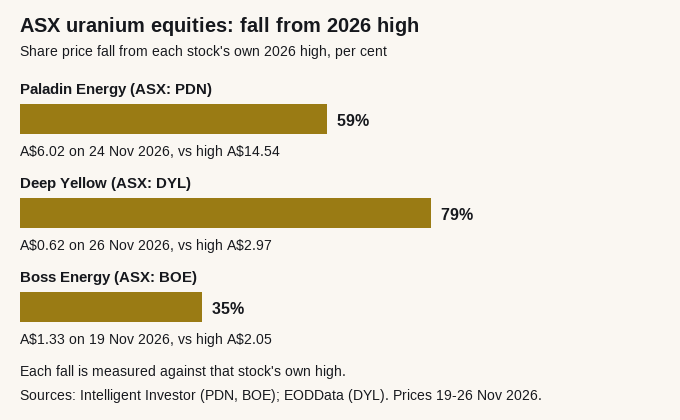
Paladin Energy (ASX: PDN) traded at A$6.02 on 24 November 2026, almost 59% below its 52-week high of A$14.54, reached on 17 April. However, uranium spot was US$90.15 a pound on 26 November, up about 16% on a year earlier, according to Trading Economics.
The fall in the equities has been fast. Paladin shares have sunk 30% over the past two weeks and are 40% lower so far in 2026, the Motley Fool reported on 26 November, after touching an annual low of A$5.85 on 20 November.
Deep Yellow (ASX: DYL) closed at A$0.62 on 26 November, about 79% below its 2026 high of A$2.97 and more than 50% lower so far in 2026. Deep Yellow deferred the final investment decision on its Tumas uranium project in Namibia in October 2026 because its share price was not at a level from which it could responsibly fund the development, chair Chris Salisbury told shareholders on 18 November.
Boss Energy (ASX: BOE) traded at A$1.33 on 19 November, about 35% below its 12-month high of A$2.05. Boss owns the Honeymoon uranium project in South Australia, which began production in 2024, and holds a 30% interest in the Alta Mesa project in South Texas.
Part of the pressure on Paladin is dated and specific. Paladin announced a fully underwritten A$525 million equity raising on 12 November, pricing new shares at A$7.80, a 10.3% discount to the A$8.70 close on 11 November. At A$6.02, the shares traded below the price at which institutions had just bought in.
The raising funds the Patterson Lake South project in Canada, resource growth and a longer mine life at Triple R, and exploration across Paladin’s Athabasca Basin portfolio. A share purchase plan at the same A$7.80 price opened on 23 November and closes on 7 December.
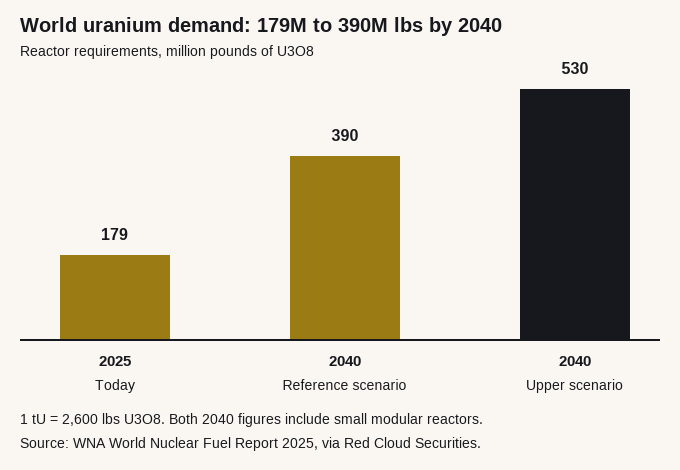
At the same time, the demand case behind the commodity keeps strengthening. The World Nuclear Association’s 2025 World Nuclear Fuel Report puts reactor uranium requirements at 68,920 tonnes of uranium, about 179 million pounds of U3O8, in 2025, rising to just over 150,000 tonnes, about 390 million pounds, by 2040 under its reference scenario.
David Talbot, managing director and head of equity research at Red Cloud Securities, charted the increase from the association’s data. The association raised its 2040 demand forecast from 99% growth to 124% growth on 2024 demand, according to Aranca Research, with electrification, AI data centres and 31 countries targeting a tripling of nuclear capacity providing further upside.
Supply has not kept pace. World mines produced 60,213 tonnes of uranium in 2024, about 90% of reactor requirements, the association’s data shows, leaving a gap of roughly 6,700 tonnes, about 17 million pounds. The association expects requirements to rise to about 86,000 tonnes by 2030, and projects existing supply will meet only 46% of demand between 2030 and 2040.
The United States ban on Russian uranium imports, which takes full effect by January 2028, removes a supply source that previously met about 25% of US utility requirements.
Along with the reactor build, technology companies are adding a new source of demand. Meta agreed in January 2026 to procure up to 6.6 gigawatts of nuclear power by 2035. A gigawatt of nuclear capacity needs roughly 200 tonnes of uranium a year for fuel, according to the World Nuclear Association, so 6.6 gigawatts of new capacity would need about 1,300 tonnes a year, though Meta’s procurement is power purchase agreements, not necessarily new reactors.
The International Energy Agency expects global data-centre electricity demand to rise from 460 terawatt hours in 2024 to 1,300 terawatt hours by 2035.
Citi is bullish on uranium for the next two to three years and expects prices to trade above US$100 a pound in the near term, Dow Jones reported on 19 November. Long-term uranium prices have reached a record US$97 a pound, according to Citi, and Cameco’s month-end long-term price indicator stood at US$98 a pound in October 2026.
Looking ahead, the test for the equities is whether the spot price holds near US$90 a pound and the long-term price keeps climbing. Paladin’s share purchase plan closes on 7 December, Deep Yellow’s Tumas financing remains the open question for its shares, and the term price is the number the market will watch into 2027.
Sources
- Barry FitzGerald, Despite sell-off, uranium demand growing with upside from AI, Stockhead, Garimpeiro column, 27 November 2026 (hook only; page not fetchable in this environment, no figure taken from it without a second source).
- Intelligent Investor, Paladin Energy Ltd (ASX: PDN); A$6.02 on 24 November 2026; 58.6% below the 52-week high of A$14.54, reached 17 April 2026.
- Motley Fool Australia, Paladin Energy shares sink 30%: Bargain buy or value trap?, 26 November 2026; down 30% in two weeks, 40% lower year to date, annual low A$5.85 on 20 November.
- Paladin Energy, Paladin Announces A$525 Million Fully Underwritten Equity Raising to Accelerate Paladin’s Growth Strategy, 12 November 2026; placement at A$7.80, 10.3% discount to the A$8.70 close on 11 November; proceeds for Patterson Lake South, Triple R and Athabasca exploration.
- Mining.com.au, Paladin banks $525 million for Patterson Lake South uranium, 13 November 2026; share purchase plan at A$7.80 opens 23 November, closes 7 December.
- EODData, ASX, DYL End of Day and Historical Share Prices; Deep Yellow close A$0.62 on 26 November 2026; year high A$2.97.
- Deep Yellow Limited, 2026 Annual General Meeting - Chair’s Address, ASX announcement, 18 November 2026; Deep Yellow deferred the final investment decision on Tumas in October 2026 because its share price was not at a level from which it could responsibly fund the development.
- Intelligent Investor, Boss Energy Ltd (ASX: BOE); A$1.33 on 19 November 2026; 35.24% below the 12-month high of A$2.05.
- Motley Fool Australia, Boss Energy Ltd (ASX: BOE); Honeymoon uranium project in South Australia began production in 2024; 30% interest in Alta Mesa, South Texas.
- MeltValue, Uranium Price Today; spot US$90.15/lb on 26 November 2026.
- Trading Economics, Uranium - Price - Chart - Historical Data - News; up 16.39% year on year; futures above US$91/lb in November, highest since February.
- World Nuclear Association, World Nuclear Fuel Report 2025, via David Turver, Is There Enough Uranium for the Nuclear Renaissance?; 68,920 tU (179M lbs U3O8) in 2025 to just over 150,000 tU (390M lbs) by 2040, reference scenario; charted by David Talbot of Red Cloud Securities.
- Aranca Research, Uranium’s Structural Supply Gap: Creating the Next Investment Opportunity, August 2026; WNA raised its 2040 demand forecast from +99% to +124% (175M to 391M lbs); AI data centres among the drivers.
- Yellowcake Analytics, Uranium Supply and Demand 2026: How Big Is the Deficit?, updated 15 November 2026; world mine production 60,213 tU in 2024, about 90% of reactor requirements; gap about 6,700 tU (17M lbs); requirements about 86,000 tU by 2030.
- Crux Investor, 10,000-tU Uranium Supply Gap Widens as Russian Import Ban and AI Demand Increase Future Requirements; Meta 6.6 GW nuclear procurement by 2035; existing supply meets only 46% of 2030-2040 demand; US Russian import ban removes about 25% of US utility supply by January 2028; 2026 spot high US$101.41/lb on 29 January.
- Yellowcake Analytics, How Much Uranium Does a Nuclear Power Plant Use a Year?; 1,000 MWe LWR, ~193 tU/yr at 90% capacity factor; WNA material balance 211 tU/yr at 100% output.
- Saxo, The Explosive Comeback of Uranium, 30 March 2026; International Energy Agency: data-centre electricity demand 460 TWh in 2024, 1,300 TWh by 2035.
- Dow Jones Market Talk via TradingView, Uranium Bull Expects Rising Demand, Constrained Supply, 19 November 2026; Citi bullish for the next 2-3 years, expects prices above US$100/lb in the near term; long-term prices at a record US$97/lb.
- Yellowcake Analytics, Uranium This Week (Nov 6, 2026); Cameco month-end long-term price indicator US$98/lb, October 2026.