
Correction, 26 November 2026: the featured image on this article has been changed. The original image showed the Indonesia Morowali Industrial Park; it has been replaced with a photograph of sulphur stockpiles in Vancouver harbour, Canada, which does not depict an Indonesian site.
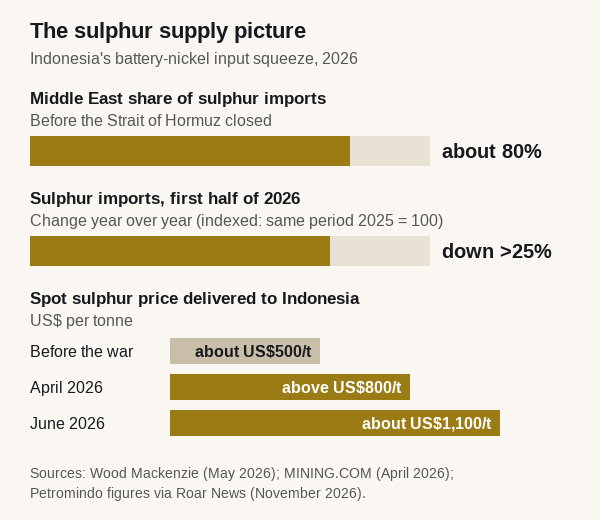
Indonesia paid about US$1,100 a tonne for sulphur in June, more than three and a half times the price a year earlier, Petromindo figures show. Wood Mackenzie warned on Wednesday that the shortage threatens Indonesia’s nickel plans, in a briefing reported by MINING.COM. The market did not rally on the news. Three-month nickel on the London Metal Exchange fell 1.13 percent to US$15,270 a tonne on Wednesday, after the cash price had settled at US$15,060 a tonne the day before.
The constraint is not ore. Indonesia relied on the Middle East for about 80 percent of its sulphur imports before the Strait of Hormuz closed in late February, and the supply line has not yet normalised. Imports fell by more than a quarter in the first half of 2026, Petromindo figures show, yet Indonesia still spent a record US$373 million on sulphur in June and US$1.27 billion across the half, more than double the US$628 million of a year earlier, for 770,000 tonnes less.
Spot sulphur delivered to Indonesia cost above US$800 a tonne in April, against about US$500 before the war, MINING.COM reported. “Sulphur supply constraints are unlikely to ease quickly,” Wood Mackenzie research associate Ziyi Liu said in the briefing reported by MINING.COM. “Logistics normalisation takes time even if conflict-related disruptions subside, and persistent competition from the fertiliser sector limits the reallocation of available supply to industrial buyers.”
Why does sulphur set the cost of battery nickel?
Sulphur matters because of how Indonesia makes battery nickel. Its high-pressure acid leach plants burn sulphur to make the sulphuric acid that dissolves nickel and cobalt from laterite ore, producing mixed hydroxide precipitate, the intermediate that feeds battery-chemical production.
The International Energy Agency estimated before the price surge that sulphur accounts for roughly half the operating cost of these plants. Later 2026 estimates put the share at 30 to 40 percent, but on either measure the input now dominates the cost line. When the sulphur input nearly triples in price, the economics of the whole route move with it.
“Plants that were among the world’s cheapest nickel producers a year ago are now among the dearest,” Jim Lennon, a nickel analyst who founded Red Door Research, told Roar News.
Where did the supply line break?
Wood Mackenzie had already traced the shock to its source. In its May assessment of the Middle East conflict, the consultancy said more than 75 percent of Indonesian granular sulphur imports originated from the Middle East in 2025, and that the disruption threatened roughly half of global seaborne sulphur supply. Sulphur prices had peaked at US$550 a tonne by the end of 2025, driven in part by demand from Indonesia’s HPAL sector, before surging again once the conflict started.
“Major producers are slowing output and stepping back from long-term contracts as shortages loom,” Wood Mackenzie principal nickel analyst Alina Zhunussova said at the time. “The sector’s rapid expansion has left it heavily exposed to this disruption.”
What else is squeezing Indonesian nickel?
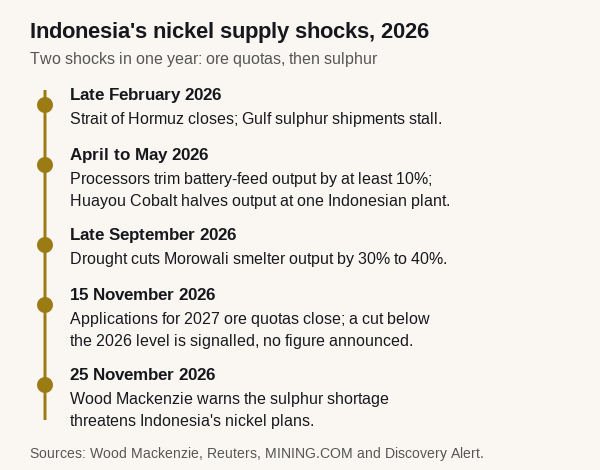
The sulphur squeeze is the second supply shock to hit Indonesian nickel this year, and it lands on top of the first. Jakarta has tightened nickel ore quotas, with the 2027 allocation expected to sit below the revised 2026 level of roughly 290 to 300 million wet metric tonnes. Applications for the 2027 quotas closed on 15 November, and no 2027 figure had been announced as of 24 November.
Drought has compounded the pressure. Smelters at the Indonesia Morowali Industrial Park on Sulawesi cut output by 30 to 40 percent in late September as water grew scarce and barges struggled to deliver coal, the park operator said. Earlier in the year, several processors trimmed battery-feed output by at least 10 percent after the sulphur squeeze first bit, and Huayou Cobalt roughly halved output at one Indonesian plant from 1 May.
Why has the nickel price not rallied?
The squeeze reaches beyond batteries into stainless steel. Falling grades in Indonesian ore have cut production of nickel pig iron, prompting stainless mills to buy more pure nickel and use more scrap, Wood Mackenzie said. Even so, the consultancy expects a surplus of high-purity metal to persist unless supply also falls.
That surplus is why the price has not responded to the Indonesian news the way it did earlier in November, when three-month nickel rose as much as 4.2 percent intraday to US$16,525 a tonne on 18 November on quota hopes, only to fall back below US$15,500 a tonne by 24 November.
SMM’s market analysis pointed to weak macro and supply-demand factors behind the latest decline, while Discovery Alert cited fading policy optimism and inventories that remain high. LME nickel stocks stood at 275,604 tonnes as of 24 November.
What does it mean for ASX investors?
For ASX investors the exposure is uneven, and the distinction matters. Nickel Industries (ASX: NIC) is the most directly exposed Australian-listed name. Its Excelsior Nickel Cobalt HPAL project in Indonesia produced first mixed hydroxide precipitate in July 2026 and first cathode in August, and was running at about half of nameplate capacity in the September quarter.
Management flagged sulphur cost pressure on its first-half earnings call, so a prolonged shortage hits its newest and highest-margin asset first, even as its mining and rotary kiln operations keep generating cash.
IGO (ASX: IGO) sits at the other end. It has no Indonesian HPAL exposure, and its nickel exposure is shrinking rather than growing. Mining and processing at its Nova operation in Western Australia concluded in November 2026, its Forrestania assets have been sold, and its Cosmos project is being transferred to a gold explorer.
Its future rests on lithium through the Greenbushes joint venture and on copper. For IGO, Indonesia’s sulphur problem is a nickel price story, not an operating one.
Ardea Resources (ASX: ARL) is the third case, and the most indirect. It has no assets in Indonesia. Its Kalgoorlie Nickel Project at Goongarrie Hub in Western Australia is a proposed nickel-cobalt HPAL operation, with a definitive feasibility study under way on a 30,000 tonne a year plant in a joint venture with Sumitomo Metal Mining and Mitsubishi Corporation.
A sulphur shock in Indonesia does not touch Ardea’s cash flow, but it does set the cost benchmark its own HPAL plant would have to beat, and a slower Indonesian build-out is the competitive context in which that project will be judged.
What to watch next
The outlook turns on whether the constraint eases or hardens. Wood Mackenzie forecasts nickel prices recovering towards US$19,000 a tonne by 2030, but the forecast is expressly subject to Indonesian policies and sulphur supply disruptions, and the consultancy’s own language points the other way for now.
Three tests come first: whether Gulf sulphur shipments normalise and spot prices retreat from June levels, whether Jakarta’s 2027 ore quota lands below the 2026 level, and whether HPAL output trims deepen or reverse. Liu’s warning that constraints are unlikely to ease quickly, set against fertiliser buyers competing for the same scarce tonnes, leaves Indonesia’s battery-nickel producers waiting on a sulphur supply line that has not yet normalised.
Sources
- MINING.COM, “Sulphur shortage threatens Indonesia’s nickel plans”, 25 November 2026: https://www.mining.com/sulphur-shortage-threatens-indonesias-nickel-plans/
- The Northern Miner, “Sulphur shortage threatens Indonesia’s nickel plans”, 25 November 2026: https://www.northernminer.com/news/sulphur-shortage-threatens-indonesias-nickel-plans/1003898246/
- Roar News, “The Energy Transition runs on Oil’s Leftovers”, 10 November 2026: https://roarnews.co.uk/2026/the-energy-transition-runs-on-oils-leftovers/
- Wood Mackenzie, “Middle East conflict disrupts major metals and mining markets, threatening global supply and prices”, 2026: https://www.woodmac.com/press-releases/middle-east-conflict-disrupts-major-metals-and-mining-markets-threatening-global-supply-and-prices/
- Wood Mackenzie, “Geopolitical supply shocks and AI power crunch collide across global base metals”, 22 October 2026: https://www.woodmac.com/press-releases/wood-mackenzie-geopolitical-supply-shocks-and-ai-power-crunch-collide-across-global-base-metals/
- Shanghai Metals Market, “Indonesia Nickel Ore Daily Price Update”, 25 November 2026: https://news.metal.com/newscontent/SJJ4GSAP2I3HZEMRBQ7WG7RKXUU3IHVBBCQPAXA-smm-nickel-flash-newsindonesia-nickel-ore-daily-price-update-november-25-2026
- Shanghai Metals Market, “[SMM Analysis] SHFE nickel fell 2% to 114,500 in the night session, with futures plunging while spot premiums struggled to catch up as weak macro and supply-demand factors resonated”, 25 November 2026: https://news.metal.com/newscontent/GC2B5X3LMLKUGLF242E3DBTJRH2WL5SDGQX4UHY-smm-analysis-shfe-nickel-fell-2-to-114500-in-the-night-session-with-futures-plunging-while-spot-premiums-struggled-to-catch-up-as-weak-macro-and-supply-demand-factors-resonated
- Discovery Alert, “Nickel Price Outlook: Indonesia’s 2027 Quota Gap Explained”, November 2026: https://discoveryalert.com/analysis/nickel-price-outlook-indonesia-2027-quota-november-2026/
- Reuters, “Gulf disruption squeezes Indonesia nickel makers’ sulphur supply”, 6 March 2026: https://www.reuters.com/world/asia-pacific/gulf-disruption-squeezes-indonesia-nickel-makers-sulphur-supply-2026-03-06/
- MINING.COM, “Indonesia nickel makers trim battery-feed output as sulphur squeeze bites”, 14 April 2026: https://www.mining.com/web/indonesia-nickel-makers-trim-battery-feed-output-as-sulphur-squeeze-bites/
- MINING.COM, “Huayou cuts output at Indonesian nickel plant as sulphur costs surge”, 29 April 2026: https://www.mining.com/web/huayou-cuts-output-at-indonesian-nickel-plant-as-sulphur-costs-surge/
- Nickel Industries, Q3 2026 Quarterly Activities Report, 22 October 2026 (as summarised): https://mfam.com.au/asx-announcements/nic-2026-10-22-q3-2026-quarterly-activities-report/
- Kalkine Media, “Why Did IGO’s (ASX:IGO) Nova Nickel Mine Finish Above Guidance as Operations Ended?”, November 2026: https://kalkinemedia.com/au/stocks/metal-and-mining/why-did-igos-asxigo-nova-nickel-mine-finish-above-guidance-as-operations-ended
- Grafa, “IGO sells Cosmos Project for 19.9% Gorilla Gold Mine stake”, November 2026: https://grafa.com/en/news/australia/igo-sells-cosmos-project-for-19-9-gorilla-gold-mine-stake
- Ardea Resources, investor presentation, July 2026: https://cdn-api.markitdigital.com/apiman-gateway/ASX/asx-research/1.0/file/2924-03112992-6A1334812&v=undefined
- DrillTape, “Indonesia crackdown sends LME nickel jumping”, November 2026: https://drilltape.com/commodities/nickel-indonesia-crackdown-lme-jump/