
Gold has fallen below US$3,800 an ounce to a 14-month low, and the banks that cover it now disagree about how far the fall goes. Spot gold was trading at US$3,580.89 an ounce in the Wall Street Journal’s market roundup this week, after a slide of about 36 percent from its record high. ANZ (ASX: ANZ) still expects the metal to reach US$4,800 an ounce in 2027.
Commonwealth Bank (ASX: CBA) is more guarded. Its commodities strategist Vivek Dhar expects gold to end the year at around US$3,500 to US$3,700 an ounce, and argues the downside is limited because the US dollar has already done most of its expected rise. The two Australian banks agree the correction is not the end of the story. They disagree on the price at which it stops.
The week told the story in stages. On 18 November gold fell below US$3,800 for the first time since September 2025, touching about US$3,790 as bets on further US Federal Reserve rate rises lifted the dollar and Treasury yields. ANZ held its US$4,800 forecast for 2027 through that fall. By 26 November spot gold was at US$3,580.89 an ounce, down 0.1 percent on the day. On 27 November the metal rebounded about 1.9 percent to around US$3,630 an ounce, while silver jumped nearly 5 percent to around US$43 an ounce.
ANZ: a dip to US$3,600, then US$4,800
ANZ’s view, set out in a research note dated 17 November, is that the sell-off is a correction inside a longer bull market, not the end of it. The bank does not rule out a further fall before the recovery starts. Its analysts see a possible drop to around US$3,600 an ounce, followed by a recovery towards US$4,800 by the end of 2027.
The US$3,600 level matters because ANZ expects buying to meet the market there. Strategic buyers and retail investors returning to the market should provide support at that level, the bank argues, even as higher US interest rates weigh on investment demand in the near term. Political gridlock around government funding, debt negotiations and fiscal policy adds to gold’s appeal as a portfolio diversifier, in ANZ’s reading, and that appeal survives the rate rises.
The rate rises themselves are part of the bank’s base case. ANZ expects the Federal Reserve to raise rates by 25 basis points each in December, January and March, and it “cannot rule out a 50bp hike next month”. Tighter money damps investment demand, the bank accepts. Its point is that the damping is temporary, and that the buyers who matter for the floor are the ones who buy through it.
That is why the US$4,800 figure has survived the fall. ANZ maintained its positive outlook for the metal over the medium and long term even as gold traded below US$3,800, and the forecast it kept is the same one it held before the correction. The bank’s case rests on the buyers, not on the rate path: central banks and retail investors buying the dip, at US$3,600 first, and then carrying the price back towards US$4,800 through 2027.
CommBank: the dollar has done most of its work
Commonwealth Bank’s case starts in a different place. For Dhar, the dollar is now the main force behind gold prices in the coming months, and the dollar has already risen faster than the bank expected. It is now just short of the peak CBA had forecast for the middle of 2027.
With most of the dollar’s rally already done, the main headwind for gold may be near its strongest. That is the logic behind the bank’s call, and Dhar put the conclusion plainly: “This suggests limited downside risks to current gold prices.”
The shift in what drives bullion is central to the call. Structural safe-haven demand has moved further into the background, Dhar said, as the “Sell America” and US dollar debasement trade has given way to traditional market relationships, the inverse link between gold and the US dollar and between gold and US 10-year real yields. Gold has gone back to trading off the dollar and real yields rather than haven demand, and with the dollar already close to the bank’s forecast peak, CBA sees limited downside and a year-end range of US$3,500 to US$3,700.
With only weeks left in the year, that range is effectively the near-term trading band. With only weeks until year-end, gold is expected to finish the year close to where it has been trading this week after the steep sell-off. A rate rise that is already expected, without a more hawkish signal in the Fed’s guidance, could allow the dollar to plateau and gold to stabilise. A signal that further rises are coming would push real yields higher and test the lower end of the bank’s range.
The rest of the Street is split
The two Australian banks sit inside a wider field that is split between buyers of the dip and callers of further falls. Three of the big houses are looking for a strong recovery, while HSBC warns the low is not yet in and Saxo Bank sets a test the price must pass before any recovery can be called.
Goldman Sachs is the closest to ANZ. The bank sees gold at US$4,800 an ounce by the end of 2027, the same figure ANZ holds, and its strategists have pointed to central-bank buying as the structural support that survives the rate rises. JPMorgan goes higher still, to an average of US$6,000 an ounce in the fourth quarter of 2027 and US$6,300 at the end of the year. A Reuters survey of 30 analysts puts the median 2027 average at US$4,650 an ounce, below ANZ’s US$4,800 and well below JPMorgan’s US$6,300, though still well above current levels.
However, the cautious side has its own numbers, and they are the levels traders are watching first. HSBC has warned that continued weakness in equity markets could push gold through major support at US$3,400 an ounce, and said it is too early to call an end to the slide. That US$3,400 level is HSBC’s, not CommBank’s, and it is the next big test if the equity selling continues. Saxo Bank’s Ole Hansen, by contrast, pointed to signs that selling may be exhausting, and set out a path towards around US$3,700 if gold can close above roughly US$3,590.
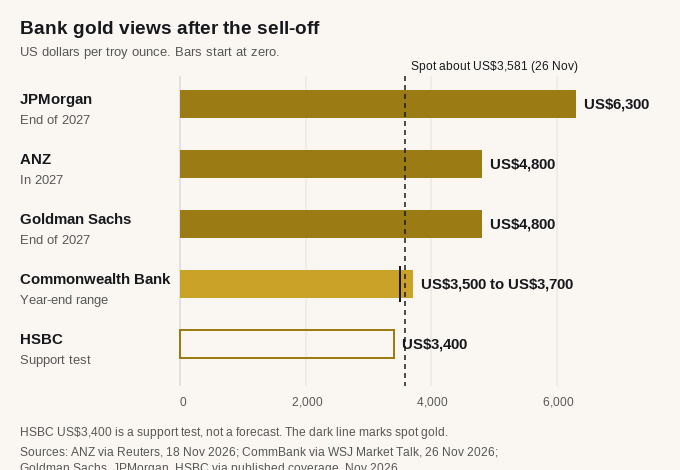
Bank gold views after the sell-off, from the most bullish to the most cautious. Sources: ANZ research note via Reuters, 18 November 2026; Commonwealth Bank via Wall Street Journal Market Talk, 26 November 2026; Goldman Sachs, JPMorgan and HSBC via published coverage, November 2026.
The spread is the story. From HSBC’s US$3,400 support test to JPMorgan’s US$6,300 end-2027 target is a gap of US$2,900 an ounce, almost as wide as the current price itself. The bulls are betting that central-bank buying and a peaking dollar carry gold back up. The bears are betting that equity weakness and further rate rises break the next support level first. Both sides agree on the drivers, the dollar, real yields and equities. They disagree on which one wins.
The structural backdrop has not moved
Beneath the disagreement, the structural demand that drove gold to its record has not gone away. Central banks bought 321 tonnes of gold in the third quarter of 2026, up 42 percent year on year, according to World Gold Council data. ANZ expects central banks to keep buying the dip. DrillTape reported the third-quarter figures on 25 November.
That matters for both banks’ cases. ANZ’s US$3,600 support level assumes strategic buyers return, and central banks are the strategic buyers with the deepest pockets. CommBank’s limited-downside call assumes the dollar is the binding constraint, and central-bank buying is the reason the metal has a level buyers defend even while the dollar rises. The 321 tonnes is the figure both arguments lean on, and it is the one figure from the third quarter that neither side disputes.
Silver tells the same story in miniature. The metal fell with gold through the correction, then jumped nearly 5 percent to around US$43 an ounce in the 27 November rebound, outpacing gold’s 1.9 percent recovery. The two metals are moving together again, driven by the same dollar and rate expectations, and silver’s sharper bounce is the market’s way of saying the selling may be exhausting itself.
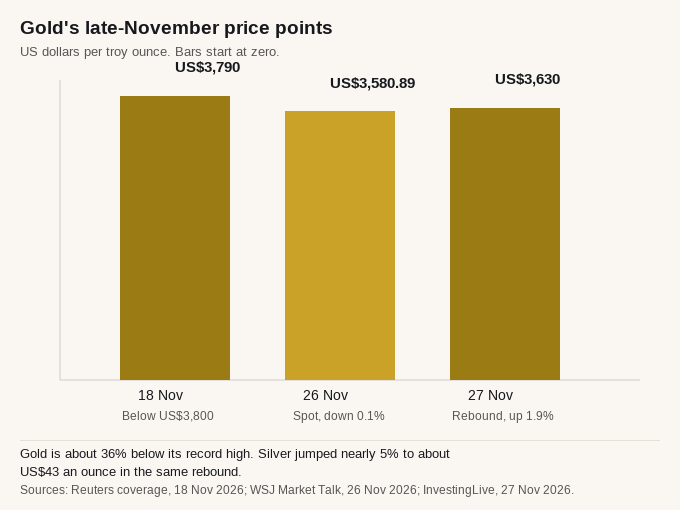
Gold’s late-November price points, from the 18 November low below US$3,800 to the 27 November rebound. Sources: Wall Street Journal Market Talk, 26 November 2026; InvestingLive, 27 November 2026; Reuters coverage, 18 November 2026.
What to watch next
Three tests will settle which bank is right. First, the Federal Reserve’s December decision, and whether it delivers the 25 basis point rise ANZ expects or the larger 50 basis point move ANZ says cannot be ruled out. A bigger rise would lift the dollar and real yields and test the lower end of CommBank’s range.
Second, the US$3,590 level. Saxo’s Hansen has made it the line in the sand: a close above roughly US$3,590 opens a path towards around US$3,700, while failure there leaves HSBC’s US$3,400 support test in play. Gold closed the week near US$3,630, above the line, but the test is whether it holds.
Third, the dollar itself. CommBank’s whole call rests on the greenback being close to its forecast mid-2027 peak. If the dollar pushes beyond that peak, the bank’s limited-downside view fails with it, and the lower end of its year-end range becomes the next level to watch. If the dollar plateaus, ANZ’s buyers at US$3,600 get their chance, and the road to US$4,800 opens.
The banks agree the correction is a test of who buys gold now that the haven trade has faded. ANZ says the buyers are already there, at US$3,600. CommBank says the sellers have nearly run out of room, with the dollar near its peak. The price will show which of them is right, and the December Fed decision is the first chance it gets.
Sources
- Wall Street Journal, Basic Materials Roundup: Market Talk (Dow Jones), November 2026: Commonwealth Bank analyst Vivek Dhar on the dollar, limited downside and the US$3,500 to US$3,700 year-end range; spot gold US$3,580.89/oz.
- InvestingLive, Gold’s downside looks limited because the dollar has already done most of its work, CBA says, 27 November 2026: CommBank range, HSBC US$3,400 support test, Saxo’s US$3,590/US$3,700 levels, 1.9% rebound to ~US$3,630, silver ~US$43, 37% slide from record.
- Reuters coverage of ANZ’s gold view, 18 November 2026, syndicated by Turkish Post: Gold price below $3,800: ANZ US$4,800 in 2027, US$3,600 support, Fed hike base case.
- GoldFix commentary on ANZ, 18 November 2026, reported by Cynicy: ANZ: gold could fall further even as central banks keep buying: ANZ two-stage view (dip to ~US$3,600, recovery towards US$4,800 by end of 2027); JPMorgan US$6,000 Q4 average / US$6,300 end of 2027.
- XTB market analysis, November 2026: Gold drops 2.5%: Are precious metals entering a bear market?: Goldman Sachs US$4,800 by end of 2027.
- 100news.tv, Gold After the Great Correction: Can Prices Recover by the End of 2027?, November 2026: Reuters survey of 30 analysts, average US$4,650 in 2027.
- World Gold Council Q3 2026 data via DrillTape, Central banks bought 321 tonnes of gold in Q3 while retail faded, 25 November 2026.
- Stockhead, Gold Digger: Correction or capitulation? Banks predict gold’s next move, 27 November 2026 (hook only; page not fetched in this session, no figure taken from it).