
OPEC+ goes into Sunday’s meeting with the easiest decision in months in front of it, and the hardest argument underneath it.
The group is likely to maintain its oil output targets for at least the first quarter of 2027, two people with knowledge of the talks told Reuters, because the Iran war is still disrupting Middle East exports and the members cannot agree on how much oil each of them is able to produce.
No decision has yet been reached, the sources said, and talks continue.
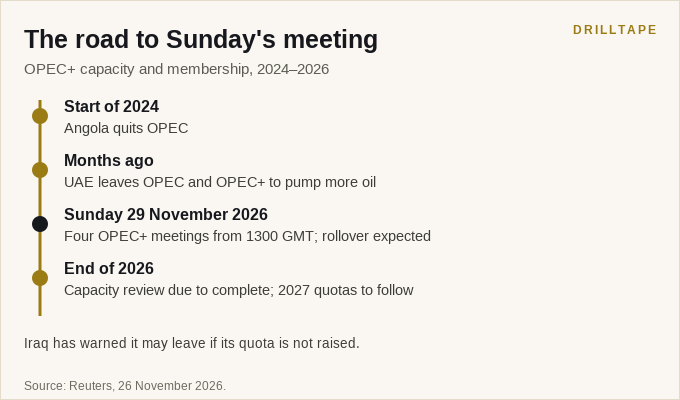
Oil ministers from OPEC and OPEC+ are set to begin a series of four meetings on Sunday 29 November at 1300 GMT. That is the meeting that matters: it was meant to use the results of the group’s first-ever review of members’ production capacity to help determine output quotas for 2027, and the disagreements over that review appear to have made a quota decision more difficult, not less.
Why hold? The war and the surplus point the same way
The case for standing still rests on two facts that point in the same direction. First, the Iran war continues to disrupt exports from the group’s Middle East members, and with infrastructure damaged and the conflict’s duration uncertain, ministers have little appetite for a decision that assumes supply will recover on schedule.
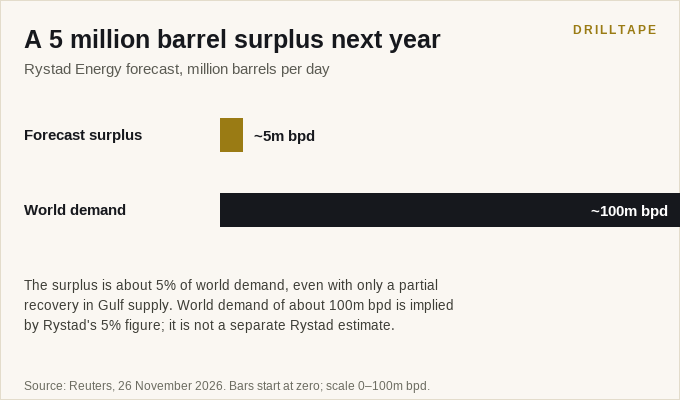
Second, the market does not need more oil. Rystad Energy sees a global oil surplus averaging around 5 million barrels per day next year, equal to about 5 per cent of world demand, even with only a partial recovery in Gulf supply.
That forecast raises the stakes for any production plan the meeting delivers: adding barrels into a surplus would push prices down, while cutting them would hand market share to producers outside the group.
Oil analyst firm Rapidan also expects no changes to targets on Sunday. “Given infrastructure damage and uncertainty over the conflict’s duration and lasting impact on production and exports, we expect ministers to maintain existing targets and postpone major quota decisions until next year,” Rapidan said in a report.
The strains underneath: Iraq, Kazakhstan and the capacity review
The capacity review is where the rollover stops looking like consensus and starts looking like postponement. Iraq is dissatisfied with the review’s preliminary findings, which assessed its production capacity at 4.9 million barrels per day, and Kazakhstan is also asking OPEC+ to lift its estimate of the country’s production capacity.
The 4.9 million figure is an assessment under dispute, not Iraq’s quota and not its output, and the argument over it is the reason the review cannot yet do the job it was designed for.
Russian Deputy Prime Minister Alexander Novak said on Wednesday that the group would complete the capacity review by the end of the year, and that ministers on Sunday would see what stage the review was at. That leaves the 2027 quotas to be settled later, after the review is finished, rather than at this meeting.
The strains are not new. The United Arab Emirates left OPEC and OPEC+ months ago in order to pump more oil, after years of arguing that its quota did not reflect its investment in capacity.
Angola quit OPEC at the start of 2024. Iraq has warned it may leave if its quota is not raised. Each departure and each warning narrows the room for a deal that asks anyone to accept a lower number.
What to watch
Sunday’s four meetings, from 1300 GMT, will show first whether the rollover holds or whether any member forces the capacity argument onto the agenda. The second test comes by the end of the year, when Novak says the capacity review will be complete: that is when the 2027 quotas, postponed from this meeting, come back into play.
The third test is the one no meeting controls. If Gulf exports recover faster than Rystad assumes, the forecast 5 million barrel per day surplus grows and the case for holding output steady weakens. If the war disrupts them further, the surplus shrinks and the rollover looks like restraint.
Either way, Sunday’s expected decision settles the first quarter and leaves the argument about who can produce what for the new year.
Sources
- Reuters via Kitco News, OPEC+ likely to roll over oil output targets for Q1 as capacity disputes persist, sources say, 26 November 2026 (reporting by Ahmad Ghaddar, Olesya Astakhova and Alex Lawler; the verified source for every fact in this article; read in full). All expectations in this article are attributed to the two people with knowledge of the talks, to Rystad Energy or to Rapidan, as the wire attributes them. No decision has been made.
- Related DrillTape coverage: Brent nears $97 as Hormuz attacks lift oil towards first weekly gain in four weeks (the Gulf supply disruption cited in the wire as a reason for the rollover, from this batch).