
Eramet’s Comilog has lifted its December offer for Gabonese manganese lump to US$4.90 per dry metric tonne unit, up US$0.10 on the month, for 44.5% material delivered to China. The 2025 average price for 44% ore was an estimated US$4.50 per unit, down from US$5.53 in 2024, according to the United States Geological Survey.
However, Stockhead argued on 26 November that steelmakers could face a manganese shortage the market is not pricing in. The claim is worth testing, because the price and the risk are pointing in opposite directions. About 90% of manganese goes into steelmaking, according to the International Manganese Institute, and the metal has no satisfactory substitute in its major uses, the Geological Survey says.
Why the price says there is no shortage
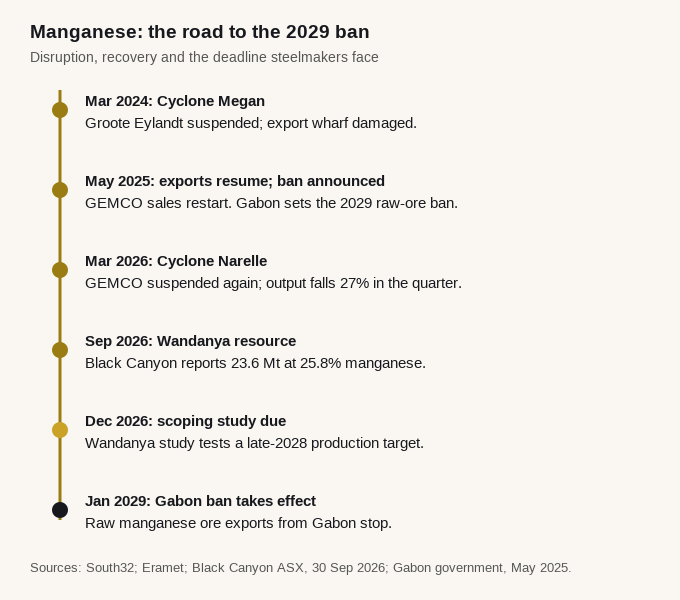
The strongest evidence against a shortage is the world’s biggest Australian manganese mine. South32’s Groote Eylandt operation, known as GEMCO, was fully suspended after Tropical Cyclone Megan struck in March 2024 and damaged its export wharf. Export sales resumed in May 2025, and attributable production in the year to June 2026 reached 3,031,000 wet metric tonnes, nearly triple the 1,106,000 tonnes of the year before.
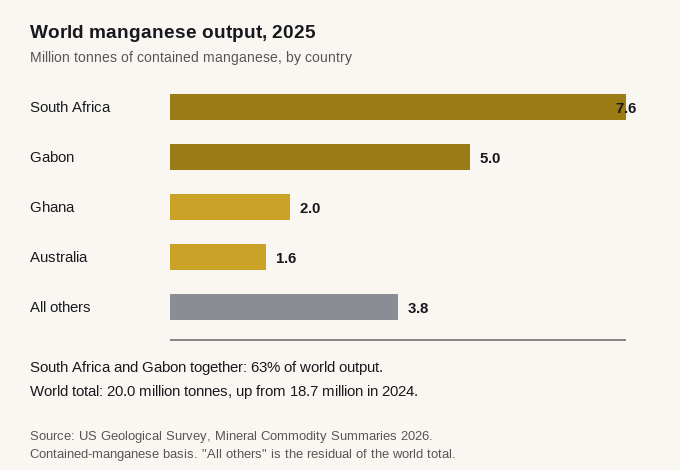
World mine production tells the same story. The Geological Survey estimates 2025 output at 20.0 million tonnes of contained manganese, up from 18.7 million tonnes in 2024, a rise of about 7%. At the same time, Comilog’s September offer to China was US$4.90 per unit, down US$0.20 on the month, before the December offer held at US$4.90, up US$0.10 on November.
Eramet’s own volumes are holding up. Production at its Moanda mine in Gabon reached 7.1 million tonnes of ore in 2025, up 4%, with 6.1 million tonnes transported and 5.5 million tonnes sold externally. The company has confirmed a 2026 transported target of 6.4 to 6.8 million tonnes.
Where the risk actually sits
The risk is not the size of the resource. The Geological Survey puts world manganese reserves at 1.8 billion tonnes. The risk is where the metal comes from. South Africa mined 7.6 million tonnes of contained manganese in 2025, or 38% of world output, and Gabon mined 5.0 million tonnes, or 25%. Two countries hold 63% of production, and the next largest, Ghana at 2.0 million tonnes and Australia at 1.6 million, are far behind.
Gabon has now put a date on the biggest single change to that picture. Its government announced in late May 2025 that exports of raw manganese ore will be banned from 1 January 2029, giving the sector more than three years to prepare. The ban covers unprocessed ore only, not processed products such as ferromanganese. Eramet, which operates Moanda through its Comilog subsidiary, noted the government’s intention and said it would keep working with the authorities “in a spirit of constructive partnership and mutual respect”.
Australia’s own supply is thinner than it looks. GEMCO was hit by a second cyclone in two years when Tropical Cyclone Narelle forced a temporary suspension in March 2026. Production in that quarter fell 27% to 589,000 wet metric tonnes, and South32 cut its 2026 Australian guidance to 3.0 million tonnes, then cut 2027 guidance to 2.65 to 2.9 million tonnes from 3.2 million. In the Northern Territory, OM Holdings’ Bootu Creek manganese mine has been on care and maintenance since production ceased in January 2022. Western Australia’s Woodie Woodie mine, operated by Consolidated Minerals, continues to operate, but it is a far smaller, high-grade operation than GEMCO, and it does not change the picture of Australian supply resting on one dominant mine.
What the producers are doing about it
Eramet is moving to meet the Gabon deadline rather than fight it. On 20 July 2026 it signed a memorandum of understanding with the Gabonese Republic to process up to 700,000 tonnes of ore a year locally by the end of 2031. The first half of 2026 was weaker at the mine, with Moanda production down 11% to 3.2 million tonnes on equipment availability, but external sales rose 4% to 2.8 million tonnes and the realised price rose 14%.
OM Holdings has stopped being a miner and become a buyer instead. Bootu Creek exported just 10,546 tonnes of manganese product in 2025, drawn from stockpiles, against 697,328 tonnes in 2021, and no ore was mined at the site during the year. Its Sarawak smelter in Malaysia produced 311,791 tonnes of manganese alloys and 191,087 tonnes of ferrosilicon in 2025. In August 2026 its trading arm signed a binding five-year take-or-pay offtake for all of the manganese concentrate from Element 25’s Butcherbird expansion in Western Australia, subject to carve-outs for Element 25’s battery-grade plans, which targets annual output of 1.1 million tonnes, with mechanical completion expected in the first quarter of 2027.
The most advanced Australian answer is still unbuilt. Black Canyon (ASX: BCA) reported a maiden resource at its Wandanya project in Western Australia’s Pilbara on 30 September 2026 of 23.6 million tonnes at 25.8% manganese, with more than 90% in the Measured and Indicated categories, including a direct shipping component of 3.7 million tonnes at 38.9% manganese. A scoping study is due in December 2026.
“Wandanya is one of the most significant recent greenfields manganese discoveries in Australia with a global Mineral Resource estimate comprising 23.6Mt @ 25.8% Mn,” managing director Brendan Cummins said. Black Canyon is assessing a development concept targeting about a 10-year mine life and production of up to about 1 million tonnes a year, with late 2028 as a management target if studies, approvals, financing and development all land.
The case for the shortage, and the case against it
The case for the shortage rests on concentration. Two countries supply 63% of the world’s manganese, one of them will stop exporting raw ore in just over two years, and the largest Australian mine has now been shut by two cyclones in two years. Steelmakers buy an input with no substitute, and the price they pay has not moved to reflect any of that. On this reading, the market is pricing today’s tonnes, not tomorrow’s access.
The case against it rests on the same numbers. World output rose 7% in 2025, GEMCO is back at close to full production, and the price has fallen by nearly a fifth from its 2024 average. Reserves of 1.8 billion tonnes mean the metal is not running out, and the supply response is already visible: a scoping study at Wandanya, a 1.1-million-tonne expansion at Butcherbird, and a processing roadmap in Gabon itself.
Both cases can be true at once, and that is the point. A physical shortage of manganese ore is not visible in today’s market. A concentration risk is, and it is the kind of risk that stays invisible until a cyclone, a rail outage or a policy deadline turns it into a shortage overnight. The price says there is plenty of ore. The map says most of it comes from very few places.
What to watch next
Five tests will show whether the risk stays theoretical or starts to bite.
First, Black Canyon’s Wandanya scoping study, due in December 2026, and whether it supports the late-2028 production target. Second, Comilog’s January offer to China, which will show whether the December rise to US$4.90 per unit holds or fades. Third, South32’s December-quarter GEMCO result, the next test of the mine’s recovery after Cyclone Narelle. Fourth, progress on Gabon’s local processing, where the 700,000-tonne-a-year roadmap, which runs to 2031, has to become plants, and the gap between the 2029 ban and the 2031 horizon is itself the risk. Fifth, steel output itself, since manganese demand follows steel, and a weak steel market would keep the ore price soft whatever happens to supply.
The shortage Stockhead described has not arrived. The conditions that would create one are already in place, and the market has two years to decide what they are worth.
Sources
- Stockhead, “Steelmakers could face a manganese shortage the market isn’t pricing in”, 26 November 2026: https://stockhead.com.au/resources/steelmakers-could-face-a-manganese-shortage-the-market-isnt-pricing-in/ (hook only; no figure from this piece is used in the article)
- US Geological Survey, Mineral Commodity Summaries 2026: Manganese: https://www.usgs.gov/centers/national-minerals-information-center/manganese-statistics-and-information (world production, country shares, steel demand, reserves, prices)
- Black Canyon Limited, “Wandanya Maiden Mineral Resource Estimate: 23.6Mt @ 25.8% Mn”, ASX announcement, 30 September 2026: https://announcements.asx.com.au/asxpdf/20260930/pdf/074ppx8hmykcn4.pdf (resource figures, cut-offs, scoping study timing, Cummins quote)
- Black Canyon Limited, September Quarterly Activities Report, ASX, 27 October 2026 (resource confirmation, A$6.2 million cash at 30 September 2026)
- Eramet, “Structural measures to strengthen balance sheet and prepare the future, after a challenging year 2025”, 18 February 2026: https://live.euronext.com/en/products/equities/company-news/2026-02-18-eramet-structural-measures-strengthen-balance-sheet-and (Moanda 2025 production, transported and sold volumes, 2026 targets)
- Eramet, H1 2026 results, July 2026 (Moanda H1 production, sales, realised price, Gabon memorandum of understanding) via Ferro-Alloys.com: https://www.ferro-alloys.cn/en/News/Details/333446
- South32 quarterly report, July 2026, via Northern Territory Government manganese factsheet, August 2026: https://resourcingtheterritory.nt.gov.au/media/docs/commodity-factsheets/Manganese_Oct2025.pdf (GEMCO FY2025 and FY2026 attributable production)
- Reuters, “Eramet shares slide as Gabon plans manganese ore export ban”, 3 June 2025, via Kitco: https://www.kitco.com/news/off-the-wire/2025-06-03/eramet-shares-slide-gabon-plans-manganese-ore-export-ban (ban announcement, Eramet statement)
- OM Holdings Limited, Annual Report 2025: Bootu Creek Mine Operational Review (production ceased 25 January 2022, FY2025 exports of 10,546 tonnes, Sarawak smelter output)
- New Straits Times, “OM Holdings secured long-term manganese concentrate production from West Australia’s Butcherbird mine”, 15 August 2026: https://www.nst.com.my/business/corporate/2026/08/1504012/om-holdings-secured-long-term-manganese-concentrate-production (Element 25 offtake, 1.1 Mtpa target, Q1 2027 completion)
- Mining Bulletin, “Eramet Comilog increased its manganese ore quotation for China in December”, 2 November 2026: https://www.mining-bulletin.com/index.php/product_5.html (December offer US$4.90/dmtu, up US$0.10)