
The Democratic Republic of Congo exported more than one million tonnes of copper in a single quarter for the first time, government data show, closing the gap on Chile in a race the South American nation has led for decades. Congolese shipments rose 8 percent year on year to 2.7 million tonnes in the first nine months of 2026, while Chile exported 1.28 million tonnes in the third quarter.
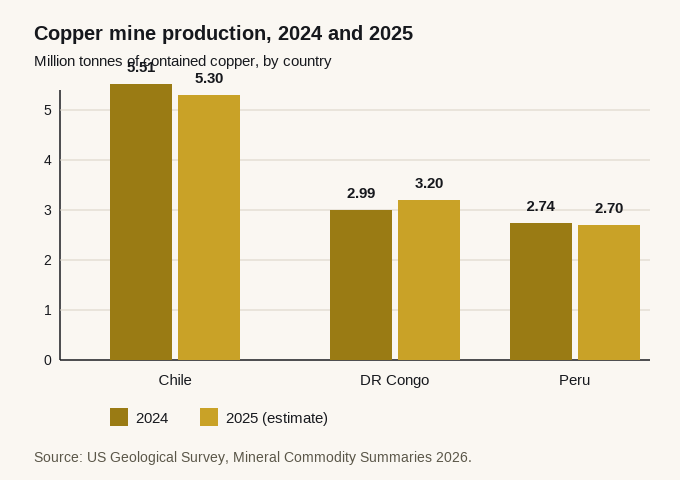
Chile is still the world’s largest copper producer, and the gap on a full-year basis remains wide. Chilean mines produced an estimated 5.3 million tonnes of copper in 2025 against 3.2 million tonnes in Congo, according to the United States Geological Survey.
But Chile’s output is now forecast to fall below 5 million tonnes in 2026, its lowest level since 2003, and Congo’s rise has put the crown in play for the first time.
How close is the race?
The quarterly export figures flatter Congo and understate Chile, so the two measures need to be kept apart. Exports count what leaves the country in a period, including metal drawn from stockpiles, while mine production counts what is dug up.
On exports, Congo shipped more than one million tonnes in the third quarter against Chile’s 1.28 million tonnes. On mine production, Chile is still well ahead.
The full-year production figures show how far Congo still has to travel.
The Geological Survey puts world mine production at 23 million tonnes in 2025, with Chile at 5.3 million tonnes, or 23 percent, Congo at 3.2 million tonnes, or about 14 percent, and Peru at 2.7 million tonnes. Chile and Peru together account for about a third of global mined output.
Congo’s own mines ministry puts national copper production higher, at 3,485,269 tonnes in 2025, a reminder that the two tallies are built on different bases.
Chile’s expected 2026 output of 4.94 million tonnes would still be about 40 percent higher than Congo’s 2025 production on the ministry’s basis. On these figures, that is the narrowest the margin has been in the modern history of the copper market.
Congo’s output has more than tripled over the past decade, driven by high-grade deposits on the Central African Copperbelt and a wave of investment, mostly from China.
Who is shipping the copper?
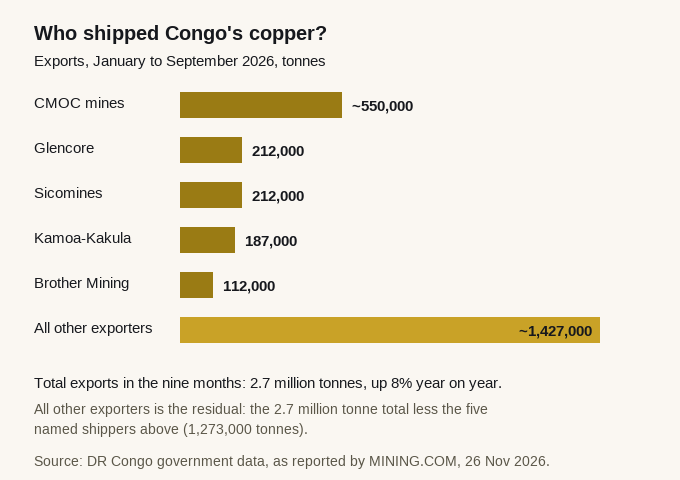
Five operations account for just under half of Congo’s exports so far this year, and all five are named in the government data. Two large mines owned by China’s CMOC Group accounted for almost 550,000 tonnes of exports through September. Glencore’s operations and the Sicomines complex each contributed 212,000 tonnes.
Kamoa-Kakula, co-owned by Canada’s Ivanhoe Mines and Zijin Mining Group, exported 187,000 tonnes. Brother Mining, a joint venture involving China’s Chengtun Mining Group, shipped 112,000 tonnes.
CMOC is the largest single force in Congolese copper.
Its Tenke Fungurume and Kisanfu mines together produced 741,100 tonnes of copper in 2025, the company reported, and output rose again in the first half of 2026, when the two mines produced 387,961 tonnes, up 9.73 percent on the same period a year earlier. CMOC owns 80 percent of Tenke Fungurume and 71.25 percent of Kisanfu.
Sicomines, the other 212,000-tonne contributor, is a joint venture between China Railway Group, Power Construction Corp. of China, known as PowerChina, and the Congolese state-owned miner Gécamines.
Kamoa-Kakula tells a different story: a world-class mine that spent 2025 fighting back from disaster. The complex produced 388,838 tonnes of copper in concentrate in 2025, within its revised guidance of 380,000 to 420,000 tonnes, after a seismic event and flooding at the underground Kakula mine in May forced Ivanhoe to cut its original guidance of 520,000 to 580,000 tonnes.
The 2025 figure was also below the record 437,061 tonnes produced in 2024. Ivanhoe holds 39.6 percent of the complex, Zijin holds 39.6 percent, the Congolese government holds 20 percent, and Crystal River holds the remaining 0.8 percent. Its on-site smelter, a 500,000-tonne-a-year direct-to-blister plant, produced its first anode in late December 2025.
Why Chile is slipping
Chile’s problem is not a lack of copper in the ground. It is that the mines it already has are producing less of it.
The Chilean Copper Commission, Cochilco, cut its 2026 production forecast to 4.94 million tonnes in its October trends report, down 8.4 percent on 2025 and down from the 5.27 million tonnes it had forecast only in August. It expects 5.08 million tonnes in 2027, a partial recovery.
The nine-month figures explain the cut. Chilean mines produced 3.633 million tonnes between January and September, down 8.5 percent on the same period of 2025. Three operations account for 77.3 percent of the decline: BHP’s Escondida, down 127,000 tonnes; state-owned Codelco, down 84,000 tonnes; and BHP’s Spence, down 51,000 tonnes.
Cochilco points to declining ore grades, maintenance at processing plants and operational disruptions. Chile’s 2018 peak of 5.83 million tonnes now looks a long way off.
The decline comes as the world races to secure more copper for power grids, electric vehicles and data centres. Chile and Peru, which together account for about a third of global mined output, have struggled to revive growth amid falling grades, project delays and permitting challenges, and the shortfall has handed Congo its opening.
Can Chile hold the crown?
The case for Congo is momentum. Output has more than tripled in a decade, the largest operator is still expanding, Kamoa-Kakula’s new smelter is ramping up, and Kinshasa is now moving to capture more of the value of what it ships.
State-owned Gécamines, which holds minority stakes in several major mines and has already ventured into copper marketing, plans to establish a trading desk in Switzerland, chief executive Baraka Kabemba said on Wednesday at the Makutano conference in Kinshasa.
“We cannot be the leading copper producer in the world, be the custodian of the next technological revolution, and not have a presence in the commodities market,” Kabemba said. “From my point of view, that doesn’t make sense.”
Gécamines is already building the platform behind the ambition. Its trading venture with Swiss trader Mercuria exercised a right in January to buy 100,000 tonnes of Tenke Fungurume’s 2026 copper for the United States market, and the company has set a longer-term goal of securing marketing rights for 500,000 tonnes of copper and 40,000 tonnes of cobalt.
Kabemba told the Makutano forum on 23 November that Gécamines expects to market 300,000 tonnes of copper in 2026.
The case for Chile is scale and time. Even at its weakest in 23 years, Chile is expected to produce about 4.94 million tonnes this year, far above anything Congo has yet shipped in a full year, and its recovery pipeline is real.
CRU Group forecasts Chilean output of about 6 million tonnes by 2030 as mine expansions and new projects come online. Cochilco’s own ten-year outlook puts the peak later, at 6.06 million tonnes in 2033, but it points the same way: Chile’s lead narrows, it does not vanish overnight.
What to watch next
Five tests will decide whether this is a changing of the guard or a one-year squeeze. First, Congo’s fourth-quarter exports, which will show whether the country clears 3.4 million tonnes for the full year and matches or beats its 2025 total.
Second, Cochilco’s next trends report, and whether the 4.94 million tonne forecast for 2026 holds or is cut again. Third, Kamoa-Kakula’s recovery, where dewatering at Kakula and the ramp-up of the new smelter decide whether the complex returns toward its pre-flood output.
Fourth, Gécamines’ Swiss trading desk, where the timing and scale of the plan have not yet been announced. Fifth, Chile’s 2027 rebound, where Cochilco expects 5.08 million tonnes and CRU expects about 5.5 million tonnes.
Congo has closed to within a quarter of Chile on quarterly exports. The full-year production crown still belongs to Chile, and the distance between the two measures is the story of the next two years.
Sources
- MINING.COM, Congo closes in on Chile’s long-held copper crown, 26 November 2026 (hook source; DRC government export data, mine-level export split, Gécamines trading desk plan and Kabemba quote, via Bloomberg files).
- US Geological Survey, Mineral Commodity Summaries 2026 (2025 mine production estimates: Chile 5.3Mt, DR Congo 3.2Mt, Peru 2.7Mt, world 23Mt; 2024 figures).
- Cochilco, Copper Market Trends Report, third quarter 2026, as reported by Pauta Financiera and Plusmining (Chile 2026 forecast 4.94Mt, 2027 forecast 5.08Mt, January to September production 3.633Mt, Escondida/Codelco/Spence declines).
- Ivanhoe Mines, Kamoa-Kakula 2025 production results and 2026 guidance, 15 January 2026 (388,838 tonnes of copper in concentrate in 2025, revised guidance 380,000 to 420,000 tonnes, smelter first anode).
- CMOC Group DRC operations reporting, as summarised by Lobito Corridor (Tenke Fungurume and Kisanfu combined 741,100 tonnes of copper in 2025; ownership stakes; first-half 2026 production 387,961 tonnes).
- Reuters, via CNBC Africa, 16 September 2026 (DRC first-half 2026 exports 1,724,217 tonnes, DRC Mines Ministry statistics report).
- MINING.COM, Congo copper exports up 10% last year as boom extends (DRC 2025 exports 3.4Mt, up from 3.1Mt in 2024).
- Copperbelt Katanga Mining, Gécamines eyes 300,000 tonnes in copper sales, November 2026 (Gécamines Trading, Mercuria venture, 100,000-tonne Tenke Fungurume purchase, 500,000-tonne goal).
- CRU Group, via eNCA (Chile at about 6 million tonnes by 2030); Cochilco 2025-2034 outlook via MINING.COM (peak 6.06 million tonnes in 2033).