
Artificial intelligence in mining usually promises the next discovery, a new orebody found faster than a geologist could find it. At Simberi, it found ounces in rock St Barbara already owned.
Stratum AI says its deep-learning models of weathering and material type now underpin the mineral resource estimate for the Simberi gold project in Papua New Guinea, in one of the first cases of its kind in the mining industry. The Toronto-based company worked with St Barbara (ASX: SBM) to build the models into the estimate, which is reported in line with the JORC Code, the Australian reporting standard that governs what a listed miner can claim about its resources. MINING.COM reported the milestone on 25 November 2026.
The two companies have worked together at Simberi for more than four years. That length of time matters, because the claim here is not a pilot result or a laboratory test. It is a model that survived contact with an operating mine and ended up inside the formal estimate of what the mine holds.
What did the model actually do?
Simberi is an open-pit gold mine on Simberi Island in New Ireland province, and its ore comes in three flavours that behave very differently in a processing plant: oxide, transitional and sulphide. Oxide ore suits the existing carbon-in-leach circuit. Sulphide ore does not, and it is stockpiled for later treatment once the expansion plant is built. Getting the classification wrong means feeding the wrong rock to the mill, generating extra waste and wearing out equipment for no return.
Stratum AI’s job was to model sulphur and other indicators of oxidation, so the mine could tell oxide from sulphide mineralisation more reliably than the old material-type classification allowed. The models were first deployed in pilot programs on exploration data. They were then run on operational data, to sort ore for the carbon-in-leach plant, and validated against grade-control reconciliation, the check that compares what the model predicted with what the mine actually dug up.
St Barbara adopted the models as its preferred method for material-type classification after that validation. Farzi Yusufali, Stratum AI’s co-founder and CEO, put the progression plainly: “St Barbara has harnessed Stratum AI’s proprietary algorithms to classify certain ores that were previously considered to be unsuitable for Simberi’s existing carbon-in-leach circuit. What began as an AI pilot has evolved into a technology that now underpins the mineral resource estimate in Simberi’s feasibility study.”
The point worth holding onto is the sequence. Pilot, then operations, then reconciliation, then adoption, then the resource estimate. A model earns its place in a JORC estimate by being right about rock the mine has already mined, not by promising to be right about rock it has not.
What did it add, in numbers?
The first hard numbers came in May 2024, and they are the figures to date carefully, because they are two and a half years old. St Barbara said on 7 May 2024 that the collaboration had identified carbon-in-leach treatable sulphides that would previously have been considered unsuitable for the existing circuit. The reclassification covered 3.7 million tonnes at 1.2 grams per tonne of gold, which works out at about 143,000 ounces of additional treatable material. The arithmetic checks: 3.7 million tonnes at 1.2 grams a tonne holds roughly 4.44 million grams of gold, or about 143,000 ounces.
St Barbara said the reclassification extended the mine’s oxide processing life by 17 months. It also said the model had identified an extra 10 percent of carbon-in-leach treatable material during the March 2024 quarter alone. Andrew Strelein, St Barbara’s managing director and CEO, said at the time: “The work achieved with Stratum AI has been highly effective in enabling the Simberi team to delineate more ore which can be treated with the existing CIL plant.”
To put 143,000 ounces in scale, set it against what Simberi was expected to produce. St Barbara lifted its Simberi production target for the 2025 to 2027 financial years to between 70,000 and 75,000 ounces a year, up from guidance of 60,000 to 70,000 ounces for the 2024 financial year. At that rate, the reclassified material represents about two years of output. It did not come from a new discovery. It came from re-reading rock the company already held.
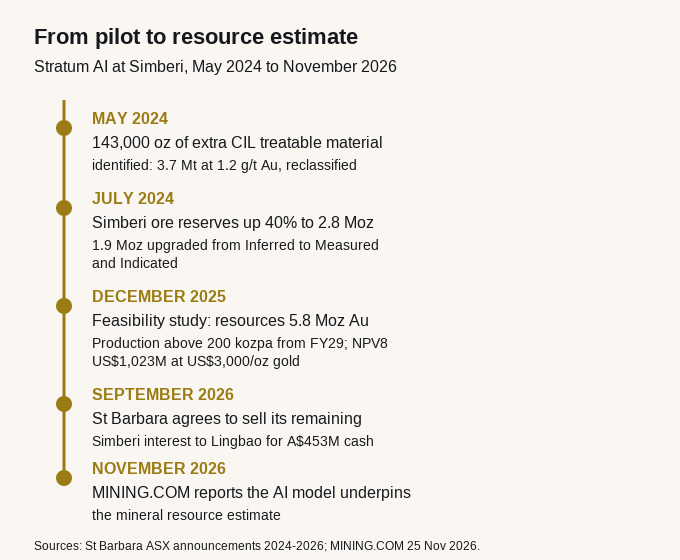
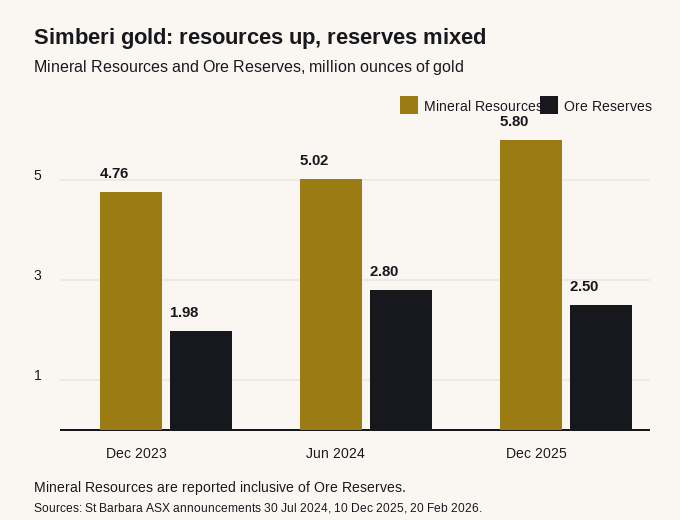
The reclassification also fed the next reserve statement. On 30 July 2024 St Barbara reported Simberi ore reserves up 40 percent, by 0.8 million ounces, to 2.8 million ounces, with mineral resources of 5.0 million ounces. The company said 1.9 million ounces had been upgraded from Inferred to Measured and Indicated through the 2024 resource definition drilling campaign and additional modelling work. The AI model was part of that modelling work, alongside the drilling, and the announcement credits both.
Does the estimate change what Simberi is worth?
The feasibility study for the Simberi expansion, released on 10 December 2025, is where the AI-classified estimate meets the economics. The study put Simberi’s mineral resource at 5.8 million ounces of gold, in 138 million tonnes at 1.3 grams per tonne, with ore reserves of 2.5 million ounces. It set out total gold production of 2.1 million ounces from the second quarter of the 2026 financial year to 2039, with annual production rising above 200,000 ounces a year from the 2029 financial year. The post-tax net present value was US$1,023 million, with an internal rate of return of 79 percent, at US$3,000 an ounce for gold and US$30 an ounce for silver. Initial project capital was estimated at US$275 million, and the life-of-mine plan runs for 13 years.
Strelein said the study showed Simberi developing into a compelling opportunity: “Simberi will be a low capital intensity brownfields development, taking advantage of existing infrastructure to realise the value from this high quality resource at a globally competitive operating cost.”
But an honest reading of the numbers also sets a limit on the AI story. Ore reserves stood at 2.5 million ounces at 31 December 2025, down about 0.2 million ounces on December 2024, driven mainly by a smaller life-of-mine oxide pit footprint to protect previously unaffected water catchments. Mineral resources rose by about 0.9 million ounces over the same period, to 5.8 million ounces, but St Barbara said that rise was primarily due to reporting at a higher gold price, US$2,500 an ounce against US$2,000 an ounce previously. The AI model changed what the mine could classify and treat. The gold price changed what the ground was worth reporting. Both are in the estimate, and only one of them is a technology story.
That distinction is also the right way to read Stratum AI’s “one of the first cases of its kind” claim. It is the company’s characterisation of its own milestone, and no independent benchmark of every AI-assisted resource estimate in the industry sits behind it. What can be verified is narrower and still notable: a deep-learning model, validated against grade control at an operating mine, now sits inside a JORC-compliant estimate that supports a feasibility study for a 13-year mine life. The model did not find Simberi. It changed how much of Simberi counts.
Who benefits now that Lingbao is buying in?
The ownership of Simberi has moved while the model has been working. On 10 December 2025, the same day as the feasibility study, St Barbara announced that Lingbao Gold Group would take a 50 percent interest in St Barbara Mining, the holding company, equal to a 40 percent attributable interest in the project. The deal completed in April 2026 for A$389 million in cash. Kumul Mineral Holdings agreed to take a 20 percent interest for A$100 million, with completion still pending; as of 25 November 2026 the acquisition was before PNG cabinet. In September 2026 St Barbara agreed to sell its remaining interest to Lingbao for A$453 million in cash, made up of A$410 million on completion and A$43 million repaying its share of construction capital, plus a 2.75 percent net smelter return royalty on all future gold and silver production from Simberi and a 1.5 percent royalty on the Tabar Island Group exploration licences. Completion is targeted for the March quarter of 2027.
The December 2025 transaction valued 100 percent of the New Simberi gold project, the expansion of the existing mine, at about A$800 million. That valuation rests on the feasibility study, and the feasibility study rests on the resource estimate, and the resource estimate rests in part on the classification model. So the party that ends up holding the benefit of the reclassification is changing hands: on completion of the September 2026 sale Lingbao will hold an 80 percent interest in New Simberi, with Kumul holding the other 20 percent if its acquisition completes, while St Barbara keeps the royalties and the cash, and Stratum AI keeps the reference case.
That handover is the next test of the story. If the model works as claimed, Lingbao inherits a resource estimate whose material-type classification has already been validated against grade control, and an expansion plan built on it. If the classification proves less robust at the larger scale of the expansion, with sulphide ore moving from stockpile to feed, the cost will land on the new owner. Either way, the evidence will show up in the same place it always does in mining: in reconciliation, in what the mill recovers against what the model predicted.
The transaction is expected to complete in the March quarter of 2027, subject to regulatory approvals in China and Papua New Guinea. St Barbara and Lingbao approved the final investment decision on 2 April 2026, and construction of the US$333 million project is now under way, with first ore production expected in the second half of the 2028 financial year; the study points to production above 200,000 ounces a year from the 2029 financial year. Those are the dates that will tell whether an AI model underpinning a resource estimate was a milestone or a footnote.
Sources
- David Cassels, Stratum AI model feeds Simberi’s mineral resource estimate, MINING.COM, 25 November 2026 (hook; central claim, Yusufali quote, ownership, September 2026 sale).
- St Barbara Limited, FY25 to FY27 Production Target 70 to 75kozpa: Simberi AI Collaboration Success, ASX announcement, 7 May 2024 (3.7 Mt at 1.2 g/t Au for 143 koz additional CIL treatable material; deployment Q2 FY24, validation Q3 FY24; 10 percent additional CIL treatable material in Q3 FY24; FY25 to FY27 target 70,000 to 75,000 oz a year; Strelein quote).
- St Barbara Limited, Simberi Ore Reserves Increase by 40% to 2.8Moz: Mineral Resource and Ore Reserve Statement as at 30 June 2024, ASX announcement, 30 July 2024 (reserves up 0.8 Moz, 40 percent, to 2.8 Moz; resources 5.0 Moz; 1.9 Moz upgraded from Inferred to Measured and Indicated).
- St Barbara Limited, Feasibility Study confirms Simberi as a High-Quality, Long-Life, Low-Cost Asset, ASX announcement, 10 December 2025 (resource up 0.9 Moz Au; total production 2.1 Moz, Q2 FY26 to FY39; above 200 kozpa from FY29; post-tax NPV8 US$1,023M and IRR 79 percent at US$3,000/oz Au and US$30/oz Ag; initial capital US$275M; 13-year life of mine; 43 percent Proved and 57 percent Probable; Strelein quote).
- St Barbara Limited, Mineral Resources and Ore Reserves Statement as at 31 December 2025, ASX announcement, 20 February 2026 (Simberi resources 136.5 Mt at 1.3 g/t Au for 5.8 Moz; reserves 42.9 Mt at 1.8 g/t Au for 2.5 Moz; silver resources 15.3 Moz; resource rise primarily due to US$2,500/oz gold price; reserve fall driven by smaller oxide pit footprint).
- St Barbara Limited, St Barbara to be Fully Funded for Simberi Expansion: Lingbao Gold to Acquire a 50% Strategic Interest, ASX announcement, 10 December 2025 (Lingbao 50% of St Barbara Mining for A$370M; Kumul 20% for A$100M; transaction values 100% of the Simberi Gold Project at A$800M).
- St Barbara Limited, St Barbara to Sell Simberi Interest to Lingbao, ASX announcement, 10 September 2026 (binding agreement; A$410M cash plus A$43M repayment; 2.75 percent NSR on gold and silver; 1.5 percent NSR on Tabar Island Group exploration licences; completion targeted March quarter 2027).
- St Barbara Limited, 19 November 2026 Presentation to 2026 Annual General Meeting, ASX, 19 November 2026 (Lingbao 50 percent interest completed April 2026 for A$389M cash; September 2026 sale of remaining interest for A$453M cash; royalties; completion targeted March quarter 2027).
- International Mining, Stratum AI models gaining recognition with Simberi resource JORC milestone, 29 October 2026 (earlier reporting of the milestone; models validated against grade-control reconciliation; 100 percent of New Simberi valued at about A$800M in the December 2025 transaction).