
A price set in government offices, not on a trading floor, now underwrites the West’s rare earth supply chain.
Within eight months, three separate agreements fixed the same minimum price for the same product: US$110 a kilogram for neodymium-praseodymium oxide, the NdPr that feeds permanent magnets. The Pentagon agreed it first, Tokyo’s buyers agreed it second, and Washington agreed it a third time with the company that already supplies both. The question the market is now asking is the one in the headline. A floor guarantees revenue. It does not guarantee a mine.
The floor is now US$110, in three places
The sequence began on 10 July 2025, when MP Materials (NYSE: MP) announced a partnership with the US Department of Defense. The department agreed a 10-year price floor of US$110 per kilogram for MP’s NdPr products stockpiled or sold, bought US$400 million of newly created convertible preferred stock, and lent US$150 million towards heavy rare earth separation at Mountain Pass in California.
The department also agreed to ensure that all magnets from MP’s planned second magnet plant, the 10X Facility, are purchased for 10 years once it is built. The plant is expected to begin commissioning in 2028 and take MP’s total US magnet capacity to an estimated 10,000 metric tons a year.
“This initiative marks a decisive action by the Trump administration to accelerate American supply chain independence,” James Litinsky, founder, chairman and chief executive of MP Materials, said in the announcement.
Eight months later the same number appeared on the other side of the Pacific. On 10 March 2026, Lynas Rare Earths (ASX: LYC) finalised a revised 12-year supply agreement with Japan Australia Rare Earths (JARE), the buyer for Japanese industry. JARE committed to firm offtake of 5,000 tonnes a year of NdPr at a US$110 per kilogram floor, with upside shared when prices pass US$150 per kilogram, capped at US$10 million a year.
Lynas will also make up to 7,200 tonnes a year of NdPr available to Japanese industry to 2038, and JARE takes firm offtake of half of all Lynas heavy rare earth oxides.
Six days after that, Lynas signed a binding letter of intent with the US Government for about US$96 million of light and heavy rare earth oxide purchases over four years, again with a US$110 per kilogram floor for NdPr oxide. The letter replaces an earlier agreement, after uncertainty over whether Lynas would build a heavy rare earth plant at Seadrift in Texas.
Three floors, one number, two US agreements and one Japanese buyer.
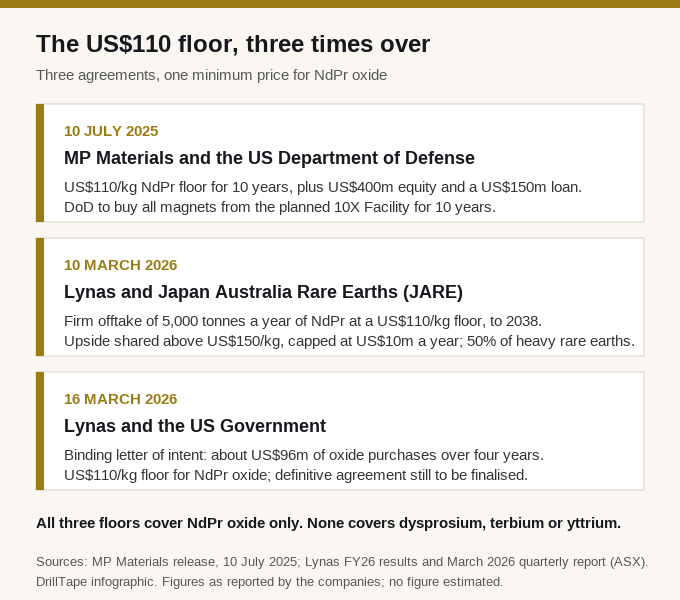
The US$110 floor, agreed three times. Sources: MP Materials release, 10 July 2025; Lynas FY26 results and March 2026 quarterly report (ASX).
The case for the floor
The bull case is straightforward, and it starts with why the floor exists at all. China mined an estimated 270,000 tonnes of rare earth oxide in 2025, about 69 percent of world mine production of about 390,000 tonnes, according to the US Geological Survey.
The concentration is heavier downstream: China refined about 85 percent of the world’s magnet rare earths in 2025, down from over 90 percent in 2023, the International Energy Agency reported in July. Beijing has also tightened export licensing on heavy rare earths, including yttrium, since April 2025. A producer outside China does not only compete on cost. It competes against a supplier that can cut the price and the shipment at the same time.
A floor removes the worst case from a lender’s spreadsheet. A bank funding a separation plant no longer has to model NdPr at the price China chooses to set. It models it at US$110 a kilogram, for the volumes covered, for the term agreed. That is the difference between a project that cannot be financed and one that can, and it is why the floor has become the instrument of choice rather than the subsidy. The money follows the contract, not the other way round.
Lynas shows what the contract is worth once it is signed. Its firm JARE offtake of 5,000 tonnes a year is about 69 percent of the 7,260 tonnes of NdPr it produced in the year to June 2026. The floor therefore covers most of its core product for 12 years, to 2038.
And the Australian Government has now built the same logic into law for projects that do not yet exist. Its A$1.2 billion Critical Minerals Strategic Reserve, legislated in March 2026 and due to operate by the end of the year, can sign offtake agreements at fixed or floating prices and contracts for difference with price floors and ceilings, starting with antimony, gallium and rare earths.
The first test of that reserve has already passed. Arafura Rare Earths (ASX: ARU) announced a final investment decision on its Nolans project in the Northern Territory on 21 May 2026, after the Government gave a non-binding commitment to secure 500 tonnes of rare earths from the project through the reserve. Nolans is projected to supply about 4 to 5 percent of global rare earth demand once operating. The floor, in this telling, is not a prop for incumbents. It is the mechanism that takes a project from study to construction.
The case against the floor
However, a floor is not a mine, and the bear case starts exactly where the bull case stops. A floor guarantees a price. It guarantees nothing about cost, nothing about qualification, and nothing about the customer at the end of the chain.
Start with coverage. The US$110 floor applies to NdPr oxide only. It does not cover dysprosium, terbium or yttrium, the heavy rare earths where China’s grip is tightest and where the price swings are widest. Lynas produced just 23 tonnes of dysprosium and terbium combined in the September 2026 quarter, against 2,082 tonnes of NdPr. The floor protects the product Lynas already makes at scale. It does not protect the products it is still learning to make.
Added to this, the floors cover named buyers for fixed terms, not the whole market. MP’s floor runs 10 years; Lynas’s US letter of intent runs four. JARE’s runs to 2038, but only for the volumes JARE takes. A developer with no JARE-style buyer and no Pentagon contract gets no floor at all, and must still convince a lender that a magnet maker will qualify its oxide, at a price, on a date. Qualification is the slow step in this industry, and no government has yet put a floor under it.
Then there is the cost side, which the floor does nothing to fix. Lynas’s expanded heavy rare earth facility in Malaysia, the plant that will separate the elements the floors do not cover, has risen in estimated cost from about A$180 million to about A$294 million including contingency.
Lynas blames additional equipment to meet customers’ purity requirements, the higher cost of sourcing equipment outside China, and cost escalation from the geopolitical environment. First gadolinium is expected early in its 2028 financial year, and yttrium later. The most expensive lesson of the non-Chinese supply chain is that building outside China costs more than the first estimate, and a floor on the selling price does not bring the building cost down.
For some critics, the deepest problem is what the floor leaves untouched. The IEA projects that even if every planned refining project proceeds, China’s share of magnet rare earth refining only falls to about 70 percent by 2035. Planned refining capacity outside China reaches only around two-thirds of expected mine output by that year, and planned magnet production only about one-third. A floor under NdPr oxide does not build the magnet factories that must buy the oxide, and without them the oxide has nowhere to go at any price.
What the numbers already show
The two producers with floors have just reported strong quarters, and the figures show the floor working as designed.
MP Materials reported third-quarter 2026 results on 5 November. NdPr production was 1,018 metric tons, up 41 percent year on year, and sales were 1,020 metric tons, up 94 percent. Revenue rose 176 percent to US$147.7 million, and price protection agreement income, the cash the floor pays when the market sits below US$110, was US$8.1 million. The realised NdPr price was about US$100 per kilogram, which is why the floor paid out at all. For the fourth quarter, MP expects about 1,000 metric tons of NdPr sales at about US$100 per kilogram, and about US$8 per kilogram of price protection income on sold NdPr.
Lynas reported a record quarter of its own on 29 October. NdPr production ready for sale was 2,082 tonnes in the September quarter, a record for its Malaysian plant and up from 1,857 tonnes in the June quarter. Total rare earth oxide production was 4,254 tonnes, and dysprosium and terbium added 23 tonnes.
Gross sales revenue reached A$310.1 million, up 55 percent on the same quarter a year earlier and the highest since the fourth quarter of its 2022 financial year. The average selling price across all its rare earth products hit a record A$102.1 per kilogram. The two sets of numbers are measured differently and cannot be ranked against each other, but they point the same way: the producers that hold floors are producing more, selling more, and earning more than a year ago.
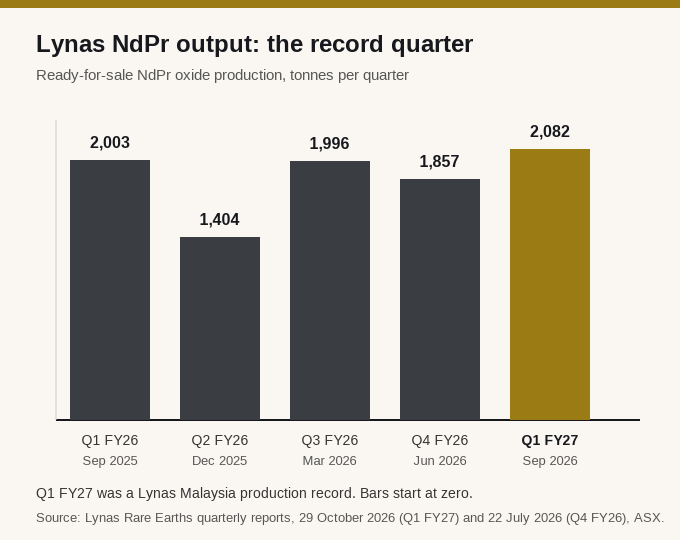
Lynas quarterly NdPr production, with Q1 FY27 a Lynas Malaysia record. Source: Lynas quarterly reports (ASX).
Lynas’s full year tells the same story at larger scale. In the year to 30 June 2026 it produced 13,089 tonnes of rare earth oxide, including 7,260 tonnes of NdPr, and reported revenue of A$977.9 million, up 76 percent on the A$556.5 million of the year before. Net profit after tax was A$222.4 million, against A$8.0 million the year before. The company puts the recovery down in part to the floor price agreements led by global governments. Read the full-year picture in DrillTape’s Q3 rare earths coverage.
What to watch next
The argument now turns on four tests, and each has a date attached.
First, Lynas’s December quarter. Planned maintenance at its Malaysian plant will cut production below the record September quarter, and the market will read the December number as the run rate, not the record.
Second, the heavy rare earth build: first gadolinium early in the 2028 financial year, then yttrium, will show whether the A$294 million plant can produce the elements the floors do not cover. Third, Arafura’s Nolans construction, which will show whether a reserve commitment converts into tonnes on a schedule. Fourth, and most important, whether any developer without a floor reaches financial close at all. A second Nolans would prove the mechanism. A year with none would show its limit.
The floor has already done one thing beyond doubt. It has taken the two producers that exist outside China and given them a revenue line their lenders can underwrite. Whether it can fund the projects that do not yet exist is the question the next year will answer, and the answer will come from construction sites and financing documents, not from the price of NdPr. Two January deadlines will test the same supply chain from a different angle.
Sources
- MP Materials, “MP Materials Announces Transformational Public-Private Partnership with the Department of Defense to Accelerate U.S. Rare Earth Magnet Independence”, 10 July 2025: https://www.businesswire.com/news/home/20250710526348/en/
- MP Materials, “MP Materials Reports Third Quarter 2026 Results”, 5 November 2026: https://mpmaterials.com/news/mp-materials-reports-third-quarter-2026-results/
- MP Materials, Q3 2026 earnings call, 5 November 2026 (Q4 guidance: about 1,000 metric tons of NdPr sales at about US$100 per kilogram, about US$8 per kilogram of price protection income), transcript via The Motley Fool: https://www.fool.com/earnings/call-transcripts/2026/11/06/mp-materials-mp-q3-2026-earnings-call-transcript/
- Lynas Rare Earths, Financial Results for the year ending 30 June 2026, 26 August 2026 (ASX): https://cdn-api.markitdigital.com/apiman-gateway/ASX/asx-research/1.0/file/2924-03126367-6A1340315&v=undefined
- Lynas Rare Earths, Quarterly Report for the period ended 31 March 2026, 21 April 2026 (ASX): https://cdn-api.markitdigital.com/apiman-gateway/ASX/asx-research/1.0/file/2924-03080721-6A1321239&v=undefined
- Lynas Rare Earths, Quarterly Report for the period ended 30 June 2026, 22 July 2026 (ASX): https://announcements.asx.com.au/asxpdf/20260722/pdf/071y3m2j4fp9px.pdf
- Lynas Rare Earths, Quarterly Report for the period ended 30 September 2026, 29 October 2026 (ASX): https://announcements.asx.com.au/asxpdf/20261029/pdf/075xzndxqk7000.pdf?utm_source=chatgpt.com
- Reuters, “Australia’s Lynas inks US rare earth oxide supply deal”, 16 March 2026: https://www.reuters.com/world/asia-pacific/australias-lynas-inks-us-rare-earth-oxide-supply-deal-2026-03-15/
- Australian Government, Department of Industry, Science and Resources, Answers to Questions on Notice on the Critical Minerals Strategic Reserve, 27 March 2026: https://www.aph.gov.au/DocumentStore.ashx?id=5d101e8a-5e74-4a6a-a48d-7a10aa911fb2&subId=787228
- Australian Government, Minister for Resources, Media conference, Rockingham WA (Critical Minerals Strategic Reserve): https://www.minister.industry.gov.au/king/media/media-conference-rockingham-wa
- Export Finance Australia, “Strategic reserve supporting Arafura final investment decision”, 21 May 2026: https://www.exportfinance.gov.au/newsroom/strategic-reserve-supporting-arafura-final-investment-decision/
- International Energy Agency, “Supply concentration, export restrictions and declining investment put critical mineral security at risk” (Global Critical Minerals Outlook 2026), 16 July 2026: https://www.iea.org/news/supply-concentration-export-restrictions-and-declining-investment-put-critical-mineral-security-at-risk
- US Geological Survey, Mineral Commodity Summaries 2026, Rare Earths chapter (2025 mine production: China 270,000 tonnes of world 390,000 tonnes rare earth oxide equivalent)
- MINING.COM, “Can price floors fund rare earth projects beyond China?”, 25 November 2026 (hook only; the article was not accessible at research time and none of its analysis is restated here): https://www.mining.com/can-price-floors-fund-rare-earth-projects-beyond-china/