
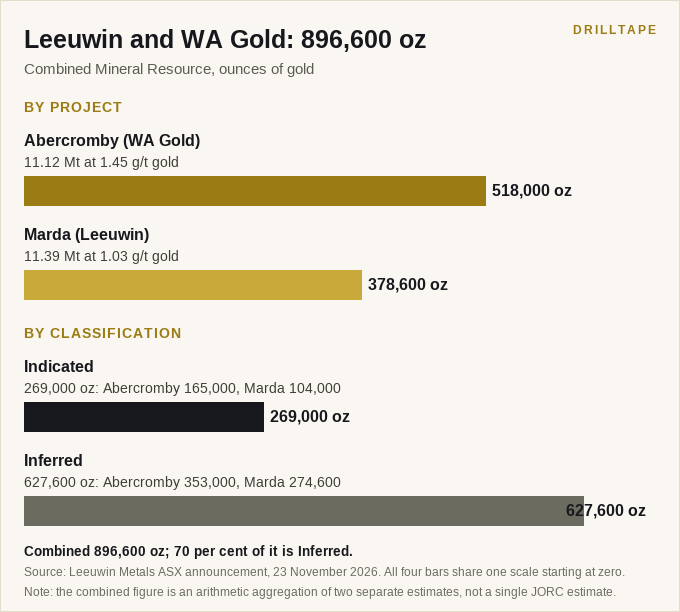
Leeuwin Metals (ASX: LM1) has agreed to buy WA Gold (ASX: WAU) in an all-scrip deal worth about A$25.7 million, putting 896,600 ounces of gold across two Western Australian projects into a single company.
WA Gold shareholders will receive one new Leeuwin share for every 11.72 shares held. At Leeuwin’s A$0.21 close on 20 November, that implies A$0.0179 a share, a 49.3 per cent premium to WA Gold’s last close of A$0.012 and 42.0 per cent to its one-month volume-weighted average price.
The combined group would list with about 253.8 million shares on issue and a pro forma market capitalisation of about A$53.3 million, owned about 52 per cent by Leeuwin’s existing holders and about 48 per cent by WA Gold’s.
The deal is the latest test of a simple idea now running through Western Australia’s gold juniors: that scale buys relevance. The question is whether 896,600 ounces is enough of it.
The numbers underneath the headline give the sceptics plenty to work with. Seven in every ten of those ounces, 627,600 of 896,600, are Inferred, the lowest-confidence resource category. The Marda project, which contributes 378,600 ounces, has no declared Ore Reserve, no completed mining study and no production target.
And the combined group would hold only about A$5 million in cash before transaction costs, with drilling and studies still to fund.
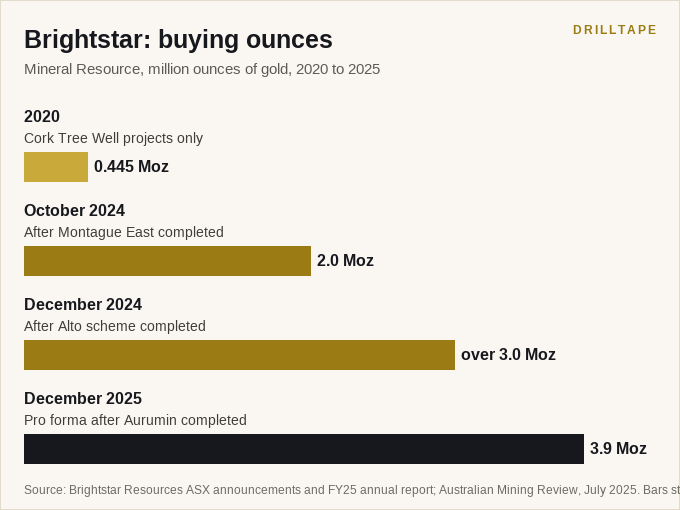
The believers have a precedent to point to. Brightstar Resources (ASX: BTR) spent 2023 to 2025 buying its way from a 445,000-ounce explorer to a producer with a resource approaching four million ounces, and the market followed. This article tests the Leeuwin deal against that precedent, and against the gold price that frames both of them.
What Leeuwin is actually buying
The combined 896,600 ounces is an arithmetic aggregation of two separate estimates prepared by different Competent Persons using different cut-offs and methods, not a single JORC estimate.
Abercromby is the larger half of the combination. WA Gold’s project near Wiluna holds 518,000 ounces in 11.12 million tonnes at 1.45 grams a tonne, split between an open-pit component of 354,000 ounces at 1.17 grams a tonne and an underground component of 164,000 ounces at 3.09 grams a tonne.
Metallurgical testwork has returned gold recoveries of 93 to 95 per cent. The resource sits on granted mining leases and remains open along strike and at depth, and historic drilling includes 57.5 metres at 5.73 grams a tonne, 30 metres at 10.01 grams a tonne and 26 metres at 6.07 grams a tonne.
The resource itself dates from 2023. A 54-hole, roughly 7,200-metre reverse circulation program began at the Capital deposit in August 2026 to support an updated estimate, and the Capital North and South targets are on the combined group’s 2027 drilling list.
Marda is Leeuwin’s own project, near Southern Cross, and it contributes 378,600 ounces in 11.39 million tonnes at 1.03 grams a tonne. A mining lease at Evanston covering 165,500 ounces was granted in April 2026, and environmental studies are under way. The company is assessing a standalone operation against third-party processing. It has not completed a mining study, and it has established no Ore Reserve or production target.
The combination also brings tenure beside Minerals 260’s Bullabulling gold project, and WA Gold has said the combined group would run two development or toll-milling hubs, at Southern Cross and Wiluna, targeting first gold within about 12 months. That is a target, not a commitment: there is no assurance either project will proceed to production.
“Together we will have almost 900,000 ounces and multiple high-priority targets to test across Abercromby, Marda and Bullabulling in 2027. We are acquiring WA Gold’s ounces at an attractive enterprise value of approximately A$45 per ounce,” Leeuwin executive chairman Christopher Piggott said.
“By combining our significant Western Australian-based gold development and exploration assets, with mineral resources totalling nearly 900,000 ounces of gold, we are creating a stronger, well-funded development and exploration company with enhanced scale, diversification and technical depth,” WA Gold non-executive chair John Prineas said.
The timetable runs into next year. The scheme booklet is expected in January 2027, WA Gold shareholders vote in late February and implementation is targeted for early to mid-March. The scheme needs at least 75 per cent of the votes cast and a majority in number of the shareholders voting, plus court approval and an independent expert’s conclusion that it is in WA Gold shareholders’ best interests. WA Gold’s board has unanimously recommended it, subject to no superior proposal and the expert’s support.
There are no financing or due-diligence conditions, reciprocal break fees are A$270,000, and Leeuwin will provide an unsecured loan facility of up to A$300,000 that cannot be drawn until three months after the deed was signed. Leeuwin’s management will lead the merged company, and Prineas is expected to join the Leeuwin board.
Why now: the money went back to the producers
Rick Squire, a portfolio manager at Acorn Capital, told Stockhead that gold explorers and developers were largely ignored through 2024 in favour of cash-generating producers. They found support when gold hit its record high in January, he said, and then lost it again as the price fell and money rotated back to the producers.
The price path bears him out. Spot gold set its intraday record of US$5,595.46 an ounce on 29 January 2026, and the London afternoon benchmark closed that day at a record US$5,405. By 12 November spot gold had slipped below US$4,000, closing that day at US$3,877.59 on GoldPrice.com’s spot series.
On Friday 20 November it closed at US$3,521.38 on Original Pricing’s spot series, down 37 per cent from the January intraday record, and by early trading on Wednesday 25 November it was near US$3,524 an ounce on Kitco’s spot quote. DrillTape’s gold price coverage sets out the rates repricing behind the fall in full.
The rotation sits inside a wider small-cap squeeze. Data provider Dealogic counts 20 pending takeover deals for Australian listed companies, worth US$62.3 billion, and nearly all involve small caps. Datt Capital puts smaller companies at their widest discount to large caps in at least 20 years, about 14 times earnings against 17 to 18 times for the largest stocks, and year to date to 11 November the S&P/ASX 100 had risen 6.31 per cent while the Small Ordinaries had fallen 12.25 per cent.
DrillTape’s takeover-wave coverage covers that wave, led by Gold Fields’ tilt at Northern Star. Leeuwin and WA Gold are the junior end of the same story: two small companies combining because neither, alone, is big enough to hold the market’s attention.
The precedent: how Brightstar bought its way to relevance
Brightstar started the decade as a single-project explorer. In 2020 it held only the Cork Tree Well projects in the Laverton greenstone belt, with a combined estimated 445,000 ounces of gold.
The buying began with a merger. Brightstar’s scheme with Kingwest Resources was implemented on 26 May 2023, bringing the Menzies tenements into the group.
Then came the deal that changed what the company was. On 25 March 2024 Brightstar announced an off-market scrip takeover offer for Linden Gold Alliance. It completed the acquisition on 31 May 2024 with 96.75 per cent of the shares, and compulsory acquisition took it to 100 per cent on 10 July 2024. Linden brought the operating Second Fortune underground mine, 75 kilometres from the Laverton mill, and with it Brightstar went from explorer to producer.
August 2024 brought two deals at once. Brightstar signed a binding agreement on 1 August to buy the Montague East gold rights from Gateway Mining for A$14 million, made up of A$5 million in cash, A$7 million in shares and A$2 million in deferred shares on milestones. It completed that acquisition on 2 October 2024, adding 9.6 million tonnes at 1.6 grams a tonne for half a million ounces and taking the group’s total endowment to 2.0 million ounces.
On the same day, 1 August 2024, Brightstar announced the scheme to acquire Alto Metals and its Sandstone gold project. The scheme became effective on 2 December 2024 and completed on 9 December, with Alto shareholders receiving four Brightstar shares for each Alto share. Sandstone held about 1.05 million ounces, and by the end of 2024 Brightstar’s resource base stood at more than 3.0 million ounces at 1.5 grams a tonne, on granted mining leases.
Production followed the ounces. Ore haulage began from Brightstar’s Laverton hub to Genesis Minerals’ Laverton mill under an ore purchase agreement, with the first gold pour completed on 20 March 2025.
The spree did not stop there: Brightstar entered a scheme implementation deed with Aurumin on 21 July 2025, implying an undiluted equity value of A$60 million for Aurumin, and completed the acquisition on 2 December 2025, taking the pro forma group resource to 3.9 million ounces at 1.5 grams a tonne. By April 2026 the company had US$120 million of senior secured bonds listed on Euronext.
The worked comparison is the point of the precedent. Leeuwin’s 896,600 ounces is about 30 per cent of the resource Brightstar held by the end of 2024, at a lower average grade, 1.24 grams a tonne against 1.5. Brightstar’s resource grew almost ninefold, from 445,000 ounces in 2020 to 3.9 million ounces pro forma, and it took four deals plus a producing mine to do it.
The price per ounce tells the same story in miniature. Montague East cost A$14 million for about 507,000 ounces, about A$28 an ounce of headline consideration including the A$2 million deferred. Alto cost about A$43 million for about 1.05 million ounces, about A$41 an ounce. Leeuwin is paying about A$45 an ounce of enterprise value for WA Gold’s ounces.
The ounces are not identical, the categories differ and each deal carried tenure and other value besides the resource, but the direction is plain. Leeuwin is paying a fuller price per ounce than Brightstar paid at the start of its run.
The case for the deal
The first argument for the combination is that both projects are advanced and both sit on granted mining leases. This is not greenfields ground. Abercromby has an open-pit component and a higher-grade underground component, metallurgy that recovers 93 to 95 per cent of the gold, and drilling planned for 2027. Marda has a mining lease at Evanston and studies under way. A combined group can drill both projects from one balance sheet and one management team.
The second argument is the price. Leeuwin says it is acquiring WA Gold’s ounces at about A$45 an ounce of enterprise value, against about A$66 an ounce for its own Marda ounces on the same measure. Buying ounces more cheaply than the market values your own is the arithmetic every consolidator wants to show, and the near-even ownership split, 52 per cent to Leeuwin’s holders and 48 per cent to WA Gold’s, presents the deal as a merger of two companies of similar size rather than a rescue.
The third argument is the precedent. Brightstar’s scale came first, and production, a mill deal and bond-market access followed it. Leeuwin’s combination is the first step on the same path. The Bullabulling tenure beside Minerals 260’s Bullabulling project adds exploration optionality that neither company held alone. And the deal carries no financing or due-diligence conditions, with WA Gold’s board unanimously recommending it.
The case against
The first argument against is the quality of the ounces. Seven in every ten are Inferred, and the Abercromby resource dates from 2023, so the update from the Capital drilling program has to do real work before the headline number carries more weight. Marda has no Ore Reserve, no mining study and no production target, and the first gold within about 12 months is a target the companies have set themselves, not a commitment the market can hold them to.
The second argument is the money. About A$5 million in combined cash before transaction costs does not fund a drilling program at two projects plus the studies Marda still needs. Further funding would likely dilute shareholders, and the scheme itself is all scrip at a 49.3 per cent premium, so Leeuwin’s existing holders keep only 52 per cent of a company whose ounces are mostly Inferred, while the value WA Gold holders receive moves with Leeuwin’s share price until implementation.
The third argument is the backdrop. Gold has fallen 37 per cent from its January record, and the tailwind that carried juniors in January is gone. Squire’s rotation point stands: as gold fell, money went back to the producers. A sub-million-ounce developer has to prove it belongs in the other camp, and one deal does not replicate a precedent that took Brightstar four deals and a producing mine.
What to watch next
The scheme booklet is expected in January 2027, with the first court hearing late that month, the WA Gold shareholder vote in late February and implementation targeted for early to mid-March. The independent expert’s conclusion and the court hearings are the formal gates. The vote is the real one: the scheme needs 75 per cent of the votes cast and a majority in number of the shareholders voting.
The drilling matters as much as the paperwork. The 2027 programs at Abercromby, including the Capital North and South extensions, and at Marda will show whether the combined group can grow ounces as well as count them. The updated Abercromby resource, built on the 54-hole program that began in August, is the first test of whether the ounces Leeuwin is buying are growing on firmer ground or standing still.
The gold price sets the backdrop for all of it. The Federal Open Market Committee meets on 9 December, and the metal’s direction from here decides whether the next WA junior deal is priced as a recovery trade or a distress sale. DrillTape first noted the Leeuwin deal in the First Drill briefing for 25 November. The scheme vote in February will show whether WA Gold’s shareholders think 896,600 ounces is enough.
DrillTape holds no position in any company named in this article. This article is not financial product advice. All prices and premiums are as stated at the dates given.
Sources
- Leeuwin Metals, Transformational Acquisition of WA Gold Limited, ASX announcement, 23 November 2026 (full announcement text via Bold Investors; terms, resource figures, timetable and conditions).
- Mining Weekly, Leeuwin Metals to acquire fellow Australian gold miner WA Gold, 23 November 2026.
- GlobalData, Leeuwin Metals agrees to acquire WA Gold for $17m, 24 November 2026 (Piggott quote; board composition; loan facility).
- Discovery Alert, Leeuwin Metals (LM1) WA Gold Acquisition: ~900koz Deal, November 2026 (resource table by project and classification; pro forma ownership and market capitalisation; Piggott quote).
- Bold Investors, Leeuwin Metals (ASX: LM1) Strikes $25.7m All-Scrip Deal for WA Gold, 22 November 2026 (Abercromby open-pit and underground split; Marda lease and study status; timetable; funding warning).
- Middle.news, WA Gold’s 49% premium deal creates a larger Western Australian gold group, November 2026 (VWAP premiums; board recommendation; no financing or due-diligence conditions; break fees; first-gold target and Marda’s lack of Ore Reserve).
- Middle.news, Leeuwin builds a 896,600oz WA gold platform with WA Gold deal, November 2026 (Abercromby and Marda Indicated/Inferred splits; Capital drilling program; enterprise value per ounce).
- BullsNBears, WA Gold, Leeuwin unite in near-million-ounce WA gold deal, November 2026 (Prineas quote; first-gold target and toll-treatment pathways; break fees).
- Brightstar Resources, Annual Report for the year ended 30 June 2025, ASX, 12 September 2025 (Linden completion dates; Alto completion 9 December 2024; Aurumin scheme implementation deed 21 July 2025 and pro forma 3.9Moz resource).
- Brightstar Resources, First Laverton Gold Pour Complete, ASX, 20 March 2025 (Maiden gold pour completed at Genesis Minerals’ Laverton mill).
- Brightstar Resources, December 2024 Quarterly Activities Report, ASX, 31 January 2025 (Sandstone transactions complete; resource base over 3.0Moz at 1.5g/t; ore haulage to Genesis Laverton mill; first gold pour scheduled March 2025).
- Brightstar Resources, Brightstar completes Montague East acquisition with BTR group mineral resources now 2.0Moz Au, ASX, 2 October 2024 (Montague East completion; 9.6Mt at 1.6g/t for 0.5Moz; group total 2.0Moz).
- Gateway Mining, Gateway sells gold rights for Eastern Montague Gold Project in WA to Brightstar Resources for $14M, ASX, 1 August 2024 (Montague East terms: A$5m cash, A$7m shares, A$2m deferred).
- Automic Group, Mergers & Acquisitions (Alto Metals scheme, value A$43m, completed December 2024; Linden Gold Alliance takeover, value A$23.7m).
- SAMSO, Brightstar Resources (ASX BTR), Research and Coverage (deal timeline: Kingwest scheme 26 May 2023; Linden bid 25 March 2024; Aurumin completion 2 December 2025).
- Australian Mining Review, Gold’s new heavy hitter, July 2025 (Brightstar 445,000oz in 2020; Menzies 595,000oz; Second Fortune and producer status).
- Euronext, Brightstar Resources Limited 12.5% senior secured USD 120,000,000 bonds 2026/2030, admission document, 13 April 2026.
- Copio Capital, Gold’s 2026 price fall: what did it protect?, November 2026 (World Gold Council prices: LBMA PM record close US$5,405 on 29 January 2026; 20 November close US$3,569.80; 23 November close US$3,667.55).
- The World Data, Global Gold Price Drop Statistics 2026, November 2026 (Reuters spot prices: record US$5,594.82 in January; gold below US$4,000 on 12 November; US$3,796.37 on 18 November).
- GoldPrice.com, Gold price on November 12, 2026, 12 November 2026 (Gold closed at $3,877.59 per troy ounce on Thursday, November 12, 2026).
- Original Pricing, Gold Price November 2026: The 37% Drawdown, Dated and Sourced, November 2026 (Spot gold close $3,521.38/oz on 20 November 2026).
- Stockhead, WA gold juniors building relevance through consolidation, 25 November 2026 (Acorn Capital portfolio manager Rick Squire’s view on the rotation between producers and explorers/developers, as reported).
- DrillTape, Gold down 37% from its January record as the debasement trade unwinds, 25 November 2026; Rejected but not gone: Gold Fields’ Northern Star tilt leads Australia’s small-cap takeover wave, 25 November 2026; First Drill, 25 November 2026, 25 November 2026; Bullabulling fully funded to first gold as Minerals 260 confirms 6.2Moz resource at AGM.