
The global silver market is forecast to record its sixth consecutive annual deficit in 2026, but the shortfall is now expected to be 35 million ounces, down from the 46.3 million ounces forecast in the World Silver Survey in April. Philip Newman, Managing Director at Metals Focus, and Sarah Tomlinson, Director of Mine Supply, presented the revised estimates at the Silver Institute’s Annual Silver Industry Dinner in New York on 12 November.
The revision is a story about price. Silver surged to a record high of US$121.65 an ounce on 26 January, supported by strong investment and tight physical liquidity in London, the Silver Institute said. Prices subsequently retreated to US$52 an ounce by 4 November, down 27 percent since the start of the year, as shifting US interest rate expectations, dollar strength and rising bond yields weighed on investor sentiment for the entire precious metals complex. The gold:silver ratio fell to 43 in January, its lowest level since 2011, before returning to the high 70s by early November.
The November revision
Total silver demand is forecast at 1.08 billion ounces in 2026, down 5 percent year on year, against 1,112.6 million ounces forecast in April. Industrial demand is expected to reach 640 million ounces, around 22 percent above its 2019 level and its fourth-highest level in Metals Focus’ series, despite a 3 percent decline this year. That industrial figure is essentially unchanged from April’s forecast of 639.6 million ounces. What changed is the shape of demand inside it.
Industrial silver demand outside photovoltaics is expected to rise by 4.5 percent to 492 million ounces this year, the Silver Institute said, partially offsetting lower consumption in solar cells, where elevated silver prices have accelerated thrifting and substitution. Installations have fallen short of expectations, particularly in China. Photovoltaic demand implied by the two industrial figures is about 148 million ounces, against 151.0 million ounces in the April survey.
Jewellery is expected to see the largest reduction in ounces of any demand segment, followed by silverware and industrial demand. Jewellery demand is forecast to fall by 22 percent in 2026, against a 16 percent fall forecast in April, and silverware by 17 percent, against 20 percent in April. Higher prices and weaker rural spending in India are encouraging purchases of smaller, lighter products, while changing consumer preferences in China and subdued demand in Europe and the US are also weighing on jewellery volumes.
However, pockets of resilience remain. Gold-plated silver designs are attracting Indian buyers seeking lower-cost alternatives to gold, while branded silver jewellery in the US is better placed to absorb higher metal costs, the Silver Institute said.
Bar and coin demand is forecast at 215 million ounces in 2026, down 2 percent year on year but still around 13 percent above 2024. That is a sharp turn from April, when the survey forecast coin and net bar demand of 257.6 million ounces, up 18 percent and the highest since 2022. Exceptionally strong retail investment in late 2025 and early 2026 gave way to far more subdued buying from March as silver prices weakened. US retail investment is expected to reach its lowest level since 2010, and Indian demand is forecast to fall by 10 percent for the year, although a modest recovery has emerged since June.
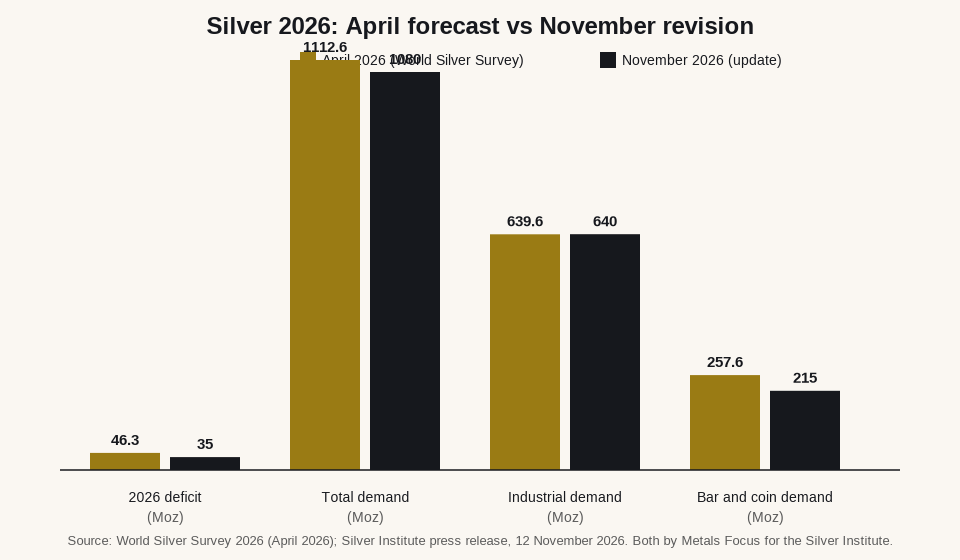
The April and November 2026 forecasts compared. Sources: World Silver Survey 2026 (April 2026); Silver Institute press release, 12 November 2026. Both produced by Metals Focus for the Silver Institute.
Supply holds, recycling climbs
Total mined supply is expected to edge down by 0.5 percent to 834 million ounces, as lower output in Peru, China and Argentina offsets gains in Mexico, Russia and Morocco. Primary silver mine production is forecast to rise by 6.5 million ounces to 233 million ounces in 2026. Mexican production is forecast to increase by 6.6 million ounces to 174 million ounces, supported by improved grades and recoveries at Peñasquito, the restart of Tizapa and Terronera’s first full year of commercial operations.
At the same time, mining the metal has become markedly more expensive. In the first half of 2026, average all-in sustaining costs for primary silver mines jumped by 47 percent to US$16.27 an ounce, reflecting lower ore grades, higher input costs, royalties and sustaining capital expenditure, the Silver Institute said. However, strong silver prices in the first half meant margins for these mines surged 187 percent to US$62.19 an ounce.
Recycling is forecast to rise by 6 percent to 210 million ounces in 2026, its highest level since 2012, against 211.3 million ounces forecast in April. Higher industrial scrap supply, largely reflecting structural factors, is the main contributor. Jewellery recycling is also expected to increase, particularly in China, India and Turkey, as elevated prices encourage selling.
Meanwhile, the investment side of the market has turned. Silver exchange-traded product holdings have recovered by 24 million ounces since end-June, partially reversing the first-half outflows, but by 3 November global holdings stood at 1.25 billion ounces, down 4 percent or 55 million ounces since the start of the year. For the full year, Metals Focus is forecasting net outflows of 45 million ounces. That is a 75 million ounce turn from April, when the survey forecast a net rise of 30 million ounces in ETP holdings for the year.
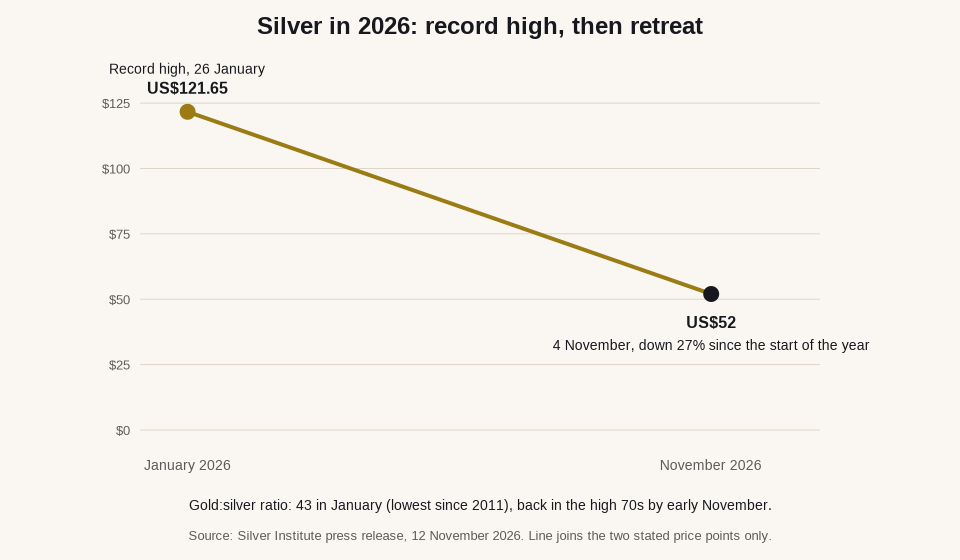
Silver’s 2026 price arc, from record high to November retreat. Source: Silver Institute press release, 12 November 2026.
A narrower deficit is not a comfortable market
The silver market is forecast to record a deficit of 35 million ounces in 2026, bringing the cumulative shortfall for 2021 to 2026 to approximately 746 million ounces, the Silver Institute said. The narrower shortfall and metal released through ETP selling have helped ease physical market tightness.
That easing should not be mistaken for surplus. The April survey warned that the drawdown of above-ground stocks over the past five years leaves the silver market vulnerable to elevated bursts of reduced liquidity, volatile prices, premiums and lease rates. Five consecutive deficits preceded this year’s: 83.7 million ounces in 2021, 254.0 million in 2022, 200.1 million in 2023, 137.9 million in 2024 and 40.3 million in 2025, on the survey’s own table. The 2026 deficit is the smallest of the six, but it is still a deficit, and it still has to be met from stocks that have been drawn down for five years.
The shape of the revision matters as much as its size. The deficit narrowed because demand fell, not because supply rose. Mine production is forecast to edge down, and the demand that disappeared was the price-sensitive kind: jewellery, silverware, solar cells and retail bars and coins. The demand that held up was the industrial kind that has few substitutes at short notice: automotive uses supported by vehicle electrification and expanding charging infrastructure, and brazing alloys and solders edging higher. A market that balances only when prices rise high enough to ration fabrication demand is a market that has not solved its supply problem.
For Australian investors, the direct read-through is limited but real. Silver is rarely mined alone in Australia: it arrives as a by-product of gold, lead and zinc operations, and as the principal metal at a small number of primary silver mines. The price arc of 2026, a record high in January and a 57 percent retreat by November, sets the margin backdrop for every one of them, and the 47 percent rise in primary miners’ sustaining costs sets the floor under it. DrillTape’s coverage of Iltani Resources shows the other side of the same metal: a Queensland silver project growing on drilling, not on price.
What to watch next
The revision leaves an open question: whether a deficit cut by almost a quarter in seven months is a market rebalancing or a pause before the next squeeze. Five tests will answer it.
First, the next Silver Institute update, and whether the 35 million ounce figure holds or moves again. Second, Chinese photovoltaic installations, which fell short of expectations this year and decide how much silver the solar industry absorbs. Third, Indian jewellery demand, where weaker rural spending and lighter products cut the deepest. Fourth, ETP flows, which released metal into the market this year and are forecast to end it 45 million ounces lighter. Fifth, Mexican mine supply, which carries the growth in primary production through Peñasquito, Tizapa and Terronera.
Silver’s sixth consecutive deficit is now a smaller one. The metal’s price has already shown what happens when a market that has drawn down its stocks for five years meets a rush of investment demand, and the November figures show what happens when that price then does its work on demand. The next update will show whether the balance holds.
Sources
- The Silver Institute, “Silver Market Set for Sixth Consecutive Annual Deficit in 2026”, 12 November 2026: https://silverinstitute.org/silver-market-set-for-sixth-consecutive-annual-deficit-in-2026/
- The Silver Institute / Metals Focus, “World Silver Survey 2026”, April 2026 (PDF): https://silverinstitute.org/wp-content/uploads/2026/04/World-Silver-Survey-2026.pdf