
Ballard Mining (ASX: BM1) has set out a standalone development plan for its Mt Ida gold project in Western Australia’s Eastern Goldfields, targeting a feasibility study and a maiden ore reserve by mid-2027. The plan was outlined at the company’s annual general meeting in Perth on 27 November 2026.
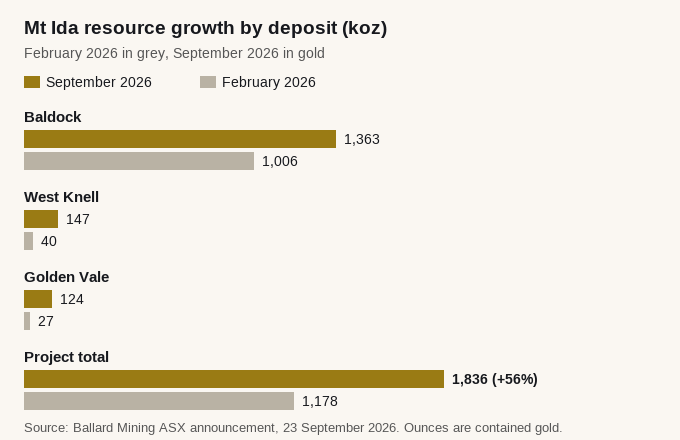
Mt Ida sits about 540 kilometres north-east of Perth and holds 20.4 million tonnes at 2.8 grams per tonne gold for 1.84 million ounces. The September estimate added 658,000 ounces, a 56% lift on the February estimate.
Baldock carries the plan. The cornerstone deposit holds 12.2 million tonnes at 3.5 grams per tonne for 1.36 million ounces, about three-quarters of the whole resource. Its grade is unchanged from February, and 647,000 ounces sits in the higher-confidence Indicated category at 3.9 grams per tonne, including 437,000 ounces in the open-pit estimate.
“The increase in the Mt Ida Gold Mineral Resource to 1.84 Moz represents a significant milestone for Ballard and highlights the quality and scale of the project,” managing director Paul Brennan said when the September estimate was released.
Ballard reported about A$89 million in cash at 30 September on a pro-forma basis after its October placement, and a market capitalisation of about A$293 million at 26 November.
How does the two-phase plan work?
The first phase, covering years one to five, draws ore from an open pit at Baldock, supplemented by regional open pits at West Knell, Golden Vale and Kestrel. All of those deposits sit on granted mining leases.
The second phase brings underground mining at Baldock into the plan, alongside additional regional open pits including Jupiter, Ayla-Pulsar-Neptune, Pluto and Astro-Quasar.
Ballard’s planning goal since listing has been a resource base that supports a 10-year mine life at 100,000 ounces a year. The company states plainly that this is not a production target. It is the goal that shapes the drilling program, and the company is targeting growth to more than 2 million ounces of resource.
The shape of the resource suits the staging. The open-pit estimate holds 970,000 ounces in 12.4 million tonnes at 2.4 grams per tonne, while the underground estimate holds 866,000 ounces in 7.9 million tonnes at 3.4 grams per tonne. Almost all of the underground ounces, 98%, sit at Baldock.
What is the drilling doing?
Infill drilling is finished at Golden Vale and Kestrel. A program of about 40,000 metres at West Knell is due to finish in January 2027, and the next resource update, due in the March quarter, will take in drilling completed up to January.
The infill campaign is targeting the conversion of about 900,000 ounces of Inferred resources to the Indicated category. Ballard says there is no certainty the drilling will achieve that objective.
At Kestrel, infill holes reported on 18 November returned some of the widest intersections recorded at Mt Ida. Hole KSGC009 returned 32 metres at 2.4 grams per tonne gold from 59 metres, and hole KSGC007 returned 27 metres at 1.3 grams per tonne from 60 metres. A narrower hit of 3 metres at 11.2 grams per tonne came from 15 metres.
“The infill program at Kestrel has provided some of the widest intersections across the project to date,” Brennan said.
Kestrel holds 1.02 million tonnes at 1.6 grams per tonne for 53,000 ounces, all of it in the Inferred category. The infill work is designed to lift confidence in the geology and the grade continuity enough to support a higher classification.
At Baldock, drilling found mineralisation outside the current resource but inside the existing open-pit shell, including 7 metres at 2.5 grams per tonne from 77 metres and 5 metres at 3.2 grams per tonne from 21 metres. Across Baldock and Kestrel, 40 holes were drilled for 6,876 metres in September and October.
What is already in place?
Mt Ida has a head start on permitting. Ballard holds an approved mining proposal and mine closure plan covering open-pit and underground mining at Baldock, and works approval for a 2.0 million tonne per annum processing plant and a tailings storage facility.
A groundwater licence covers 3.7 gigalitres a year, eight production bores are installed, and the diversion of the Mt Ida public road around the proposed Baldock mining area is complete. All of the mineral resources sit on granted mining leases.
Ballard is running internal studies on the expanded resource to set processing plant design parameters ahead of detailed engineering work. Geotechnical studies and metallurgical test work at Golden Vale and West Knell are among the activities feeding the feasibility study.
The company plans detailed plant engineering and construction of its 250-person accommodation village during 2027, with a final investment decision targeted for the closing months of the year, according to Small Caps’ report of the annual general meeting presentation, later than the mid-2027 timing in the company’s 9 November presentation.
No capital cost, operating cost, production rate or project return has been published. The feasibility study is the test that will put numbers to the plan.
Ballard’s gold ground came from Delta Lithium (ASX: DLI). Under a Mineral Rights Deed, Ballard holds the exclusive rights to gold at Mt Ida, while Delta retains the rights to all other minerals. Ballard stopped being a Delta subsidiary on 9 July 2025, when it listed on the ASX, and Delta still holds 29.9% of Ballard, escrowed until 14 July 2027.
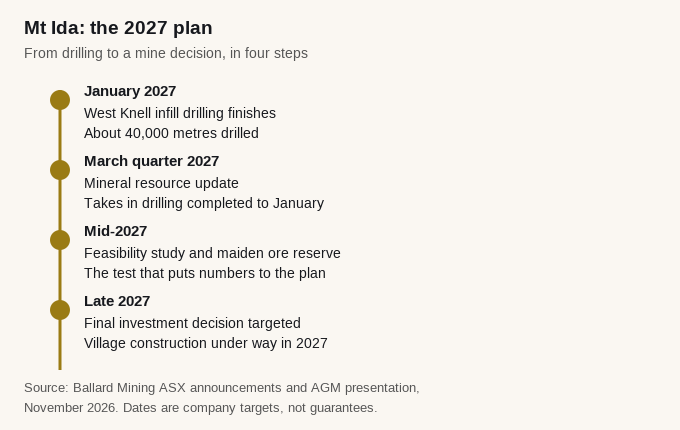
The March-quarter resource update is the next checkpoint. It will show whether the infill drilling has lifted enough of the resource into the Indicated category to support the feasibility study and the maiden ore reserve due in the middle of the year.
Sources
- Ballard Mining, Mt Ida Gold Resource increases 56% to 1.84 Moz, ASX announcement, 23 September 2026 (primary source for the resource estimate, deposit figures and the Brennan quote).
- Ballard Mining, Company Presentation - Canaccord Noosa Mining Conference, ASX announcement, 9 November 2026 (primary source for the two-phase plan, the 10-year planning goal, the +2Moz target, permitting, cash, market capitalisation and the Delta Lithium holding).
- Ballard Mining, September 2026 Quarterly Activities Report, ASX announcement, 26 October 2026 (primary source for the Delta Lithium relationship, the Mineral Rights Deed and the cash position).
- Ballard Mining, Drilling delivers growth beyond current MRE, ASX announcement, 28 October 2026 (primary source for the project location and the standalone strategy).
- Ballard Mining, Notice of Annual General Meeting, ASX announcement, 26 October 2026 (primary source for the 27 November 2026 meeting date and venue).
- Ballard Mining, Drill results continue to build confidence in 1.84 Moz MRE, ASX announcement, 18 November 2026 (primary source for the Kestrel and Baldock intercepts and the second Brennan quote; ASX announcement of 18 November 2026, accessed via the Market Index mirror of the ASX announcement).
- Small Caps, Ballard Mining Maps Out Standalone Development for Mt Ida Gold Project, 27 November 2026 (reporting of the annual general meeting presentation).
- Middle News, Ballard maps 2027 path from 1.84Moz resource to Mt Ida feasibility study, 27 November 2026 (reporting of the annual general meeting presentation).
- Kalkine Media, Ballard Mining Chairman Simon Lill Highlights 232,000m Drilling and 1.84Moz Mt Ida Resource Expansion at 2026 AGM, 27 November 2026 (reporting of the annual general meeting presentation).