
Marimaca Copper (TSX: MARI; ASX: MC2) has won the mining method permit for its Marimaca Oxide Deposit (MOD) in northern Chile, clearing the way for site preparation and bulk earthworks to start at the copper project. Shares in Marimaca were up 6.85 per cent at A$6.86 in Sydney at the time of writing, valuing the company at about A$828 million.
The permit is the Método de Explotación de Minas (Mining Method) Sectorial Permit, granted by Chile’s National Geology and Mining Service, SERNAGEOMIN, to Marimaca’s wholly owned subsidiary, Compañía Minera Cielo Azul Limitada. Marimaca announced the approval on 26 November, and it was lodged on the ASX before the open on Friday 27 November.
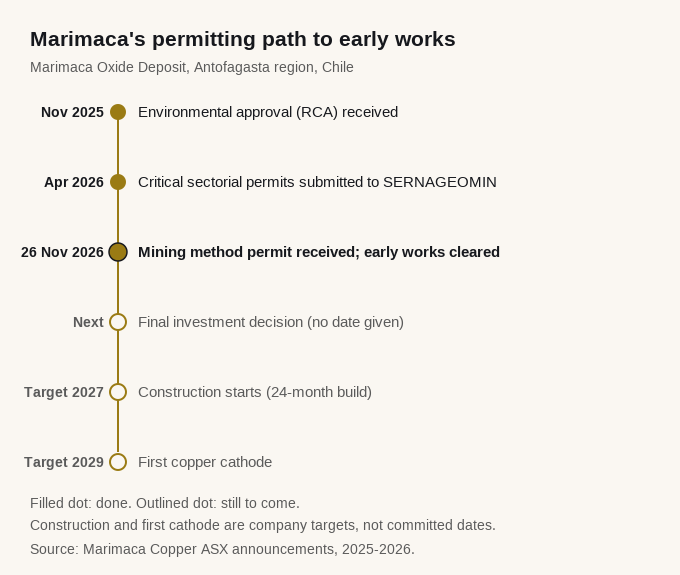
It is the second major approval for the MOD. The project won its environmental approval, the RCA, in November 2025. Marimaca lodged the critical sectorial permits with SERNAGEOMIN in April 2026, covering the closure plan, the open-pit mining method and approvals for the crushing plant, leaching pads and waste storage. The company had expected those approvals in the fourth quarter of 2026, and this one has landed on schedule.
The permit does not green-light the mine itself. Full-scale construction still needs a positive final investment decision from Marimaca’s board, and the company has given no date for it. What the permit does is let money go into the ground on early works while that decision is still to come.
“The receipt of the Método de Explotación Sectorial Permit builds on the RCA (Environmental Approval) received in November 2025 and is another major milestone for the MOD, allowing for the commencement of the fully funded early works construction activities at the project,” José Antonio Merino, Marimaca’s managing director in Chile, said.
Merino said the Chilean team continues to advance the MOD through detailed engineering, initial procurement and early works as it moves towards a final investment decision.
The MOD sits about 40 kilometres from Antofagasta and 25 kilometres from the port of Mejillones, in Chile’s main copper-producing region. Marimaca calls it one of the few globally significant greenfield copper discoveries of the last decade. Chile remains the world’s largest copper-producing country, a position the Democratic Republic of Congo is closing in on. The company also holds the Pampa Medina and Madrugador exploration properties 30 kilometres from the deposit.
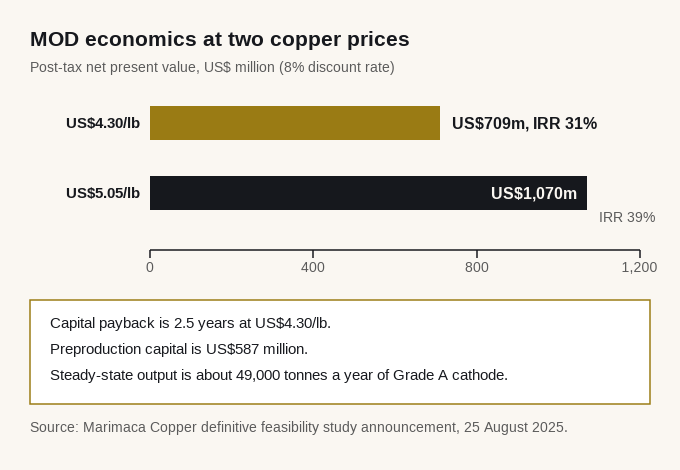
An August 2025 definitive feasibility study sized the MOD as a 50,000-tonne-a-year copper cathode operation over a 13-year reserve life, built for US$587 million. Reserves stand at 178.6 million tonnes at 0.42 per cent copper for 750,000 tonnes of contained copper, inside a measured and indicated resource of 213.5 million tonnes at 0.40 per cent copper. A further 21.2 million tonnes at 0.29 per cent copper sits in the inferred category and is treated as waste in the study’s mine plan.
The study put the post-tax value of the project at US$709 million, with a 31 per cent return, at a long-term copper price of US$4.30 a pound. At US$5.05 a pound, the value rises to US$1.07 billion with a 39 per cent return. Steady-state production in years two to ten is put at about 49,000 tonnes a year of Grade A cathode, from a simple open pit with a life-of-mine strip ratio of 0.8 to 1.
What the permit unlocks
Site preparation and bulk earth movement can now start. Marimaca describes the early works as fully funded, and it held about US$127 million in cash at the end of September.
Work already under way includes upgrades to the primary access road, which the company expects to finish by the end of 2026. The project also has its grid connection authorised, to the 110-kilovolt El Lince line about 13 kilometres from the site.
At this stage the early works are about getting the site ready, not building the mine. The crushing plant, the leaching pads and the processing plant all sit on the other side of the investment decision.
What still has to happen
Three things stand between Marimaca and a producing mine. The first is the board’s final investment decision, for which no date has been given. The second is the rest of the sectorial permits: the company said in May it would keep submitting the remaining approvals needed to support construction. The third is the money to build it.
Marimaca is targeting construction from 2027, with a 24-month build and first cathode in 2029. Those are the company’s targets, not committed dates, and both depend on the investment decision and the financing landing first.
How the build will be paid for
The financing took a step forward this week. On 25 November, Marimaca said Sprott Resource Lending’s investment committee had approved a proposed financing package of up to US$450 million for the MOD.
The package is up to US$425 million in senior secured project finance plus up to US$25 million in equity investment from Sprott. A non-binding term sheet has been signed. An initial US$100 million would be released once the investment decision is made, subject to the usual conditions.
The facility runs for 7.5 years and carries interest of 5.75 per cent a year plus the greater of the secured overnight financing rate or 2.75 per cent. Principal repayments start on 31 March 2031. The deal still needs legal and financial due diligence, definitive agreements and the usual closing conditions before any money moves.
Marimaca has now cleared the two approvals it needed to start putting money into the ground: the environmental approval a year ago, and the mining method permit this week. The next catalyst is the one the permit does not give it, the board’s decision to build.
Sources
- Marimaca Copper Corp., Marimaca Receives Sectorial Permit for MOD Construction, 26 November 2026 (primary source for the permit, the quote and the early-works scope; authorised for release, including to the ASX, by the Board of Directors). ASX announcement: https://www.asx.com.au/asx/v2/statistics/displayAnnouncement.do?display=pdf&idsId=03171584
- Marimaca Copper Corp., MOD Feasibility Study Confirms Robust Capital Intensity and 31%+ IRR; Maiden Ore Reserve, 25 August 2025 (primary source for the DFS production, capital, reserve, resource and economics figures).
- Marimaca Copper Corp., Marimaca Provides Positive Progress Update on the MOD and Sulphuric Acid Strategy, 19 May 2026 (primary source for the April 2026 sectorial permit submissions and the Q4 2026 approvals window).
- HotCopper, Marimaca Copper secures US$450m Sprott financing package for MOD plans in Chile, 25 November 2026 (Sprott package terms, corroborated by Australian Resources & Investment and REDIMIN).
- MINING.COM, Chile clears Marimaca to start early copper mine works, 26 November 2026 (story hook).