
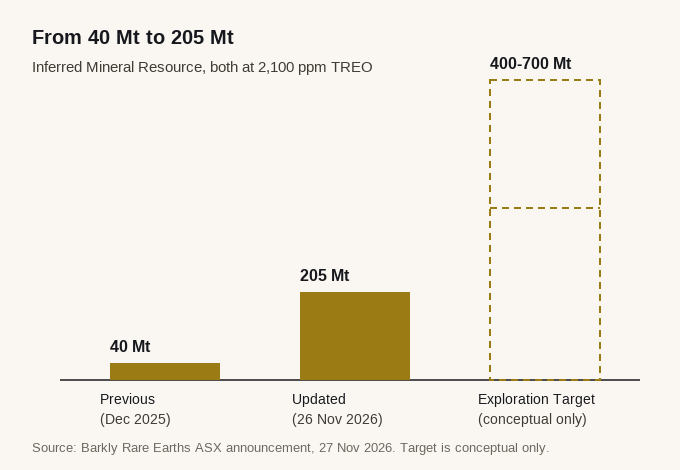
Barkly Rare Earths (ASX: BAK) has lifted the Inferred Mineral Resource at its 100%-owned Barkly Project in the Northern Territory five-fold to 205 million tonnes at 2,100 parts per million total rare earth oxides (TREO), including 700 parts per million magnet rare earth oxides (MREO).
The new estimate holds the same grade as the 40 million tonne resource it replaces. Contained TREO rises from 84,000 tonnes to 420,000 tonnes, including 140,000 tonnes of contained MREO.
Magnet oxides make up 34 per cent of the TREO grade. That share is where most of the value in a rare earths deposit sits, and Barkly says its MREO concentration is high against regolith-hosted peers, though many of those peers include Measured and Indicated resources and are further advanced.
The whole resource is classified Inferred, the lowest confidence category under the JORC Code. It is a resource, not a reserve, and no Indicated or Measured tonnes are reported.
The estimate was prepared by resource specialist RSC and is reported above a 570 parts per million MREO cut-off, inside an optimised pit shell. The previous estimate used a cut-off equivalent to about 450 parts per million MREO.
“This first update of our Inferred Mineral Resource from 40 to 205 million tonnes without sacrificing grade is a great outcome and just the start of what we believe may become a globally significant resource,” managing director Craig Wright said.
Barkly drilled 129 vertical reverse circulation holes for 3,216 metres between 19 July and 18 November 2026, stepping out on about 800-metre spacing across the corridor between its two prospects, Vanadis and Benmara. Laboratory results from 98 of those holes inform the new estimate.
Assays from the remaining 31 holes are expected through February 2027. The estimate also draws on 46 vertical aircore holes for 755 metres drilled in 2022.
The mineralisation is shallow and flat-lying, averaging 2 metres thick, from surface to about 38 metres deep. The pit shells average about 18 metres deep and reach a maximum of about 37 metres.
The rare earths sit in a near-horizontal horizon at the contact between the Bukalara Sandstone and the Cretaceous Mullaman Beds. The horizon has been intersected across 24 kilometres and remains open to the west, south and east.
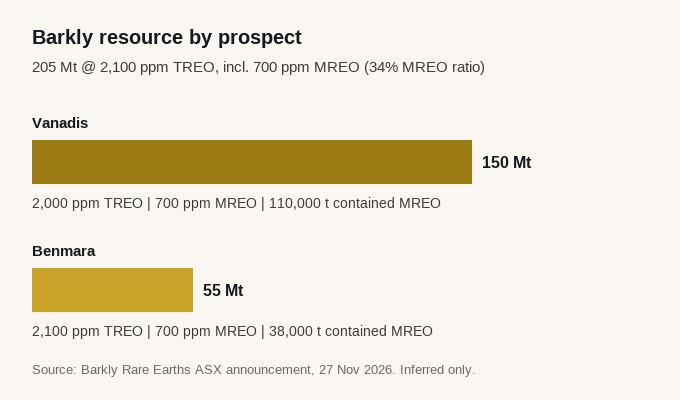
Vanadis carries the bulk
Vanadis holds 150 million tonnes at 2,000 parts per million TREO and 700 parts per million MREO, for 310,000 tonnes of contained TREO and 110,000 tonnes of contained MREO. Its MREO ratio is 35 per cent.
Benmara holds the other 55 million tonnes at 2,100 parts per million TREO and 700 parts per million MREO, for 110,000 tonnes of contained TREO and 38,000 tonnes of contained MREO. Its MREO ratio is 33 per cent.
Both prospects grade 670 parts per million neodymium-praseodymium, the two magnet oxides that dominate the MREO basket. Vanadis holds almost three-quarters of the total tonnage.
About 20 per cent of the resource is based on extrapolated modelling beyond the nominal 800-metre drill spacing. The rest sits within the drilled area, and the Inferred area extends up to about 1,200 metres from drilling.
Can the magnet oxides be pulled out?
Early sighter tests using pre-treatment followed by acid leach extracted between 97 and 99 per cent of the MREO to leach solution on one composite. Downstream product recovery still has to be tested.
The same tests put 90 to 94 per cent of the yttrium into those leach streams. Barkly plans further metallurgical testwork on more representative samples.
Uranium and thorium, which can add cost and complexity to rare earths processing, are low. The resource averages 2.3 parts per million uranium and 7.7 parts per million thorium.
Beyond the resource, Barkly has defined a conceptual Exploration Target of 400 to 700 million tonnes at 1,600 to 2,200 parts per million TREO, including 500 to 800 parts per million MREO. The target is conceptual in nature, there has been insufficient exploration to estimate a Mineral Resource over that ground, and it is uncertain whether further exploration will result in one.
The company plans to test the target with the remainder of its Phase 1 program, about 6,800 metres of shallow drilling in about 270 holes, mostly inside the target area.
What comes next
A further Mineral Resource update is scheduled for the first quarter of calendar 2027, once the 31 pending assays are in. The remainder of the Phase 1 program is scheduled to resume in the second quarter of 2027.
Passing the 200 million tonne milestone could allow Barkly to start technical workstreams for a Scoping Study. Wright said the best ground may still be undrilled, and the company will do preparatory work, including metallurgical testwork, over the coming months before considering mining and economic studies.
The 31 pending assays are the next numbers to watch. They will show whether the mineralised horizon keeps its width and grade beyond the 98 holes in this estimate.
The resource and Exploration Target information in the announcement was compiled by René Sterk of RSC, the Competent Person. Sterk is also a Non-Executive Director of Barkly Rare Earths and the principal shareholder and managing director of RSC, an association the announcement discloses.
Sources
- Barkly Rare Earths, Five-fold Growth in Rare Earth Inferred Mineral Resource to 205 Mt @ 2,100 ppm TREO, ASX announcement, 27 November 2026 (51 pages; primary source for all figures, quotes and dates in this article).
- Barkly Rare Earths ASX releases cited in the announcement: “Highest-Grade Intercept Recorded Yet at the Barkly Rare Earths Project”, 23 November 2026; “Barkly Achieves 99% Magnet Rare Earth Oxide Extraction in Sighter Test”, 31 August 2026; Prospectus dated 1 December 2025 (previous 40Mt resource).