
The most shorted stock on the ASX changed hands on a technicality, not on a trade.
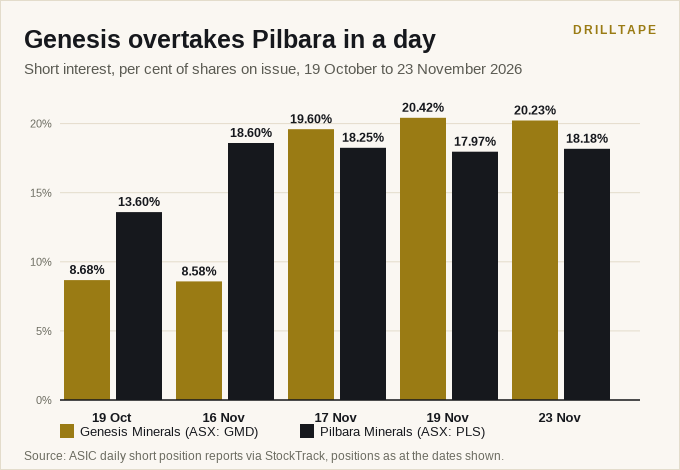
Genesis Minerals (ASX: GMD) held 20.23 per cent of its shares sold short as at 23 November, or 237.7 million of 1,175.1 million shares on issue, according to ASIC’s daily short position reports. Pilbara Minerals (ASX: PLS) sat second at 18.18 per cent, or 586.4 million of 3,225.9 million shares, a week after holding the top spot itself.
The ranking carries a qualification. Two exchange-traded funds sit above Genesis on an all-securities list, an iShares world equity income fund at 45.39 per cent and a leveraged Nasdaq fund at 22.93 per cent. Genesis is the most shorted ordinary listed company, and Pilbara the second, which is the crown The West Australian’s headline is talking about.
How did Genesis get there in a day?
Genesis did not climb to the top of the table. It jumped there in a single day. Short interest stood at 8.58 per cent, or 100.8 million shares, on 16 November, when Genesis ranked 26th.
The next day it was 19.60 per cent, or 230.3 million shares, and Genesis ranked first. The reported short position grew by 129.5 million shares, or 11.02 percentage points, in one session.
The date is the clue. 17 November was the day the Vault scheme became effective, after the Supreme Court of Western Australia approved it the day before, and Vault shares were suspended from trading at the close that day. Nothing else in Genesis’s news explains a move of that size in a single session. The spike is deal-linked in its timing, and the peak of 20.42 per cent followed two days later, on 19 November.
What the data does not show is who is short, or why. ASIC publishes one aggregate total per company and names no seller, and no trader or fund has been linked publicly to the jump. Positions built around a takeover are often hedges, with traders holding the target and shorting the bidder, but that is a description of how such positions usually work, not evidence about these ones. The file records the size of the bet, not the motive behind it.
FNArena’s weekly short report, which draws on the same ASIC data, tells the same story for the week ending 19 November: Genesis at 20.42 per cent and Pilbara at 17.97 per cent.
Why the crown should change hands again
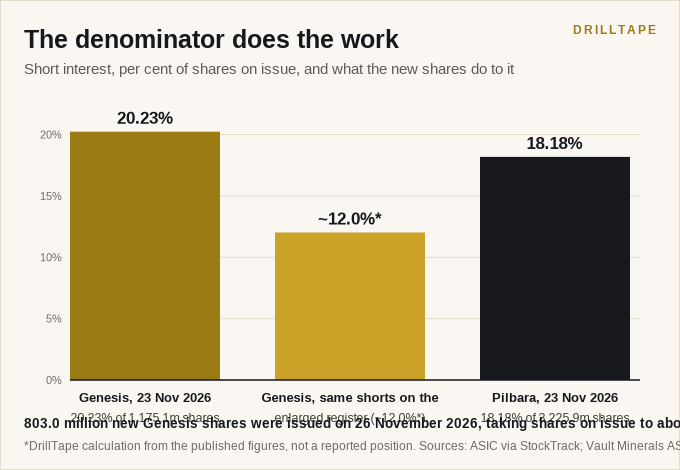
The reason Pilbara is set to take the title back is arithmetic, and it was fixed before the scheme was even implemented. Genesis issued 803,038,256 new shares to Vault shareholders when the scheme was implemented on 26 November, along with $539.5 million in cash, for all 1,052,612,872 Vault shares. That lifts Genesis’s shares on issue from 1,175.1 million to about 1,978.1 million.
Hold the short position steady at the 237.7 million shares reported on 23 November, and the same bet equals about 12.0 per cent of the enlarged register, well below Pilbara’s 18.18 per cent. That is a DrillTape calculation from the two published figures, not a reported position, and it assumes no short seller adds or covers in the meantime. But the direction is mechanical: the denominator grows by more than two-thirds, so the percentage has to fall.
The published data has not caught up yet. ASIC reports positions four business days after the trade date, so the first prints covering the enlarged register, for positions held on 26 November, are due around 2 December. Until then the reclaim is expected, not recorded. That is the quirk The West Australian’s headline points to: a crown won on deal mechanics, and lost the same way.
The bear case
For Pilbara, the short position is not a quirk. It is a judgement about lithium, and it has been building for weeks. Short interest rose from 13.60 per cent on 19 October to 18.60 per cent on 16 November, a climb of five percentage points in a month, before Genesis’s jump pushed it to second place. At 17.5 days to cover on average volume, the position would take more than three trading weeks to unwind.
The concern, as the Motley Fool put it in its weekly short report on 23 November, is lithium price volatility and the substantial capital expenditure behind Pilbara’s $1.9 billion P2000 expansion. The company is spending heavily to grow production into a lithium market that has punished optimism before. Short sellers are betting that the timing is wrong, or that the price does not cooperate.
Genesis carries its own warning in the same numbers. A short position above 20 per cent, with 21.3 days to cover, is a large bet against a gold producer that has just doubled in size, and it will need buyers to close. If the merged group stumbles on integration, or the gold price turns, that overhang becomes selling pressure of its own.
The bull case
Pilbara’s answer is in its operations. The company reported record quarterly production and lower costs at its Pilgangoora operation, the Motley Fool noted on 9 November, and it is the largest pure-play lithium producer on the ASX, according to Kalkine. A short position of 18 per cent against a producer cutting costs is a bet that the market stays weak, not that the mine fails.
Genesis’s answer is scale. The merged group is Australia’s third-largest gold producer, with pro forma production of 625,000 to 675,000 ounces in 2026-27, and Genesis puts the post-tax synergies from combining its Leonora operations with Vault’s at about $2.0 billion over ten years. Fund managers quoted by Thesis Tracker are already leaning that way: Solaris Investment Management names Genesis its preferred near-term opportunity, and Seneca Financial Solutions says the market underappreciates its assets.
There is also the arithmetic of the squeeze. Short sellers must eventually buy back the shares they borrowed, and 237.7 million Genesis shares against average daily volume implies more than four trading weeks of buying to close the position. Any good news for the merged group, a strong quarterly or a firm gold price, would force that buying into a market with fewer sellers than usual.
What to watch
The first test arrives with the ASIC file itself. Positions held on 26 November, the implementation date, are published around 2 December, and the 27 November positions a day later. Those two prints will show whether Genesis’s short percentage fell to the low teens as the maths implies, or whether short sellers added to their positions as the new shares landed. Vault’s removal from the official list, due after the close of trading on 27 November, closes the deal’s own chapter.
Beyond the file, the next markers are Genesis’s first quarterly report as the combined group, for the December quarter, and Pilbara’s progress on the P2000 expansion. The first will show whether the merged Leonora operations are delivering the production the merger promised. The second will show whether the spending that worries the shorts is buying growth or trouble.
The open question is not who holds the crown next week. On the published numbers, that is already settled in Pilbara’s favour. It is whether Genesis’s short position unwinds with the deal, or stays: a bet that outlives its own quirk, and a crown Pilbara would then hold for a different reason entirely.
Sources
- ASIC short position data via StockTrack, Genesis Minerals (ASX: GMD) Short Interest & Short Position History (data as at 23 November 2026; primary data source for all Genesis figures, the daily series and the ranking; ASIC data published on a T+4 basis).
- ASIC short position data via StockTrack, Pilbara Minerals (ASX: PLS) Short Interest & Short Position History (data as at 23 November 2026; primary data source for all Pilbara figures, the daily series and the ranking; ASIC data published on a T+4 basis).
- Vault Minerals, Final Outcome of Scheme Consideration Elections, ASX announcement, 23 November 2026 (803,038,256 new Genesis shares and $539,491,874.72 cash for 1,052,612,872 Vault shares; implementation 26 November 2026).
- Vault Minerals, Scheme Becomes Effective, ASX announcement, 17 November 2026 (scheme legally effective 17 November; Vault shares suspended from close of trading 17 November).
- Australian Mining, Genesis and Vault merger finale creates gold powerhouse, 27 November 2026 (implementation 26 November; pro forma FY27 production 625,000-675,000 ounces; shareholder vote 99.74 per cent).
- FNArena, The Short Report - 26 Nov 2026, 26 November 2026 (week ending 19 November: Genesis 20.42 per cent, Pilbara 17.97 per cent).
- Motley Fool Australia, These are the 10 most shorted ASX shares, 23 November 2026 (Pilbara short rationale: lithium price volatility and P2000 expansion capital expenditure).
- Motley Fool Australia, These are the 10 most shorted ASX shares, 9 November 2026 (Pilbara record quarterly production and lower costs at Pilgangoora; P2000 expansion $1.9 billion).
- Kalkine Media, Shorts Circle: Why Are Sellers Targeting ASX 200’s PLS Group (ASX:PLS)? (Pilbara the largest pure-play lithium producer on the ASX).
- The Distributed, GEN MINS (ASX: GMD) short positions rose to 19.6% of shares, 26 November 2026 (ASIC data names no seller and states no motive; the percentage moves when either the short count or the shares on issue moves).
- shortinterest.au, Most shorted ASX securities (all-securities ranking: WYNC 45.39 per cent, LNAS 22.93 per cent above Genesis).
- Thesis Tracker, Genesis Minerals Ltd (ASX:GMD): fund manager commentary (Solaris Investment Management names Genesis its preferred near-term opportunity; Seneca Financial Solutions says the market underappreciates its assets; Milford Asset Management on operating synergies).
- The West Australian, PLS set to reclaim ASX’s most shorted crown from Genesis Minerals after $5.7b deal quirk (headline and teaser only; paywalled, full text not accessed).
- DrillTape, Genesis completes Vault merger to create Australia’s third-largest gold producer (merger completion; 0.7629 new Genesis shares plus cash per Vault share; about $2.0 billion in post-tax synergies over ten years).