
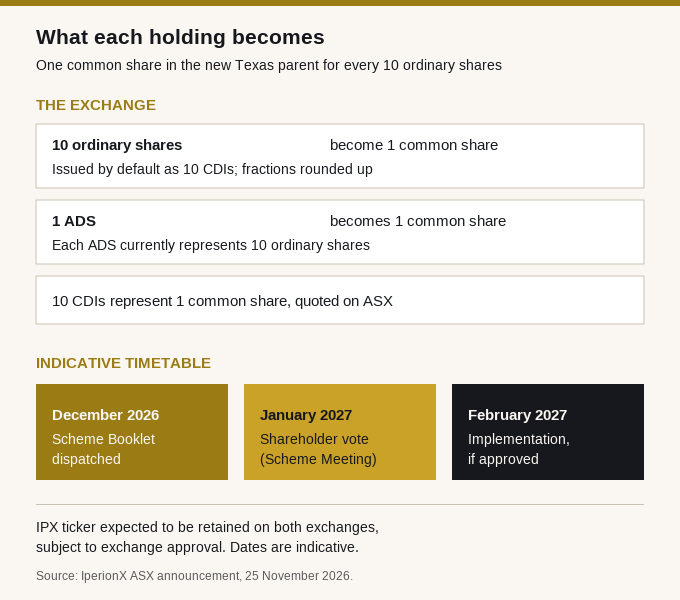
IperionX Limited (NASDAQ: IPX, ASX: IPX) has signed a scheme implementation deed with IperionX Inc., a Texas-incorporated company, to move its parent company to the United States and make Nasdaq its primary listing. Under the deal, holders of 10 ordinary shares would receive one common share in the new US parent.
The new parent’s common shares would list directly on Nasdaq, replacing IperionX’s American depositary shares, the receipts through which its US line currently trades. Australian investors would keep local access through CHESS depositary interests, or CDIs, quoted on ASX in place of the ordinary shares. IperionX expects to keep the IPX ticker on both exchanges, subject to exchange approval.
The move follows the redomiciliation plan IperionX announced on 3 August 2026. All of its operations sit in the United States: titanium production and advanced manufacturing in Virginia, the Atlas-Titan critical minerals platform in Tennessee, and titanium technology research and development in Utah.
The board says the switch lines up the company’s legal home with the business it actually runs. A US parent, it argues, should broaden the institutional investor base, deepen access to US equity and debt markets, and strengthen its standing with US government partners and commercial customers.
There is a compliance reason as well. If IperionX stayed domiciled in Australia and ceased to qualify as a US foreign private issuer, it would face full US domestic issuer reporting alongside its Australian requirements. A US domicile removes that duplicated burden.
“We are building an American titanium business with the resources, technologies and manufacturing capabilities to strengthen domestic supply chains. Establishing a U.S. parent aligns our corporate structure with the American titanium business we are now scaling,” executive chair Todd Hannigan said.
Chief executive Taso Arima said the operational focus was scaling domestic titanium manufacturing and delivering commercial-grade products to customers who depend on resilient US supply chains, and that a US parent and direct Nasdaq listing directly supported that strategy.
What shareholders get
The exchange is designed to keep each holder’s economics broadly unchanged. Ten ordinary shares become one common share in the new parent, with any fractional entitlement rounded up to the next whole share.
By default, holders receive 10 CDIs for each common share in their rounded entitlement. Ten CDIs represent one common share. Shareholders may instead elect to hold the Nasdaq-listed common shares directly.
Holders of American depositary shares are treated the same way. Each depositary share currently represents 10 ordinary shares, and each would be exchanged for one common share in the new parent.
Ineligible foreign shareholders and small parcel holders who do not opt out of the sale facility would receive the net proceeds from the sale of their attributable CDIs, rather than securities. The Scheme Booklet will set out who qualifies, how the small-parcel opt-out works, and the elections and deadlines for choosing common shares.
Existing options, performance rights and restricted stock units would be exchanged for corresponding awards in the new parent under separate exchange deeds. The replacement awards reflect the same 10-for-one ratio, with fractional entitlements rounded down.
The board has unanimously recommended shareholders vote in favour of the scheme. The recommendation is subject to the independent expert, RSM Corporate Australia, concluding and continuing to conclude that the scheme is in the best interests of shareholders. Each director who holds or controls shares intends to vote those shares in favour, subject to the same qualification.
Is the Nasdaq switch worth it?
The question is not whether the paperwork is tidy. It is whether a direct Nasdaq listing and a Texas domicile earn IperionX anything its current structure does not already give it.
The case for the move
The board’s case rests on who IperionX now sells to and who funds it. Its customers, strategic relationships and government-supported programs are mostly based in the United States, and its US government awards already total US$59.8 million under the Defense Production Act Title III and Industrial Base Analysis and Sustainment programs.
Funding under those awards is reimbursement of eligible expenditure, and the board says a US parent may strengthen its eligibility and positioning for additional program funding while reducing reliance on equity financing.
The capital markets argument is straightforward. Direct common shares are the standard equity structure for US-focused institutional and strategic investors, where depositary shares are a workaround. The board believes the switch may expand investor participation and improve access to the depth and diversity of US equity and debt capital markets as manufacturing expands and the Atlas-Titan platform develops.
Added to this, the company’s September quarter showed the scale of what the new parent would own. Cash stood at US$63.0 million at 30 September 2026, after a US$50 million US public offering in July, and about US$96.7 million of total available liquidity including US$33.7 million of remaining obligated reimbursable US government funding.
The case for caution
The scheme is proposed, not done, and the announcement says so plainly. There is no certainty it will proceed, and the anticipated funding, capital markets and commercial benefits are not guaranteed.
Implementation needs the requisite majorities of shareholders, Court approval, the independent expert’s continuing favourable conclusion, and regulatory and exchange approvals, including admission of the new parent to the official list of ASX, quotation of its CDIs, and approval of the Nasdaq listing.
The Scheme Booklet, expected in December, will carry the detail that matters to holders: the transaction costs, the changes to shareholder rights, the tax implications and the associated risks. None of that is in the market yet, and the board’s case cannot be judged until it is.
The business behind the listing is also still at the proving stage. The Titan project has a completed feasibility study and a maiden Ore Reserve, but no mine yet, and the integrated Atlas-Titan economic assessment was still underway at 30 September 2026. A listing switch does not change that timetable.
On the board’s own case, the deal reads as a sensible alignment of domicile with operations rather than a revaluation event. The test is not the listing but what follows it: whether the direct Nasdaq line brings in the institutional holders and the government funding the board is counting on.
What IperionX is moving
IperionX is building an integrated American titanium and critical minerals business, from domestic mineral resources and recycled feedstocks through to finished titanium components for defence, aerospace, automotive, consumer electronics and industrial markets.
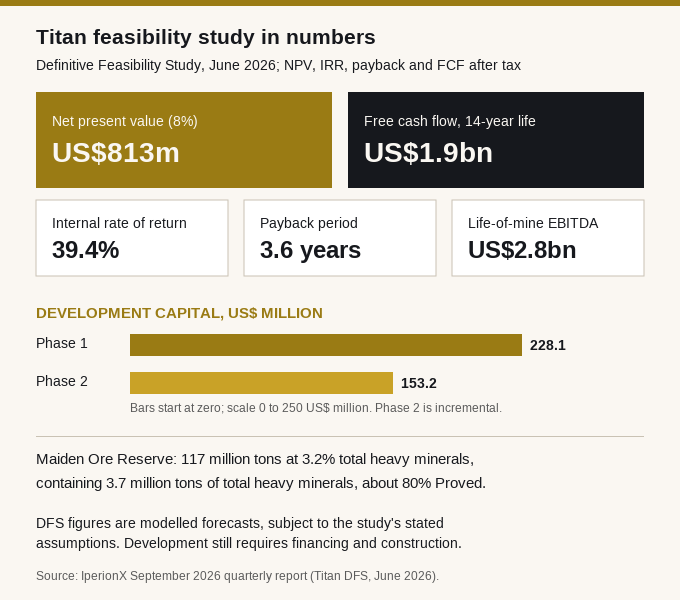
The centre of that plan is the Atlas-Titan critical minerals platform in Tennessee. The Titan project’s definitive feasibility study, completed in June 2026 with US government support, delivered an after-tax net present value of US$813 million at an 8 per cent discount rate, an after-tax internal rate of return of 39.4 per cent, a 3.6-year payback, and US$1.9 billion of cumulative after-tax free cash flow over an initial 14-year mine life.
The study established a maiden Ore Reserve of 117 million tons at 3.2 per cent total heavy minerals, containing 3.7 million tons of total heavy minerals, with about 80 per cent classified as Proved. Phase 2 annual production is forecast at about 5,287 tonnes a year of heavy rare earth concentrate, 118,658 tonnes a year of ilmenite, 24,656 tonnes a year of rutile and 65,668 tonnes a year of zircon concentrate.
Those are modelled outcomes, subject to the assumptions, qualifications and risks set out in the June 2026 study announcement. Development still requires financing, procurement, construction, commissioning and operating performance.
IperionX bought the adjacent Atlas assets for US$3 million, completing the acquisition on 1 July 2026. Atlas adds about 70 acres of at-surface stockpiles and about 180 acres of pre-stripped mineralisation, plus established power, water, natural gas and rail infrastructure.
In Virginia, the titanium manufacturing campus has validated furnace capacity above its 200 tonnes a year target run-rate. It produced 8.7 tons of titanium powder in the September quarter, up from 1.4 tons in the June quarter, and is executing a 1,400 tonnes a year expansion under the US$47.1 million Industrial Base Analysis and Sustainment award and the US$12.7 million Defense Production Act Title III award.
The road to February
The scheme now moves through the timetable IperionX set out on 25 November. The Scheme Booklet, including the independent expert’s report, is expected to be dispatched in December 2026. The shareholder meeting to vote on the scheme is expected in January 2027. If the required approvals are obtained and the other conditions are satisfied or, where permitted, waived, the scheme would be implemented in February 2027.
All three dates are indicative and may change. Shareholders do not need to take any action at this stage.
Schemes are the standard route for this kind of move in Australia. Austral Resources completed its own court-approved scheme takeover of Hammer Metals on 25 November, the same day IperionX signed its deed.
The December booklet is the next thing to watch. It will show the costs, the rights changes and the tax consequences, and the independent expert’s view on whether the scheme is in shareholders’ best interests. The January vote then decides whether Nasdaq becomes IperionX’s primary listing.
Sources
- IperionX Limited, IperionX Executes Scheme Implementation Deed to Advance U.S. Redomiciliation, ASX announcement filed as SEC Form 6-K Exhibit 99.1, 25 November 2026 (primary source for all deal terms, quotes, conditions and dates in this article; the Scheme Implementation Deed is attached to the announcement).
- IperionX Limited, September 2026 Quarterly Report, ASX announcement filed as SEC Form 6-K Exhibit 99.1, 29 October 2026 (primary source for all Titan DFS, Ore Reserve, Atlas, cash and production figures).
- IperionX Limited, IperionX Advances American Titanium Growth Strategy With Proposed U.S. Redomiciliation and Board Appointment, ASX announcement, 3 August 2026 (primary source for the original redomiciliation announcement date).
- Small Caps, IperionX Enters US Implementation Scheme to Make Nasdaq its Primary Listing, 25 November 2026 (discovery hook and cross-check only).
- DrillTape, Austral completes $80.7m Hammer Metals takeover and takes Kalman copper, 26 November 2026.