
Genesis Minerals (ASX: GMD) has completed its merger with Vault Minerals (ASX: VAU). The scheme of arrangement was implemented on Thursday 26 November, with all Vault shares transferred to Genesis.
The combination creates Australia’s third-largest gold producer and a top 20 global gold company, with about 34 million ounces of mineral resources and about 9 million ounces of ore reserves across Western Australia’s Leonora-Laverton region.
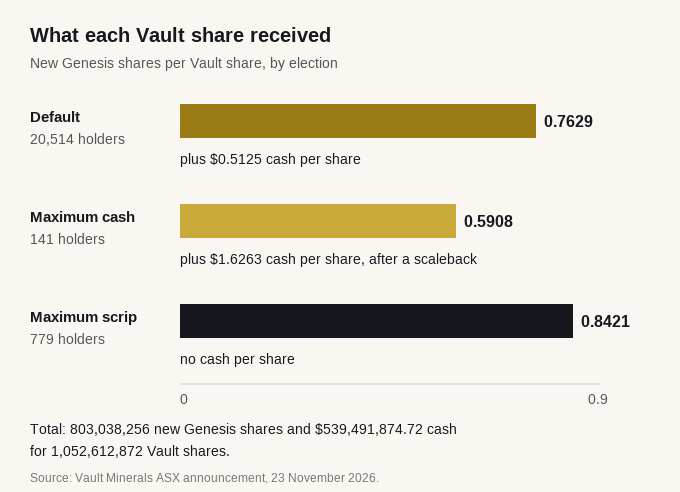
On a pro forma basis, the combined group is expected to produce 625,000 to 675,000 ounces of gold in the 2026-27 financial year. Genesis paid 803,038,256 new shares and $539,491,874.72 in cash for the 1,052,612,872 Vault shares it acquired.
What Vault holders received
Eligible Vault shareholders on the register at 4:00pm AWST on Thursday 19 November received the scheme consideration for every Vault share they held.
Most received the default consideration: 0.7629 new Genesis shares and $0.5125 in cash for each Vault share. That group covered 802,542,503 shares held by 20,514 shareholders.
Shareholders who elected the maximum cash were scaled back, because demand for cash exceeded the pool available under the scheme. They received $1.6263 in cash and 0.5908 new Genesis shares for each Vault share. The 141 holders in that group held 78,811,559 shares.
Shareholders who elected the maximum scrip were not scaled back. They received 0.8421 new Genesis shares for each Vault share and no cash. That group covered 171,258,810 shares held by 779 shareholders.
Vault shareholders now own about 40 per cent of the merged group on a fully diluted basis.
“By bringing together two complementary businesses, we are creating Australia’s third-largest gold producer, strengthening our position in the industry and laying the foundations for long-term success,” Genesis said in its announcement.
Genesis executive chair Raleigh Finlayson had made the same point at the company’s annual general meeting on 12 November, after Vault shareholders backed the deal.
“The Genesis board believes that this transaction is a unique opportunity for both companies. It is a logical and value-accretive combination of nearby assets which will create the third-largest Australian gold producer,” Finlayson said.
Does the deal stack up?
The price is not the question that will decide whether this merger is remembered as disciplined consolidation or as a premium paid at the top of the cycle. Genesis paid mostly in paper, and Vault holders kept a large slice of the upside. The question is whether the two portfolios are worth more together than apart.
The case for the merger
The two companies’ Leonora operations sit within 35 kilometres of each other. Genesis estimates the combination can deliver about $2.0 billion in post-tax, undiscounted synergies over ten years, including about $1.5 billion it says is unique to this pairing and only available because of that proximity.
Finlayson has identified the chance to share processing infrastructure between neighbouring operations, including potentially treating ore from Genesis’s Tower Hill project through the King of the Hills processing facility. Such arrangements could give the combined group more flexibility in deciding how and where individual deposits are developed, while reducing the need for duplicate infrastructure.
The merged group also starts with a strong balance sheet. Genesis reported $598 million in cash and equivalents at the end of the September quarter, after producing 72,107 ounces at an all-in sustaining cost of $2,966 an ounce. At the time the merger was agreed in July, the companies put pro forma net cash at $611 million and pro forma liquidity at $1.4 billion.
The case for caution
The $2.0 billion is an estimate, not a banked saving. It is spread over ten years, and Genesis itself has said that realising the benefits will depend on successful integration and delivering the operational improvements behind its synergy forecasts.
Added to this, the cash scaleback shows the deal’s funding was not without friction. Demand for the maximum cash election exceeded the pool available, so 141 holders took a mix of cash and scrip instead of the cash they asked for.
Tower Hill is also a plan, not a mine. Genesis expects first ore in FY28, but has given no forecast for when its ore might reach King of the Hills. The test of the merger is not the ranking it creates but the timetable: whether the shared infrastructure and the coordinated mine planning arrive, and at what cost.
On the numbers the companies disclosed, the deal reads as a fair price for a strategic combination rather than a bargain or an overpay. The test is execution, and the first evidence of it will be the updated strategic plan for the combined business, due in the June quarter of 2027.
What Genesis buys
Vault brings the King of the Hills mine and processing hub, about 29 kilometres north-west of Leonora. The open pit and underground operation is the centrepiece of Vault’s Leonora business, and the hub is the plant Finlayson wants to feed with ore from neighbouring deposits.
Tower Hill sits in the same district. It is Genesis’s development project, and the one most often named when Genesis talks about processing flexibility. Treating its ore at King of the Hills would avoid building a second plant for a deposit close to an existing one.
The combination also consolidates the Leonora-Laverton region under one owner. Genesis brings its own Leonora and Laverton operations, including the mines that produced 285,402 ounces in the 2025-26 financial year at an all-in sustaining cost of $2,670 an ounce.
Together, the two portfolios hold 33.6 million ounces of mineral resources and 9.4 million ounces of ore reserves, on the companies’ pro forma figures. Mineral resources are inclusive of ore reserves, so the two numbers are not added together.
The road to completion
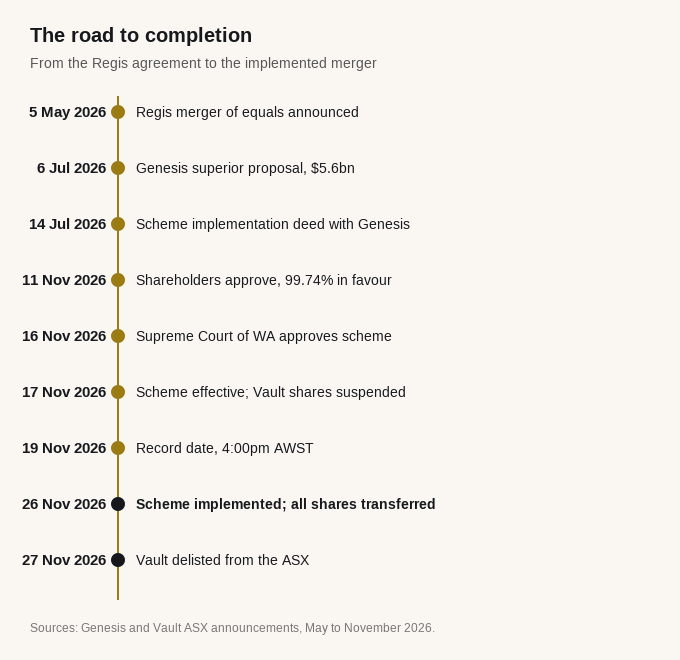
The deal was fought over before it was agreed. Vault first agreed to a merger of equals with Regis Resources (ASX: RRL) earlier in the year, under a scheme implementation deed dated 4 May 2026.
Genesis changed the contest in July. It delivered a superior proposal on 6 July, offering 0.7629 new Genesis shares plus cash for each Vault share, implying $5.2741 a Vault share on Genesis’s 3 July close of $6.29 and valuing Vault at $5.6 billion.
Regis declined to make a counterproposal on 13 July. Vault terminated the Regis deed, a step that made a break fee of about $50.7 million payable to Regis, and signed a binding scheme implementation deed with Genesis on 14 July.
Vault shareholders approved the scheme on 11 November, with 99.74 per cent of votes cast in favour. The Supreme Court of Western Australia approved it on 16 November, and it became legally effective the next day, when Vault shares were suspended from trading.
The scheme record date was 4:00pm AWST on Thursday 19 November. Implementation followed on Thursday 26 November, when all Vault shares were transferred to Genesis and the consideration was paid.
The boardroom changed with the transfer. Raleigh Finlayson, Morgan Ball and Matthew Nixon were appointed directors of Vault, and six directors resigned: chair Russell Clark, managing director Luke Tonkin, Peter Johnston, David Quinlivan, Kelvin Flynn and Rebecca Prain. Joanne Steer and Marie Forsyth became company secretaries, and David Berg resigned.
What comes next
Vault will be removed from the official list of the ASX from the close of trading on Friday 27 November. Its shares have not traded since the close on 17 November.
What happens next is integration. Genesis has said it will release an updated strategic plan for the combined business in the June quarter of 2027, after a strategic review covering optimisation of ore and mills and a review of the asset portfolio.
The December 2026 quarter will be the first report from the combined group, and the June quarter plan is the date the whole transaction will be judged against.
Related DrillTape coverage: Austral completes $80.7m Hammer Metals takeover and takes Kalman copper.
Sources
- Genesis Minerals / Vault Minerals, Genesis and Vault agree ~A$12.6bn merger to create a new Australian gold major, joint ASX announcement (Scheme Implementation Deed), 14 July 2026 (primary source for the merger terms, pro-forma resources and reserves, production, synergies and market capitalisation).
- Vault Minerals, “Implementation of Scheme”, ASX announcement, 26 November 2026 (primary source for the implementation date, the share transfer, the board changes and the delisting date): https://www.asx.com.au/asx/v2/statistics/displayAnnouncement.do?display=pdf&idsId=03171312
- Vault Minerals, Final Outcome of Scheme Consideration Elections, ASX announcement, 23 November 2026 (primary source for the consideration paid, the election outcomes and the scaleback).
- Vault Minerals, “Scheme Becomes Effective”, ASX announcement, 17 November 2026 (primary source for the effective date and the suspension): https://www.marketindex.com.au/data-api/api/v1/announcements/XASX:GMD:6A1355365/pdf/inline/vau-scheme-becomes-effective
- Vault Minerals, “Court Approves Scheme”, ASX announcement, 16 November 2026 (primary source for the court approval): https://announcements.asx.com.au/asxpdf/20261116/pdf/076nk68x3tpm5m.pdf
- Vault Minerals, “Results of Scheme Meeting”, ASX announcement, 11 November 2026 (primary source for the shareholder vote passing by the requisite majorities).
- Genesis Minerals, Quarterly Activities Report - September 2026, ASX announcement, 22 October 2026 (primary source for the September quarter production, cash position and standalone FY27 guidance).
- Genesis Minerals, “Chair’s Address to Annual General Meeting”, ASX announcement, 12 November 2026 (primary source for the FY26 production, the Magnetic Resources acquisition and the chairman’s merger remarks): https://www.marketindex.com.au/data-api/api/v1/announcements/XASX:GMD:6A1354764/pdf/inline/chairs-address-to-shareholders
- Australian Mining, Genesis and Vault merger finale creates gold powerhouse, 27 November 2026 (hook; corroboration for the implementation, the FY27 production range, the 99.74 per cent vote and the Tower Hill processing opportunity).