
Ora Banda Mining (ASX: OBM) has hit 0.3 metres at 232 grams per tonne gold in hole MUDD26001 at its Mulline trend, the standout result from a run of high-grade drilling across three regional trends at its Davyhurst project in Western Australia. The result was announced on 26 November 2026.
It is a narrow hit, a third of a metre of very high-grade vein gold from 410 metres down a 1,008-metre diamond hole. What makes it matter is the company it keeps: eleven of the 23 diamond holes drilled at Mulline returned grades above 10 grams per tonne, and all but one intersected mineralisation. The drilling was testing a newly developed three-dimensional structural model for the trend, and Ora Banda says the results support it.
The same announcement carries the more mineable numbers. Below the 1.33-million-ounce Round Dam resource, drilling at Walhalla North returned 12.0 metres at 6.7 grams per tonne and 11.0 metres at 12.1 grams per tonne, outside the current pit design. Those are widths an underground mine can work with, and the company says they point to resource growth at depth and future underground mining. The programs form part of Ora Banda’s $75 million exploration budget for FY27.
| Prospect | Interval | Grade | Notes |
|---|---|---|---|
| Young Australian, Mulline | 0.3m | 232.0g/t Au | Hole MUDD26001, from 410.43m |
| Young Australian, Mulline | 0.3m | 90.1g/t Au | Hole MUDD26001, from 324.7m |
| Young Australian, Mulline | 1.9m | 14.0g/t Au | Incl. 0.3m at 74.3g/t |
| Lady Gladys, Mulline | 4.26m | 13.6g/t Au | Incl. 1.4m at 36.0g/t; step-out 190m from nearest hole |
| Walhalla North, Round Dam | 12.0m | 6.7g/t Au | Below the resource, outside the pit design |
| Walhalla North, Round Dam | 11.0m | 12.1g/t Au | Below the resource, outside the pit design |
| Walhalla North, Round Dam | 7.2m | 5.3g/t Au | Below the resource |
| Walhalla North, Round Dam | 1.0m | 30.5g/t Au | Below the resource |
| Lady Eileen South, Round Dam | 8.0m | 3.6g/t Au | Outside the current resource area |
| Bluey Trend, Round Dam | 3.0m | 5.7g/t Au | New trend, 400m east of Round Dam |
| Two Gums, Python | 2.6m | 4.3g/t Au | Incl. 0.7m at 14.4g/t; 350m along strike |
| Two Gums, Python | 0.8m | 28.0g/t Au | EIS hole TGDD25001 |
All intervals are downhole lengths at a 0.5 grams per tonne cut-off with maximum 2 metres of internal dilution, as reported by the company. True widths are not reported, because the orientation of the drilling varies against the mineralisation at each prospect.
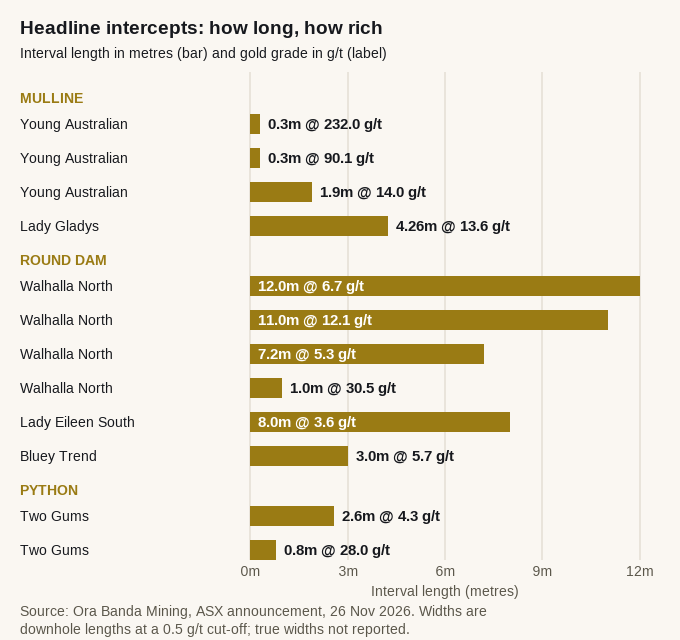
Headline intercepts from Ora Banda’s regional drilling at Davyhurst. Lengths are downhole widths at a 0.5g/t cut-off. Source: Ora Banda Mining, ASX announcement, 26 November 2026.
What Mulline proved
Mulline sits about 7 kilometres southwest of Riverina, in the northern part of the Davyhurst project. The trend runs about 16 kilometres long and 2.5 kilometres wide, and open-pit mining in the late 1990s and early 2000s produced about 275,000 ounces from the Lady Gladys, Giles and Mulline Rose pits. This program was the first serious test of the ground at depth: 23 regionally spaced diamond holes drilled against a new three-dimensional structural model, with two of the holes co-funded under the state Exploration Incentive Scheme.
The model held up. Mineralisation is alive more than 1 kilometre down dip from surface, and the high-grade hits are spread across the trend rather than confined to one shoot. At Lady Gladys, a shear-hosted system where the best grades sit in quartz sulphide veins, step-out drilling hit 4.26 metres at 13.6 grams per tonne more than 600 metres from the previous open pit and 190 metres from the nearest existing mine exploration hole. Drill core showed common visible gold flecks in the veins. The furthest step-out hole returned 10.2 metres at 2.3 grams per tonne and 10.6 metres at 1.8 grams per tonne, 320 metres from the nearest hole. The company interprets the system as open and mineralised down plunge.
At Young Australian, the lodes run along two lithological contacts traced over 800 metres before diving under transported cover, with historical workings extending the strike past 1 kilometre at Great Leviathan to the north. Foxtrot sits about 1,000 metres down dip of Young Australian as part of the same wider system. The deepest hole in the program, MUDD26001, reached 1,008 metres, and it is the hole that returned the 232-gram intercept from 410 metres. A further hit of 0.64 metres at 51.4 grams per tonne came from outside the interpreted Lady Gladys shoots, which the company flags as an exploration opportunity rather than a resource addition.
How deep does Round Dam go?
Round Dam is the regional story with the most momentum. The resource grew tenfold to 1.33 million ounces in March 2026, after the large-scale system was identified the month before. This announcement tests what sits below it.
Drilling down dip and down plunge of the resource has now returned mineralisation to depths of up to 280 metres below surface. The headline depth hits at Walhalla North, 7.2 metres at 5.3 grams per tonne and 1.0 metre at 30.5 grams per tonne, sit below the current resource. The fuller underground picture is stronger than the highlights suggest: intercepts outside the current pit design also include 12.0 metres at 6.7 grams per tonne, 5.0 metres at 17.2 grams per tonne and 11.0 metres at 12.1 grams per tonne. Ora Banda says the results give it increased confidence the system continues at depth, with multiple opportunities to grow the resource down dip and down plunge.
Along strike, the news is just as broad. At Lady Eileen South, three intercepts sit outside the current resource area: 8.0 metres at 3.6 grams per tonne, 5.0 metres at 3.7 grams per tonne and 4.0 metres at 4.8 grams per tonne. The 3-kilometre strike between the Waihi mine and Lady Eileen South is now the focus of intensive exploration, with mapping, ground magnetics and diamond and reverse circulation drilling under way. The ground between the resource and Lady Eileen South is a 6-kilometre blind stretch under shallow alluvial cover that historical drilling, broad spaced and almost entirely in the weathered zone, never properly tested.
East of Round Dam, drilling has defined a new parallel trend. Bluey sits about 400 metres east of the Round Dam trend, almost entirely under cover, and has been mapped over 4.5 kilometres of strike by aircore and reverse circulation drilling. It is open to the north and south, with best results of 3.0 metres at 5.7 grams per tonne and 5.0 metres at 2.2 grams per tonne. Two intercepts across 4.5 kilometres make Bluey a target, not a deposit, and the company plans aircore and diamond drilling over the coming months to delineate it.
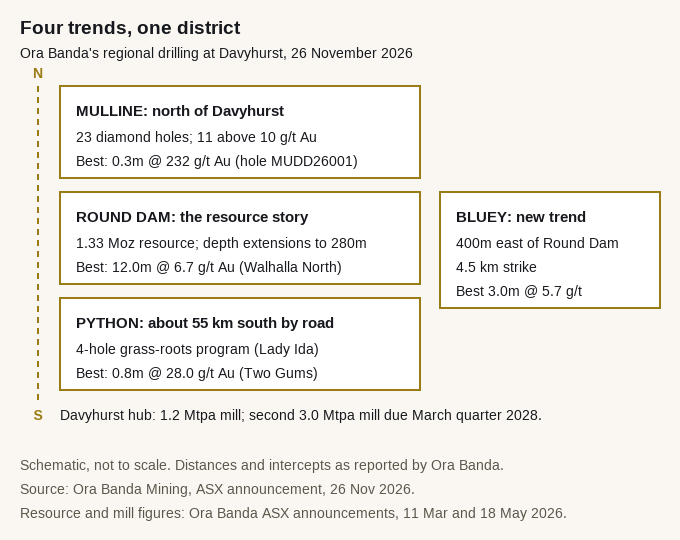
The four trends in Ora Banda’s regional drilling at Davyhurst. Distances and best intercepts as reported in the ASX announcement of 26 November 2026. Schematic, not to scale.
What Python adds
Python is the grass-roots leg of the program. The trend runs about 20 kilometres through Ora Banda’s Lady Ida project, about 55 kilometres south of Davyhurst by road, sub-parallel to the regionally significant Ida Fault. A recent four-hole diamond program, also co-funded under the Exploration Incentive Scheme, was the first real test of the ground.
One of the four holes, TGDD25001 at Two Gums, returned 0.8 metres at 28.0 grams per tonne gold in quartz sulphide veining. A follow-up hole has already intersected further high-grade gold in similar veining, 350 metres south along strike: 2.6 metres at 4.3 grams per tonne, including 0.7 metres at 14.4 grams per tonne, plus 3.2 metres at 3.5 grams per tonne and 1.3 metres at 4.0 grams per tonne. The company describes the area as largely under cover and originally part of its longer-term exploration focus. These are early results, and the announcement is careful to present them as the start of a program rather than a discovery.
“We continue to be excited by the exploration opportunities presenting at Davyhurst,” Ora Banda Managing Director Luke Creagh said. “The success of our broader regional drilling programs across the Round Dam trend, Mulline and Python are generating exciting opportunities to potentially underpin future developments across the district.”
What happens next
More drilling is planned at Mulline, and the company lists infill and extensional drilling across the project plus an assessment of all regional data to develop new exploration targets as its next steps. At Bluey, aircore and diamond drilling is planned over the coming months. At Python, follow-up drilling at Two Gums continues.
The results land on top of a production business that is already growing. Davyhurst produced a record 140,949 ounces in FY26, up 53 percent on the year before, and Ora Banda is building a second mill beside the existing plant in an aspirational push to 300,000 ounces a year by FY29. The new mill is due for commissioning in the March quarter of 2028. Regional drilling on this scale is the search for the ore that could feed it: Round Dam already holds 1.33 million ounces of resources with a pre-feasibility study outlining an open pit of 13.5 million tonnes at 1.7 grams per tonne for 724,000 ounces over about eight years, and the depth results in this announcement point to an underground future beyond that pit.
The honest read is that Mulline and Python remain high-grade but sparsely drilled concepts, while Round Dam is the thread with resource growth already in sight. The 0.3-metre bonanza intervals say more about a high-grade vein population than about mineable continuity, and the announcement does not state true widths. The 12-metre and 11-metre intercepts below Round Dam are the numbers to watch: if infill drilling repeats them, the resource grows at depth. If it does not, Davyhurst still has a 1.33-million-ounce resource and a mill expansion under way.
Sources
- Ora Banda Mining Limited, “Continuing Regional Exploration Success”, ASX announcement, 26 November 2026 (PDF): https://asx.api.cmfyapp.com/asx-research/1.0/file/2924-03166873-6A1357131&v=undefined
- Ora Banda Mining Limited, “Round Dam Mineral Resource Grows Tenfold to 1.33M Ounces”, ASX announcement, 11 March 2026 (cited in the 26 November announcement)
- Ora Banda Mining Limited, “Waihi Underground Commenced”, ASX announcement, 10 September 2026 (cited in the 26 November announcement)
- Stockhead, “Ora Banda’s high-grade gold hits highlight Davyhurst regional potential”, 26 November 2026: https://stockhead.com.au/resources/ora-bandas-high-grade-gold-hits-highlight-davyhurst-regional-potential/
- OreCast, “Ora Banda Mining Hits 4.3m at 13.6g/t Gold at Mulline and 7.2m at 5.3g/t Below Round Dam Resource”, 26 November 2026: https://orecast.news/articles/ora-banda-mining-hits-4-3m-13-6g-t-gold-mulline-7-2m-5-3g-t/
- Ora Banda Mining Limited, “DRIVE to 300 aspiration and Key Project Approvals”, ASX announcement, 18 May 2026: https://cdn-api.markitdigital.com/apiman-gateway/ASX/asx-research/1.0/file/2924-03090839-6A1325808&v=undefined
- Ora Banda Mining Limited, “DRIVE to 300 - Organically building Australia’s next 300 koz gold producer”, investor presentation, October 2026: https://asx.api.cmfyapp.com/asx-research/1.0/file/2924-03153989-6A1351785&v=undefined
- Ora Banda Mining Limited, June 2026 Quarterly Activities Report, 16 July 2026: https://cdn-api.markitdigital.com/apiman-gateway/ASX/asx-research/1.0/file/2924-03111450-6A1334044&v=undefined
- DrillTape, “Ora Banda bets $375m on a second Davyhurst mill in its push to 300,000oz a year”: https://drilltape.com/companies/ora-banda-375m-second-mill-davyhurst/
- DrillTape, “JORC resource categories explained”: https://drilltape.com/analysis/jorc-resource-categories-explained/