
Iltani Resources (ASX: ILT) has delivered its widest Vein 1 intercept yet, 14 metres at 197 grams per tonne silver equivalent, as the final 21 holes of its 110-hole drilling program at Orient in northern Queensland pushed mineralisation 900 metres beyond the existing resource.
Shares rose 3.1 percent to 34 cents on Wednesday, according to Kalkine.
Orient already holds 62.5 million tonnes grading 81.5 grams per tonne silver equivalent. Garner said the results demonstrate the potential to materially grow the resource outside Orient West and East.
The drilling points to growth on three fronts at once: Orient North, the north-east extension of Orient West, and Vein 1.
The resource splits into 38.8 million tonnes Indicated and 23.7 million tonnes Inferred. It holds an estimated 45.9 million ounces of silver and 725 tonnes of indium, cut at 30 grams per tonne silver equivalent.
The 21 holes are the last of the 110-hole infill and extension program Iltani completed in October. Thirteen tested Orient West, its north-east extension and Orient North. Eight tested Orient East and Vein 1.
They follow the 106-metre intercept at Orient East reported on 2 November, the thickest drilled at Orient to date.
“Whilst these results are not as spectacular as results recently released from Orient East, the results we are releasing today are much more meaningful, as they demonstrate the potential to materially grow the Orient System, and the Orient Mineral Resource outside of Orient West and East,” managing director Donald Garner said.
“This drilling shows the potential of the Orient West NE Extension, Orient North and Vein 1 to deliver more tonnes and grade and materially grow the Orient Mineral Resource,” he said.
How far does the system run now?
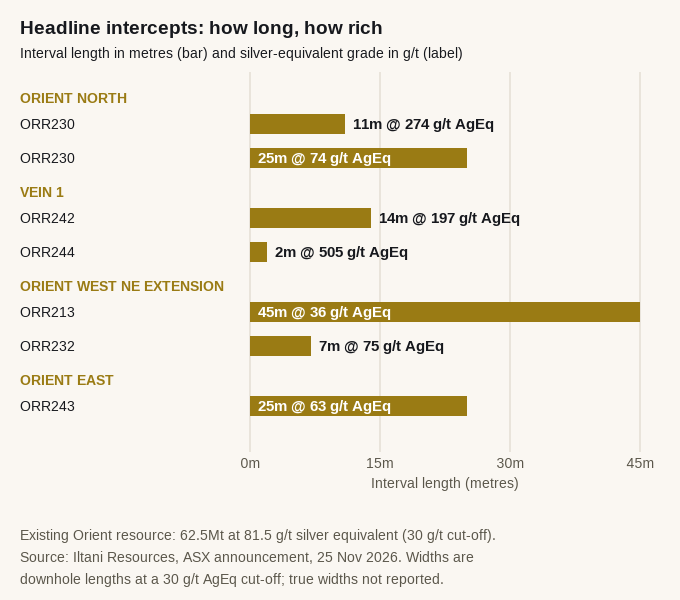
At Orient North, hole ORR230 returned the best numbers of the batch. It sits 450 metres north of the Orient East resource and 950 metres north-east of Orient West.
The hole cut six mineralised zones with a combined thickness of more than 70 metres, from 24 metres down to 274 metres.
The standout was 11 metres at 274 grams per tonne silver equivalent from 81 metres, including 4 metres at 633 grams per tonne. The interval carried 85 grams per tonne silver, 36 grams per tonne indium, 2.5 percent lead and 1.7 percent zinc.
A deeper zone ran 25 metres at 74 grams per tonne from 249 metres.
That grade runs more than three times the resource average of 81.5 grams per tonne silver equivalent. It is the same measure on both sides: silver equivalent rolls the value of silver, indium, lead and zinc into one number, using the company’s stated prices and recoveries.
All widths reported are downhole lengths, not true widths.
Not every hole at Orient North extended the story. ORR229 and ORR248 found no significant mineralisation.
The company says the geometry and lateral extent of the system still need to be established. Further appraisal will wait for the 2027 program.
The north-east extension told a different story: width rather than grade. Holes ORR209 and ORR213, drilled 250 and 350 metres beyond the Orient West resource, returned broad zones of low to moderate grade.
ORR213 ran 45 metres at 36 grams per tonne silver equivalent from 91 metres. ORR209 returned 10 metres at 60 grams per tonne and 16 metres at 56 grams per tonne, including a single metre at 323 grams per tonne.
Iltani expects that material to fall inside an eventual open pit. The plan is to mine it in bulk and upgrade it through a Tomra ore-sorting plant before processing.
At the far end of the trend, ORR232 returned 7 metres at 75 grams per tonne silver equivalent from 63 metres, including a metre at 207 grams per tonne.
The hole confirms mineralisation 900 metres along strike from the Orient West resource. Most of that 900-metre corridor remains untested.
What does Vein 1 add?
Vein 1’s best intercept of the batch came from ORR242. ORR242 cut 14 metres at 197 grams per tonne silver equivalent from 233 metres downhole, about 200 metres vertically below surface.
The core of it ran 3 metres at 470 grams per tonne, including a single metre at 923 grams per tonne. That metre carried 215 grams per tonne silver, 311 grams per tonne indium, 4.4 percent lead and 8.1 percent zinc.
It is the widest Vein 1 intercept drilled to date. All five holes targeting the vein hit mineralisation, including 2 metres at 505 grams per tonne in ORR244, 4 metres at 145 grams per tonne in ORR245 and 9 metres at 98 grams per tonne in ORR247.
The vein has now been intersected in 13 holes over at least 750 metres of strike. It remains open along strike and at depth.
Two of the holes also found something the company had not seen before: a shallow vein system in the hanging wall above Vein 1. ORR246 returned 8 metres at 90 grams per tonne from 36 metres, and ORR247 returned 3 metres at 70 grams per tonne from 33 metres.
The remaining Orient East holes filled in the edges of the known deposit rather than extending it. ORR243 returned 25 metres at 63 grams per tonne from 87 metres, and ORR240 returned 18 metres at 43 grams per tonne from 101 metres.
Mineralisation has now been defined to within 20 metres of surface. ORR241 crossed a steep structure with no significant sulphide, leaving 200 metres of strike to the west still open at depth.
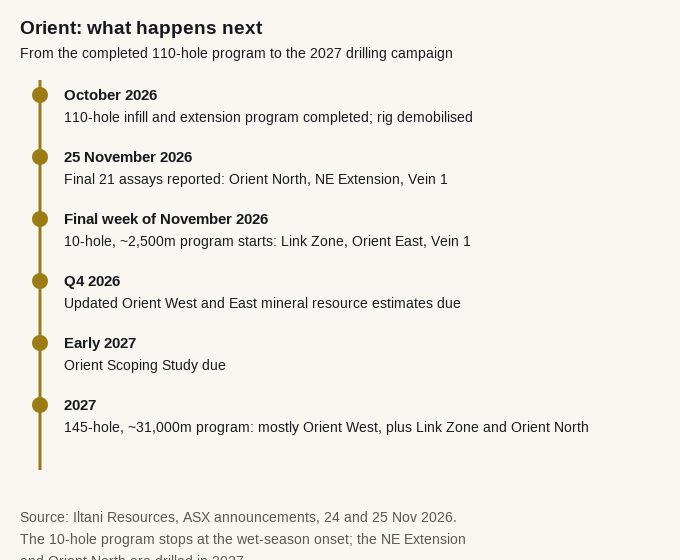
The assays now feed the resource update Iltani has promised before the end of the year. Updated estimates for Orient West and Orient East are due in the fourth quarter of 2026, and the scoping study that follows is due in early 2027.
A rig is already back on site. Iltani plans a 10-hole program of about 2,500 metres in the final week of November, targeting the Link Zone between Orient West and East, the up-dip portions of Orient East and deeper parts of Vein 1.
The program stops when the wet season arrives.
The bigger program waits for 2027. Iltani has planned 145 holes for about 31,000 metres, most of it at Orient West, with 36 holes in the Link Zone and 10 more at Orient North.
The north-east extension and Orient North will be tested then, once the wet season passes and drill pads can be cut into the steep ground.
The first test of the new ground comes with the resource update, due before the end of the year.
Sources
- Iltani Resources, “Drilling Demonstrates Material Orient Extension Upside”, ASX announcement, 25 November 2026: https://wcsecure.weblink.com.au/pdf/ILT/03166283.pdf
- Iltani Resources, “Iltani commences next phase of drilling at Orient Silver Zinc Indium Project”, ASX announcement, 24 November 2026: https://wcsecure.weblink.com.au/pdf/ILT/03165567.pdf
- Iltani Resources, “Drilling Delivers Multiple Superb Intercepts at Orient East”, ASX announcement, 2 November 2026: https://announcements.asx.com.au/asxpdf/20261102/pdf/07640vwc1t7b5m.pdf
- Small Caps, “Iltani Resources Finds New Growth Potential Beyond Current Orient MRE”, 25 November 2026: https://smallcaps.com.au/article/iltani-resources-finds-new-growth-potential-beyond-current-orient-mre
- Kalkine Media, “Growing System: Which New Zones Could Grow Iltani Resources’ (ASX:ILT) Orient Silver Resource?”, 25 November 2026: https://kalkinemedia.com/au/stocks/metal-and-mining/growing-system-which-new-zones-could-grow-iltani-resources-asxilt-orient-silver-resource