
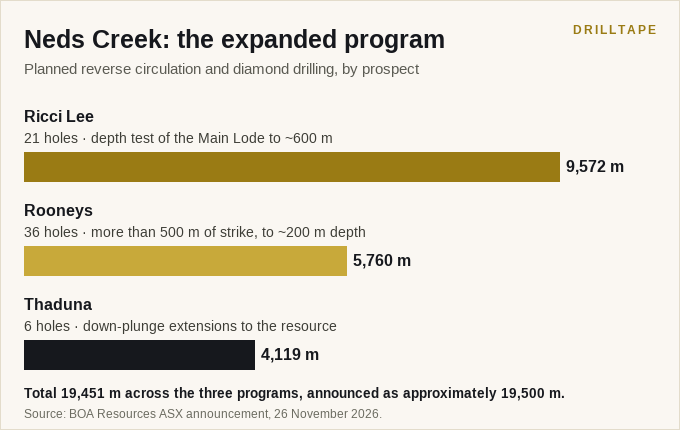
BOA Resources (ASX: BOA) has started a 19,500-metre drilling program at its Neds Creek Copper Project in Western Australia, built on the 22 metres at 3.05% copper its maiden drilling returned at Ricci Lee, including 9 metres at 6.86% copper in hole 26NCRC023.
That intercept came from the maiden program, reported in September 2026. The new campaign is the follow-up, and it is a much bigger one. At about 19,500 metres across three prospects, it is more than two and a half times the 7,364 metres BOA drilled at Ricci Lee in the maiden program.
The maiden program finished in September with 46 reverse circulation holes for 7,364 metres at Ricci Lee. It found high-grade copper in the Main Lode over more than 400 metres of strike, from surface to more than 200 metres vertical depth, together with a parallel Hanging-Wall Lode in the northern part of the prospect.
DrillTape covered the close of that program, and the 23 metres at 2.65% copper that finished it, on 25 November.
Reverse circulation drilling in the new program recommenced on 20 November, and diamond drilling started on 25 November. The program will run into the first half of 2027. The program is supported by BOA’s recent $9.2 million capital raising.
Assay results from the new holes are expected from early in the first quarter of 2027, subject to laboratory turnaround times.
All intersections are reported as downhole widths, and true widths are not yet known. Significant intercepts are reported above 0.2% copper over a minimum of 2 metres downhole, with included high-grade intervals above 1% copper.
“Results from our maiden drilling campaign have exceeded our expectations and reinforced our confidence in the copper potential of Neds Creek,” managing director Graeme Purcell said.
“We have wasted no time commencing our next phase of drilling. Our immediate focus is on testing the depth and scale potential of Ricci Lee, extending the existing Thaduna Resource and following up the expanded mineralisation at Rooneys.”
Neds Creek covers 1,378 square kilometres in the Murchison region, about 60 kilometres by 40 kilometres in the north-eastern arm of the Yerrida Basin. BOA owns 100% of the project, including the Thaduna and Green Dragon copper deposits on granted mining leases.
The exploration tenements were granted only in June, and BOA says it has delivered high-grade intersections at Ricci Lee, expanded the mineralised trend at Rooneys and found more copper at regional prospects in the five months since.
Ricci Lee
Ricci Lee takes the largest share of the new program, and the deepest test. BOA plans 21 reverse circulation and diamond holes for 9,572 metres there, more metres than the entire 46-hole maiden program at the prospect.
Sixteen of those holes will test the core of the interpreted high-grade shoot in the Main Lode, on an 80 metre by 80 metre pattern over 240 metres of strike, to about 600 metres vertical depth. The shoot is interpreted as moderately north-plunging, and it remains open at depth.
The depth matters because the maiden program hit the practical limit of reverse circulation drilling at Ricci Lee. The deepest RC holes reached just over 300 metres down hole, so the deeper holes in this phase will be drilled as RC pre-collars with diamond tails.
The program will also test along strike to the north of the Hanging-Wall Lode intersection in hole 26NCRC039, which returned 14 metres at 2.02% copper from 129 metres, including 6 metres at 3.59% copper.
It will complete hole 26NCRC038, which was abandoned at 132 metres before reaching its Main Lode target, with a diamond tail to its planned target depth.
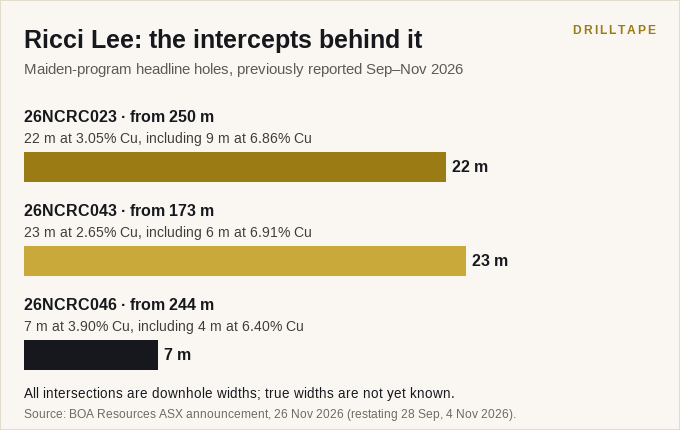
The three headline intercepts from the maiden program, all previously reported between September and November 2026, are the reason the depth test exists:
| Hole | From (m) | Interval (m) | Copper grade (% Cu) |
|---|---|---|---|
| 26NCRC023 | 250 | 22 | 3.05 |
| incl. 26NCRC023 | not stated | 9 | 6.86 |
| 26NCRC043 | 173 | 23 | 2.65 |
| incl. 26NCRC043 | 174 | 6 | 6.91 |
| 26NCRC046 | 244 | 7 | 3.90 |
| incl. 26NCRC046 | 245 | 4 | 6.40 |
The announcement does not state the from depth of the included 9-metre interval in 26NCRC023.
Thaduna
Thaduna sits 2 kilometres north-east of Ricci Lee, and it is the one prospect in the program that already holds a resource. The deposit hosts 4.1 million tonnes at 2.5% copper for 103,000 tonnes of contained copper, drilled to about 600 metres depth with only sparse drilling at depth.
BOA restated two historic deep holes in this announcement to show what the new drilling is chasing. Hole THDD238 returned 7.5 metres at 8.25% copper from 572 metres, including 6.15 metres at 9.94% copper. Hole THDD235 returned 10.28 metres at 4.73% copper from 612 metres. The high-grade shoot remains open down-plunge.
The new program at Thaduna comprises six reverse circulation and diamond holes for 4,119 metres, testing down-plunge extensions of the known mineralisation.
Rooneys
Rooneys is the shallow, wide-spaced leg of the program. BOA’s maiden aircore program there extended the interpreted mineralised trend to more than 500 metres of strike and found copper in new mineralised structures.
The aircore results, reported in October 2026, included 16 metres at 2.47% copper from 58 metres in hole 26NCAC0016, which also returned 4 metres at 3.54% copper from 10 metres, and 10 metres at 1.75% copper from 51 metres in hole 26NCAC0001.
The new program comprises 36 reverse circulation holes for 5,760 metres on a wide-spaced pattern covering more than 500 metres of strike, to about 200 metres depth. It will test the Main Rooneys structure in the east and its western extension, and an interpreted north-west trending structure identified in BOA’s aircore drilling.
Ward and Blockley
The genuinely new results in this announcement come from the final aircore assays of the maiden regional program, at Ward, Blockley and Mueller. BOA has now received results for all remaining aircore drilling at the three prospects, completing the first phase of exploration across Neds Creek.
At Ward, eight aircore holes were drilled, and two of the three southern holes testing a north-west, east-dipping structure returned the results that matter.
Hole 26NCAC0091 returned 11 metres at 1.10% copper from 39 metres, including 6 metres at 1.73% copper. Hole 26NCAC0092 returned 5 metres at 1.91% copper from 79 metres, including 2 metres at 4.01% copper.
The Ward intersections are notable for two reasons. The mineralisation dips east, which is different to all other known mineralised structures elsewhere at the project.
And the structural corridor trends towards the Green Dragon deposit, which holds 1.2 million tonnes at 1.5% copper for 18,000 tonnes of contained copper. BOA is planning follow-up drilling at Ward.
At Blockley, results are now in for all 28 holes drilled. The best results were 11 metres at 1.01% copper from 58 metres in hole 26NCAC0042, and 2 metres at 1.32% copper from 64 metres in hole 26NCAC0035.
Hole 26NCAC0028 returned 28 metres at 0.37% copper from surface, with 6 metres at 0.70% copper from 46 metres. Drilling confirms mineralisation within an east-west, north-dipping structure with more than 300 metres of interpreted continuity, and follow-up drilling is being planned there.
At Mueller, 13 aircore holes tested historic workings on an east-west structure. Only one hole returned anomalous copper mineralisation, and no further work is planned for the prospect at this stage.
The regional results also sit alongside the earlier high-grade copper at Limestone Bore, more than 7 kilometres from other known mineralisation at Neds Creek, which BOA reported on 11 November.
Drilling continues into the first half of 2027, and the first assays from the new holes are expected from early in the first quarter.
The depth holes at Ricci Lee are the test that matters most: they will show whether the high-grade shoot that stopped at the practical limit of reverse circulation drilling keeps going to 600 metres.
Sources
- BOA Resources, High-grade copper results drive expanded drilling campaign at Neds Creek, WA, ASX announcement, 26 November 2026 (19 pages; primary source for all figures, quotes and dates in this article).
- BOA Resources ASX releases cited in the announcement and restated in it: “High-grade copper intersected at depth at Ricci Lee”, 28 September 2026; “High-grade copper results confirm potential at Ricci Lee”, 4 November 2026; “Rooneys copper target expands to more than 500m strike”, 14 October 2026; “Limestone Bore delivers high-grade copper at Neds Creek”, 11 November 2026; “BOA Acquires Copper Deposits in the Neds Creek Project, WA”, 25 June 2026; “BOA raises $9.2M to advance exploration at Neds Creek Copper Project, WA”, 22 October 2026.
- DrillTape, BOA Resources closes maiden Ricci Lee drilling with 23 metres at 2.65% copper, 25 November 2026; BOA Resources finds high-grade copper at Limestone Bore, 7km from known mineralisation, 25 November 2026.