
EQ Resources (ASX: EQR) is doubling processing capacity at its Mt Carbine tungsten mine in Far North Queensland, after Queensland Premier David Crisafulli’s trade mission to the United States delivered an agreement that will send Mt Carbine tungsten into the United States market, for use by the Department of War.
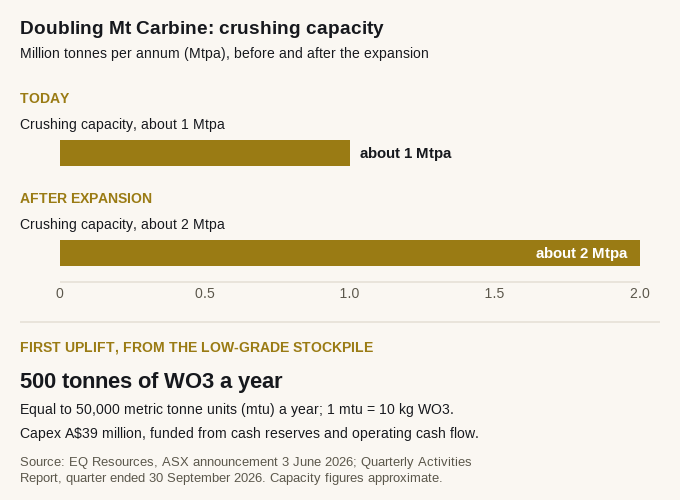
The expansion lifts crushing capacity from about one million tonnes a year to about two million tonnes.
EQ Resources approved the A$39 million project in June. It is on track and in budget for commissioning in the March 2027 quarter.
The timing is sharp. The company has just posted a record September quarter, with group tungsten production up 81 percent on the June quarter.
At Mt Carbine the work is an upgrade, not a new mine.
The project installs an upgraded crushing and screening circuit, then integrates crushing, screening, ore sorting and product handling into a single continuous flow, with automation across the site.
The company says the changes cut material handling by a factor of eight. The expanded plant will first work through the low-grade stockpile, adding about 500 tonnes of tungsten trioxide a year.
“This investment at Mt Carbine will strengthen an established Australian tungsten-producing operation and lay the foundations for its next phase of growth,” managing director Craig Bradshaw said.
“As global demand for secure and reliable critical minerals supply grows, EQ Resources is building a connected Western tungsten platform, supported by our producing operations in Australia and Spain, and our participation in downstream tungsten processing development in the United States.”
What is the US deal?
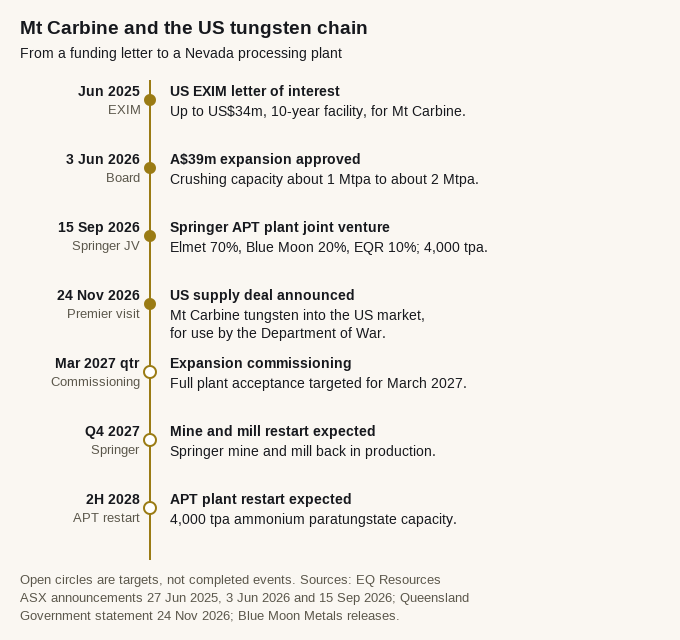
The deal has three parts, built over 17 months.
In June 2025 the Export-Import Bank of the United States issued a letter of interest under its Supply Chain Resiliency Initiative.
It said the bank is able to consider a 10-year debt facility of up to US$34 million for the capital expansion and further development of Mt Carbine.
A letter of interest is not a loan. The bank still has to run its standard due diligence before any final commitment.
In September 2026 EQ Resources signed a binding framework agreement with The Elmet Group (NASDAQ: ELMT) and Blue Moon Metals (NASDAQ: BMM) to restart the Springer ammonium paratungstate plant in Nevada.
Ammonium paratungstate, known as APT, is the intermediate chemical between tungsten concentrate and finished tungsten products.
Elmet will hold 70 percent of the joint venture and operate the 4,000 tonne a year plant. Blue Moon holds 20 percent and EQ Resources 10 percent.
The agreement gives EQ Resources an eight-year, spot-priced offtake. The joint venture will buy 4,000 tonnes of contained tungsten trioxide in concentrate from the company, nominally 500 tonnes a year once the plant is commissioned.
It also gives the company the right to use up to 1,000 tonnes a year of APT processing capacity at the plant for its first five years.
Elmet funds the first US$75 million of restart costs, supported by financing from the US Department of War.
EQ Resources’ extra exposure is capped at US$3.125 million if costs run between US$75 million and US$100 million.
Behind Elmet sits the money that makes the chain credible.
The Department of War committed US$450 million to Elmet on 14 September 2026, with about US$150 million of it allocated to the Springer transactions.
The Defense Logistics Agency has also awarded Elmet a contract to supply tungsten to the National Defense Stockpile. It carries a ceiling of up to US$2 billion and a US$150 million guaranteed minimum.
“Partnering with Blue Moon and The Elmet Group, with the sponsorship of the US Department of War, cements EQR’s position as a globally significant supplier of this critical mineral and opens a strategic new market for our Australian and Spanish production,” Bradshaw said when the Springer agreement was signed.
The joint venture is not yet final.
The framework agreement is binding on its principal terms, but the parties still have to negotiate and sign definitive agreements before the plant work can proceed.
Why does Washington want Queensland tungsten?
About 80 percent of the global tungsten market is sourced from China, the Queensland Government said.
Tungsten is classified as a strategic and critical mineral, used in defence, aerospace, batteries, mobile phones and healthcare.
From 1 January 2027, US defence procurement rules bar defence contractors from delivering tungsten metal powder or tungsten heavy alloy, or components containing it, mined, refined or otherwise produced in China, Russia, Iran or North Korea.
That deadline is what turns a Queensland crushing upgrade into a defence supply story.
Mt Carbine sits on the Mulligan Highway northwest of Cairns and was historically one of the world’s major tungsten mines.
EQ Resources has redeveloped it in stages, first through its historical stockpiles and now through open-pit mining of the primary orebody.
It is one of two producing tungsten mines the company owns. The other is Barruecopardo in Salamanca, Spain.
What does the expansion add?
The September quarter is the baseline the expansion builds on.
Mt Carbine produced 17,145 metric tonne units of tungsten trioxide in the quarter, up 31 percent on the June quarter.
A metric tonne unit, or mtu, is 10 kilograms of tungsten trioxide.
The mine set a record for quarterly material extracted at 1,185,113 tonnes, and recovery averaged 78 percent.
Across the group, production rose 81 percent to a record 51,233 mtu.
The 500 tonnes of tungsten trioxide a year the expansion adds at first is 50,000 mtu a year on the company’s own measure.
Against Mt Carbine’s September quarter, annualised at about 68,600 mtu, the uplift is close to three quarters of the mine’s current yearly output.
It comes from ore the mine has already dug: the low-grade stockpile.
The money around the expansion is strong.
Revenue reached A$158.8 million in the September quarter, against A$79 million in the June quarter.
Operating cash flow was a record A$75.6 million, and cash stood at A$82.4 million at 30 September, up from A$28.2 million at 30 June.
The company has issued production guidance for the first time, targeting 240,000 to 280,000 mtu for FY2027, or 2,400 to 2,800 tonnes of tungsten trioxide.
The resource behind the expansion is large. Mt Carbine holds 40.8 million tonnes at 0.22 percent tungsten trioxide, or 9.06 million mtu.
A drill program of 17,233 metres at the mine finished on 15 September, with assays pending at the end of the quarter.
The project supports about 100 construction jobs on top of the existing operational workforce, the Queensland Government said, with hundreds more indirect jobs through local contractors.
The expansion sits inside the state’s Delivering Queensland’s Critical Minerals Future 2026-30 strategy.
It is backed by an expanded $250 million Queensland Critical Minerals Fund and a further $146 million to commercialise former mines and attract new investment.
What happens next?
Commissioning comes first.
All procurement and contract packages for the expansion had been awarded by 30 September.
Major equipment deliveries had started, and concreting of the conveyor pedestals was under way.
Site works and commissioning run from June 2026 through February 2027, with full plant acceptance targeted for March 2027.
Then the American end of the chain has to catch up.
The Springer joint venture still needs its definitive agreements signed.
Blue Moon has said the Springer mine and mill are expected back in production in the fourth quarter of 2027, with the APT plant to restart in the second half of 2028.
If the March quarter commissioning holds, Mt Carbine will enter the second half of 2027 crushing twice the ore it does today, with a Nevada plant waiting to turn its concentrate into the material US defence plants buy.
Sources
- EQ Resources, Quarterly Activities Report for the quarter ended 30 June 2026, ASX announcement, 28 July 2026 (reproduces the 3 June 2026 “EQR Board Approves Mt Carbine Expansion” announcement nearly word-for-word and cites it by title and date; the announcement PDF itself was not directly retrievable): https://announcements.asx.com.au/asxpdf/20260728/pdf/0723qmt4wnsy7w.pdf
- US Department of Defense, DFARS final rule, DFARS Case 2021-D015, Federal Register, 30 May 2024 (DFARS 252.225-7052; 1 January 2027 restriction on tungsten metal powder and tungsten heavy alloy from China, Russia, Iran and North Korea): https://public-inspection.federalregister.gov/2024-11513.pdf
- EQ Resources, ASX Quarterly Activities Report, quarter ended 30 September 2026, 28 October 2026: https://announcements.asx.com.au/asxpdf/20261028/pdf/075wkyt4zb3lpv.pdf
- EQ Resources, ASX announcement, “EQR SIGNS BINDING FRAMEWORK AGREEMENT FOR US APT PLANT JV”, 15 September 2026: https://announcements.asx.com.au/asxpdf/20260915/pdf/0743dwfjn54fyw.pdf
- EQ Resources, ASX announcement, “US EXIM ISSUE LETTER OF INTEREST FOR MT CARBINE”, 27 June 2025: https://announcements.asx.com.au/asxpdf/20250627/pdf/06l5cndjlqtxg7.pdf
- EQ Resources, Annual Report 2026 (ASX): https://www.marketindex.com.au/data-api/api/v1/announcements/XASX:EQR:2A1700403/pdf/inline/annual-report-to-shareholders
- Queensland Government, Ministerial Media Statement, “Critical minerals boost for Far North Queensland with mine expansion”, 24 November 2026: https://statements.qld.gov.au/statements/106484
- Blue Moon Metals, The Elmet Group and EQ Resources, joint news release, “Blue Moon, The Elmet Group, and EQ Resources Announce a US$150-$175 Million Investment into the Springer Tungsten Complex, Nevada”, 14 September 2026: https://mmx.prnewswire.com/media/MS1987082/Blue-Moon-Metals-Blue-Moon-The-Elmet-Group-and-EQ-Resources-An.pdf?id=OA2944979&p=pdf&p=facebook
- The Elmet Group, GlobeNewswire release, “Department of War Makes Landmark $450 Million Committed Investment in The Elmet Group to Secure America’s Tungsten Supply Chain”, 14 September 2026: https://markets.financialcontent.com/fatpitch.valueinvestingnews/article/gnwcq-2026-9-14-the-elmet-group-to-deploy-strategic-capital-to-strengthen-us-and-allied-tungsten-supply-chain
- Australian Mining, “EQ targets US tungsten demand with Mt Carbine expansion”, 25 November 2026: https://www.australianmining.com.au/eq-targets-us-tungsten-demand-with-mt-carbine-expansion/
- Military Times, “Why the Pentagon just dropped $450M on tungsten mining”, 30 September 2026: https://www.militarytimes.com/news/pentagon-congress/2026/09/30/why-the-pentagon-just-dropped-450m-on-tungsten-mining/